Five-nation triangular axis mootedAuslin, having done to geometry roughly what Jael (Heber's wife) did to Sisera, is surely a shoo-in for the next Fields Medal.
Tuesday, May 10, 2011
Revolutionary Breakthrough In 2D Planar Geometry
Wonder if any of you caught the announcement of the most breathtaking, path-breaking advance in 2D geometry since the day the Elements were a gleam in Euclid's eye? This headline in today's Hindu spills the beans:
Monday, May 09, 2011
Hon'ble Supreme Court of India
This may just be me, but the way I pronounce "Hon'ble Supreme Court of India" (as it is often written) in my head, the image that comes to mind is this:

Very weird, no?
In other news the Hon'ble Supreme Court of India may have at least temporarily undone one stinking pile of poo. Bravo.
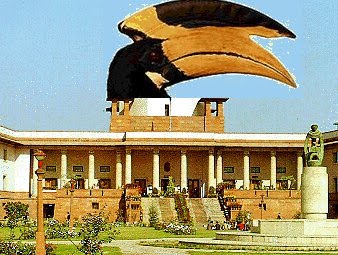
Very weird, no?
In other news the Hon'ble Supreme Court of India may have at least temporarily undone one stinking pile of poo. Bravo.
Thursday, April 28, 2011
Dell-uding People?
I have bought 2 Dell laptops. One was in 2004, for a princely $2k types, in the US. Inspiron 8600. Lovely screen for writing code. Another was for the sibling, a couple of years later, also from the US.
Both turned out to be pretty delicate physically. Keys pop off, battery dies, power adapter stops working, something or the other gets fried. Dell is reputed for super-efficient customer service in India, I think the chief reason is that they need it. Of course, warranties are carefully written to precisely not cover the exact WTF that just happened to you.
In any case, we are in need of some machines at work and one of the things we were looking at is the Dell Vostro V130, supposed to be a lightweight travel friendly beast etc. Of course, glossy photographs and soothing marketing is listed on the website.
Who cares? The first-ish questions that come to anyone buying a computer are "How much RAM?" and "How much disk space?" Now the site says that this model is "From Rs. 37,290", but nary a mention of how much of the aforementioned juice one gets.
The kicker is that there's a "Tech Specs" tab, and perhaps it is reasonable to expect RAM and disk size to be available there. Nothing. Zilch.
So unless I've been doing something drastically wrong, epic fail by Dell. May this post be easily found on the internets before someone tries to buy one...
Both turned out to be pretty delicate physically. Keys pop off, battery dies, power adapter stops working, something or the other gets fried. Dell is reputed for super-efficient customer service in India, I think the chief reason is that they need it. Of course, warranties are carefully written to precisely not cover the exact WTF that just happened to you.
In any case, we are in need of some machines at work and one of the things we were looking at is the Dell Vostro V130, supposed to be a lightweight travel friendly beast etc. Of course, glossy photographs and soothing marketing is listed on the website.
Who cares? The first-ish questions that come to anyone buying a computer are "How much RAM?" and "How much disk space?" Now the site says that this model is "From Rs. 37,290", but nary a mention of how much of the aforementioned juice one gets.
The kicker is that there's a "Tech Specs" tab, and perhaps it is reasonable to expect RAM and disk size to be available there. Nothing. Zilch.
So unless I've been doing something drastically wrong, epic fail by Dell. May this post be easily found on the internets before someone tries to buy one...
Tuesday, April 26, 2011
On Pleasing Women - A Quantitative Treatment
Exhibit A
2:22-2:36
Payyan: gundu malli rendu rubai, un koonthal eri uthirum poo kodi rubai
Pen: panchu mittai anju rubai, nee paathi thindru thantetal latche rubai
Translation (mine, bear with me)
Guy: Jasmine flowers, market price Rs. 2; if they are from your locks, Rs. 10,000,000.
Girl: Some kind of candy, Rs. 5; you eat half and give me, Rs. 100,000
A brief calculation shows that the boy derives joy magnified 5,000,000 times when the item in question has passed via the girl, whereas the girl's joy is only multiplied 40,000 times in the reverse scenario.
All further derivations and conclusions are left as exercises for the interested reader.
2:22-2:36
Payyan: gundu malli rendu rubai, un koonthal eri uthirum poo kodi rubai
Pen: panchu mittai anju rubai, nee paathi thindru thantetal latche rubai
Translation (mine, bear with me)
Guy: Jasmine flowers, market price Rs. 2; if they are from your locks, Rs. 10,000,000.
Girl: Some kind of candy, Rs. 5; you eat half and give me, Rs. 100,000
A brief calculation shows that the boy derives joy magnified 5,000,000 times when the item in question has passed via the girl, whereas the girl's joy is only multiplied 40,000 times in the reverse scenario.
All further derivations and conclusions are left as exercises for the interested reader.
Saturday, April 23, 2011
Readings du Jour
- Sean Carroll skims over many, many thought provoking questions in Avignon Day 3: Reductionism
Of course it’s difficult to describe people using Schrodinger’s equation, but that’s not evidence that our behavior is actually incompatible with a reductionist description. To believe otherwise you have to believe that somewhere along the progression from particles to atoms to molecules to proteins to cells to organisms, physical systems begin to violate the microscopic laws of physics. At what point is that supposed to happen? And what evidence is there supposed to be?
- A delightful little piece on Israel-North Korea relations! In the early 90s, apparently the Israeli Foreign Ministry tried to persuade the North Koreans to not sell missile technologies to Israel's enemies.
Enter Mossad. Israel's spy agency got wind of this plan, and rushed to Pyongyang to stop it. In a moment of high black farce, the two Israeli delegations each only learned that the other had been in town as well when they bumped into each other on the plane back to Beijing afterwards. (The foreign ministry officials were seated in first class, while Mossad had to slum it in tourist class.)
...
Bush the younger - Kim Jong-bush, shall we call him? - made many a fateful policy choice. This is one of his less famous ones, but it may yet turn out to be up there with invading Iraq. - Terry Eagleton, whom I first came across in this critical review of "The God Delusion" by Richard Dawkins, where he distinguished himself with such drivel as
Nor is he a principle, an entity, or ‘existent’: in one sense of that word it would be perfectly coherent for religious types to claim that God does not in fact exist. He is, rather, the condition of possibility of any entity whatsoever, including ourselves. He is the answer to why there is something rather than nothing. God and the universe do not add up to two, any more than my envy and my left foot constitute a pair of objects.
This, not some super-manufacturing, is what is traditionally meant by the claim that God is Creator. He is what sustains all things in being by his love; and this would still be the case even if the universe had no beginning. To say that he brought it into being ex nihilo is not a measure of how very clever he is, but to suggest that he did it out of love rather than need.
Whaddeva. But this piece on Marx is actually readable and interesting.
Tuesday, April 19, 2011
Most Random Wordplay Ever
This occurred to me once on a train.
If you take DE JUNC out of ERODE JUNCTION, you're left with EROTION.
Go on, say it out loud, like this, "If you take the junk out of Erode Junction, you're left with erosion."
Ugh.
If you take DE JUNC out of ERODE JUNCTION, you're left with EROTION.
Go on, say it out loud, like this, "If you take the junk out of Erode Junction, you're left with erosion."
Ugh.
Monday, April 18, 2011
Fasting - A Data Driven Approach
Via Facebook via Salil Tripathi via Patrick French, comes this spreadsheet. The important extract is the following:

In a convenient graphical form, it is like so:

Special mention goes out to Krishnamurthi R Rao, Garbini and Dantavakra for asking an Irom Sharmila question at a quiz, and special mention goes out to Spacebar for being one of the literal handful in the audience who knew the answer.

In a convenient graphical form, it is like so:

Special mention goes out to Krishnamurthi R Rao, Garbini and Dantavakra for asking an Irom Sharmila question at a quiz, and special mention goes out to Spacebar for being one of the literal handful in the audience who knew the answer.
Saturday, April 09, 2011
A Quiz is Just a Quiz
An abridged version appears here.
A QUIZ IS JUST A QUIZ?

The first time I realized that QED was not just an ordinary quiz team any more was at the national finals of the massively popular Landmark Quiz in 2009. The quizmaster, Chennai’s very own Navin Jayakumar, was calling the finalists on stage and the audience didn’t seem to care beyond some desultory clapping. That is, until QED were announced. Upon which a startlingly loud cheer rang through the Music Academy. Since when do the socially inept, stereotypically awkward, geeky, bookworm types have whistling, clapping fans in the galleries? This was new.
Everyone in the “quizzing circuit” knows about the rise and rise of QED. They started when they were students at PS Senior, cleverly (so they thought) borrowing their name from a familiar schoolroom trope. Version 1.0 first tasted success on the big stage when they won the Landmark Quiz. The vagaries of academics caused the team to split, and after trying out a few combinations, they settled into the current configuration in 2005 and appear to cruising ever since.
The team members know why their combination works so well. G. Swaminathan says, “Like any good team, it’s probably because we have such a varied and non-overlapping set of interests. And thankfully each of us seems to have more than one area that we care deeply about, which means we cover a broad range of subjects, to a fair degree of depth.”
V.V.Ramanan, Assistant Editor (Sports) at The Hindu and doyen of the Madras/Chennai quizzing circle, is the senior statesman and self-described dinosaur on the team. “I went to PS Senior myself, and when I was asked to join QED, it was great partly because it meant that we were still the ‘PS Possé’.” Ramanan is the quizmaster of the wildly popular Young World Quiz for schools. “Preparing for Young World helps me in QED, because I come across many things which are at a school level that are asked in open quizzes that end up stumping seasoned quizzers.”
There is no secret sauce behind their success. Writer and journalist Samanth Subramanian says, “We do read a lot as a matter of course. For example, in college I took courses in art history simply because I was so thrilled that I could. Because I had so much fun learning, it all stuck so much better. When we find something really ‘quiz type’ maybe we’ll spend an extra 5 minutes and navigate an extra couple of links, but not much beyond that. When we were going through a rough patch once we did try to ‘mug’ more systematically, but it was a drudge and we gave it up.”
Oddly enough, it appears as though the idiosyncrasies they bring to the stage may have a greater impact on their performance than any preparation! They have a vaastu configuration for how they arrange themselves; Samanth will wear an ancient baseball cap of dubious provenance rotated to a “just so” orientation; Ramanan used to sport “lucky” dark glasses. They listen very carefully to every question, but they also observe the reactions of their opponents, whose strengths and proclivities they know, to figure out bits and pieces of the answer when they are stumped.
Navin has seen the players and the team evolve over the decades, and sums it up with an apt metaphor. “The Venn diagram of their skills is just perfect. They individually ‘cover’ large independent areas of knowledge; at the same time they intersect to exactly the right extent which helps them work out answers and corroborate each other’s hunches. Secondly, their attitude helps. While other teams’ shoulders sag when they’re not doing well, QED somehow have the stamina to keep the intensity fully turned on throughout, and they don’t ever give up even if they are behind on score. It’s the sort of attitude that the Indian middle order displayed in the World Cup at 31 for 2! Finally, they seem to enjoy the quizzing, no matter what. This makes my life easier as a quizmaster, because quizzes are more fun for the participants and the audience when there is a little bit of banter between the people on stage, rather than a mechanical Q&A session. And I think their joie de vivre and sportsmanship are palpable and go down well with the audience who always love a sporting winner, which may explain the cheering.”
It’s an odd feeling, having to write about friends and on-and-off rivals. On the one hand there is the delicious thought that the day will come soon when QED’s memory banks will fire blanks, and maybe my team will have one menace less to worry about. On the other hand, inasmuch as quizzing can be a “performance art”, they do dish out regular virtuoso performances. And even if Samanth’s (“I’m the only single guy on the team.”) fond dreams that some day hordes of nubile quiz groupies will beat down the doors of his dressing room and drape themselves around him will hopefully never come to fruition, one hopes that this quiz team with a vocal “mass support base” will continue to entertain and challenge us in many more quizzes.
A QUIZ IS JUST A QUIZ?

The first time I realized that QED was not just an ordinary quiz team any more was at the national finals of the massively popular Landmark Quiz in 2009. The quizmaster, Chennai’s very own Navin Jayakumar, was calling the finalists on stage and the audience didn’t seem to care beyond some desultory clapping. That is, until QED were announced. Upon which a startlingly loud cheer rang through the Music Academy. Since when do the socially inept, stereotypically awkward, geeky, bookworm types have whistling, clapping fans in the galleries? This was new.
Everyone in the “quizzing circuit” knows about the rise and rise of QED. They started when they were students at PS Senior, cleverly (so they thought) borrowing their name from a familiar schoolroom trope. Version 1.0 first tasted success on the big stage when they won the Landmark Quiz. The vagaries of academics caused the team to split, and after trying out a few combinations, they settled into the current configuration in 2005 and appear to cruising ever since.
The team members know why their combination works so well. G. Swaminathan says, “Like any good team, it’s probably because we have such a varied and non-overlapping set of interests. And thankfully each of us seems to have more than one area that we care deeply about, which means we cover a broad range of subjects, to a fair degree of depth.”
V.V.Ramanan, Assistant Editor (Sports) at The Hindu and doyen of the Madras/Chennai quizzing circle, is the senior statesman and self-described dinosaur on the team. “I went to PS Senior myself, and when I was asked to join QED, it was great partly because it meant that we were still the ‘PS Possé’.” Ramanan is the quizmaster of the wildly popular Young World Quiz for schools. “Preparing for Young World helps me in QED, because I come across many things which are at a school level that are asked in open quizzes that end up stumping seasoned quizzers.”
There is no secret sauce behind their success. Writer and journalist Samanth Subramanian says, “We do read a lot as a matter of course. For example, in college I took courses in art history simply because I was so thrilled that I could. Because I had so much fun learning, it all stuck so much better. When we find something really ‘quiz type’ maybe we’ll spend an extra 5 minutes and navigate an extra couple of links, but not much beyond that. When we were going through a rough patch once we did try to ‘mug’ more systematically, but it was a drudge and we gave it up.”
Oddly enough, it appears as though the idiosyncrasies they bring to the stage may have a greater impact on their performance than any preparation! They have a vaastu configuration for how they arrange themselves; Samanth will wear an ancient baseball cap of dubious provenance rotated to a “just so” orientation; Ramanan used to sport “lucky” dark glasses. They listen very carefully to every question, but they also observe the reactions of their opponents, whose strengths and proclivities they know, to figure out bits and pieces of the answer when they are stumped.
Navin has seen the players and the team evolve over the decades, and sums it up with an apt metaphor. “The Venn diagram of their skills is just perfect. They individually ‘cover’ large independent areas of knowledge; at the same time they intersect to exactly the right extent which helps them work out answers and corroborate each other’s hunches. Secondly, their attitude helps. While other teams’ shoulders sag when they’re not doing well, QED somehow have the stamina to keep the intensity fully turned on throughout, and they don’t ever give up even if they are behind on score. It’s the sort of attitude that the Indian middle order displayed in the World Cup at 31 for 2! Finally, they seem to enjoy the quizzing, no matter what. This makes my life easier as a quizmaster, because quizzes are more fun for the participants and the audience when there is a little bit of banter between the people on stage, rather than a mechanical Q&A session. And I think their joie de vivre and sportsmanship are palpable and go down well with the audience who always love a sporting winner, which may explain the cheering.”
It’s an odd feeling, having to write about friends and on-and-off rivals. On the one hand there is the delicious thought that the day will come soon when QED’s memory banks will fire blanks, and maybe my team will have one menace less to worry about. On the other hand, inasmuch as quizzing can be a “performance art”, they do dish out regular virtuoso performances. And even if Samanth’s (“I’m the only single guy on the team.”) fond dreams that some day hordes of nubile quiz groupies will beat down the doors of his dressing room and drape themselves around him will hopefully never come to fruition, one hopes that this quiz team with a vocal “mass support base” will continue to entertain and challenge us in many more quizzes.
Friday, April 01, 2011
a.m. Thoughts on Thermopylae
For some reason, this occurred to me when in the shower today.
The achievement at Thermopylae was not that a 300 highly trained fanatic clones were able to defend a narrow pass for 3 days; it was that some genius of a quartermaster/s managed to supply and support an invading army of hundreds of thousands, comprised of soldiers from vastly different cultures, and some genius of a commander/s managed to keep them motivated and fighting, thousands of kilometres from their homes.
When Hannibal and Alexander do it, it's a great feat of arms and leadership, but when when Xerxes I does it a full 150 years before Alexander, it's all about those 300?! Bah!
The achievement at Thermopylae was not that a 300 highly trained fanatic clones were able to defend a narrow pass for 3 days; it was that some genius of a quartermaster/s managed to supply and support an invading army of hundreds of thousands, comprised of soldiers from vastly different cultures, and some genius of a commander/s managed to keep them motivated and fighting, thousands of kilometres from their homes.
When Hannibal and Alexander do it, it's a great feat of arms and leadership, but when when Xerxes I does it a full 150 years before Alexander, it's all about those 300?! Bah!
Friday, March 25, 2011
Friday Verse Thingy
After a long, long time. Via 3 Quarks Daily, we arrive at Kenneth Patchen's As We Are So Wonderfully Done with Each Other.
As We Are So Wonderfully Done with Each Other
BY KENNETH PATCHEN
As we are so wonderfully done with each other
We can walk into our separate sleep
On floors of music where the milkwhite cloak of childhood lies
O my lady, my fairest dear, my sweetest, loveliest one
Your lips have splashed my dull house with the speech of flowers
My hands are hallowed where they touched over your
soft curving.
It is good to be weary from that brilliant work
It is being God to feel your breathing under me
A waterglass on the bureau fills with morning . . .
Don’t let anyone in to wake us.
Similar-ish past posts - To Manijeh - Vikram Seth, To His Lost Lover - Simon Armitage, Sex Without Love - Sharon Olds
Have you seen Bob - The Angry Flower? He is most hilarious. Self described as "An irritable flower takes on aliens and wheelchair basketball." The first one I saw was this sequel to "Atlas Shrugged".

Today's Pangolins I Have Known is ridiculously funny. Can't help staring at it for a few seconds and bursting into giggles, in a loop.

As We Are So Wonderfully Done with Each Other
BY KENNETH PATCHEN
As we are so wonderfully done with each other
We can walk into our separate sleep
On floors of music where the milkwhite cloak of childhood lies
O my lady, my fairest dear, my sweetest, loveliest one
Your lips have splashed my dull house with the speech of flowers
My hands are hallowed where they touched over your
soft curving.
It is good to be weary from that brilliant work
It is being God to feel your breathing under me
A waterglass on the bureau fills with morning . . .
Don’t let anyone in to wake us.
Similar-ish past posts - To Manijeh - Vikram Seth, To His Lost Lover - Simon Armitage, Sex Without Love - Sharon Olds
Have you seen Bob - The Angry Flower? He is most hilarious. Self described as "An irritable flower takes on aliens and wheelchair basketball." The first one I saw was this sequel to "Atlas Shrugged".
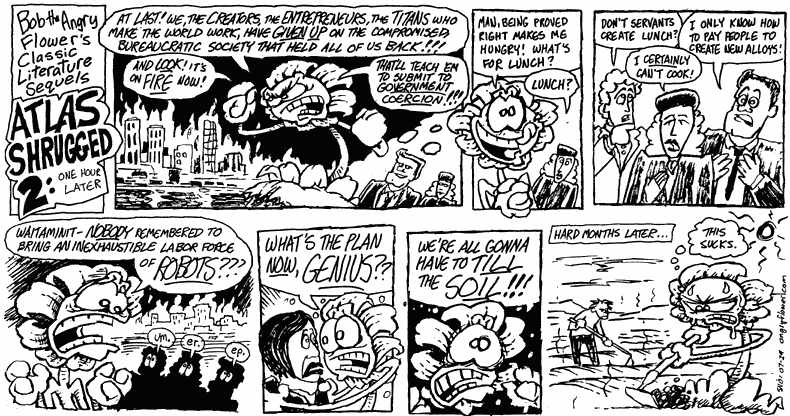
Today's Pangolins I Have Known is ridiculously funny. Can't help staring at it for a few seconds and bursting into giggles, in a loop.

Friday, March 18, 2011
Meru Cabs Loves Me...
...and says, "Dear customer, we noticed you did not used our service in the recent past. We missed you. Do call us..."
"Dear Meru cabs, I noticed your driver did not used to use his head and woked me up at 3:00 a.m. to ask for directions for a 4:30 a.m. pickup. Therefore I cannot abled to used to use your service."
"Dear Meru cabs, I noticed your driver did not used to use his head and woked me up at 3:00 a.m. to ask for directions for a 4:30 a.m. pickup. Therefore I cannot abled to used to use your service."
Tuesday, March 08, 2011
Saturday, March 05, 2011
Oh Our Ancestors Knew Everything
This stuff is just all over the place nowadays. From last Sunday's Hindu magazine
I am sure said ancestors sat around saying, "Our ancestors saw non-agricultural life as wholesome life. It's living in peace without disturbing the land and other humans, eating only what you could hunt and gather, not taking much at all from the surroundings, not eating away the capital. This perception changed in the post-agricultural, post-draft animal society. We are all children of this phenomenon."
The possibly unpalatable truth is that our ancestors were just like us. When they saw something that made life easier, they latched onto it, without worrying too much about the consequences for future generations. Which is why we ended up where we did, otherwise we would've forever been in some Gandhian "paradise".
In fact, we're better off because at least we have a more systematic (although admittedly incomplete) understanding of the good and bad consequences of industrialization or what have you, and we're in a position , at least to some extent, to make deliberate choices to not make the same mistakes that our ancestors did. For the first time in 10,000 years or whatever, a significant minority of us (if not the majority) have the notion of an ethic that values all humans equally (you must ask the ancestors what they thought about their serfs), and since the late 20th century, the notion (admittedly not widespread enough) of seriously caring at a societal level about future generations.
I wish our ancestors had actually figured all this out, so that we didn't have go through the painful process of figuring out some of these things via trial and error, but they were largely superstitious bigots who did the best they could. There's not telling (yet) if we're any better, but our attempts are definitely more solidly grounded.
During the Indian Constituent Assembly debates, in response to attempts to sanctify the village as the ideal unit for Indian democracy, Ambedkar nailed it like so:
Addenda (5-March-2011)
Time for a pre-emptive cover-my-behind! :P Thanks to an AWACS style email from the supremely well connected Mami about possible ramifications etc., this clarification, in case it was not clear from preceding rant.
I am not seriously questioning the value of living in peace with nature and other humans in the here and now! That's an eminently desirable, almost tautologically desirable, and anything we can do to take better care of the environment, including organic practices, re-cycling etc. etc. is welcome. My point is that we don't need to bolster our justification for doing this with what we imagine/wish our ancestors' thought processes were like.
Sensitivity towards environment etc. isn't something we learned from our ancestors, nor is it something they were very consciously aware of. How could they, when they did not know what the industrial alternative was like? It's just the way life was for them. If any ancestors made those kind of choices, it's the sanyasi types, not the average citizen types.
Today's sensitivity to environmental issues appears to be a mostly modern sensibility and way of thinking, which actually forces us to make certain choices about our way of life, in direct contrast to what the ancestor types would possibly have done!
“Our ancestors saw organic life as wholesome life,” said K. Vijayalakshmi and A.V. Balasubramaniam at the Centre for Indian Knowledge Systems, which advises farmers on organic practices and connects their products to consumers. “It's living in peace with nature and other humans, giving back what you take from surroundings, not eating away the capital. This perception changed in the post-industrial society. We are all children of this phenomenon.”What is perplexing is that if these ancestors were such visionaries who knew what was best, why did they ever change when industrialism and post-industrialism came around? After all, they knew that the organic, bucolic, pastoral living was the right way, non?
I am sure said ancestors sat around saying, "Our ancestors saw non-agricultural life as wholesome life. It's living in peace without disturbing the land and other humans, eating only what you could hunt and gather, not taking much at all from the surroundings, not eating away the capital. This perception changed in the post-agricultural, post-draft animal society. We are all children of this phenomenon."
The possibly unpalatable truth is that our ancestors were just like us. When they saw something that made life easier, they latched onto it, without worrying too much about the consequences for future generations. Which is why we ended up where we did, otherwise we would've forever been in some Gandhian "paradise".
In fact, we're better off because at least we have a more systematic (although admittedly incomplete) understanding of the good and bad consequences of industrialization or what have you, and we're in a position , at least to some extent, to make deliberate choices to not make the same mistakes that our ancestors did. For the first time in 10,000 years or whatever, a significant minority of us (if not the majority) have the notion of an ethic that values all humans equally (you must ask the ancestors what they thought about their serfs), and since the late 20th century, the notion (admittedly not widespread enough) of seriously caring at a societal level about future generations.
I wish our ancestors had actually figured all this out, so that we didn't have go through the painful process of figuring out some of these things via trial and error, but they were largely superstitious bigots who did the best they could. There's not telling (yet) if we're any better, but our attempts are definitely more solidly grounded.
During the Indian Constituent Assembly debates, in response to attempts to sanctify the village as the ideal unit for Indian democracy, Ambedkar nailed it like so:
The love of the intellectual Indian for the village community is of course infinite, if not pathetic …What is a village but a sink of localism, a den of ignorance, narrow mindedness and communalism?A somewhat tangential disabusing of the ancestors-knew-all tack is found in Meera Nanda's article in Open Magazine on yoga title Not as Old as You Think...or very Hindu either.
Addenda (5-March-2011)
Time for a pre-emptive cover-my-behind! :P Thanks to an AWACS style email from the supremely well connected Mami about possible ramifications etc., this clarification, in case it was not clear from preceding rant.
I am not seriously questioning the value of living in peace with nature and other humans in the here and now! That's an eminently desirable, almost tautologically desirable, and anything we can do to take better care of the environment, including organic practices, re-cycling etc. etc. is welcome. My point is that we don't need to bolster our justification for doing this with what we imagine/wish our ancestors' thought processes were like.
Sensitivity towards environment etc. isn't something we learned from our ancestors, nor is it something they were very consciously aware of. How could they, when they did not know what the industrial alternative was like? It's just the way life was for them. If any ancestors made those kind of choices, it's the sanyasi types, not the average citizen types.
Today's sensitivity to environmental issues appears to be a mostly modern sensibility and way of thinking, which actually forces us to make certain choices about our way of life, in direct contrast to what the ancestor types would possibly have done!
Saturday, February 12, 2011
Asereje
A goodish chunk of one of those soullessly cold New England winters was spent watching, listening, and in general being absorbed by this song.
It was a super-duper international hit, of course. At the end of the Inca Trail, the night before the climb to Machu Pichu, there is a camp at Winay Wayna. Where a mixed bunch of very ragged looking tourists spend a night feeling very thrilled that they managed to "trek" 3 days to get there (in reality, a number of extremely frugally equipped Quechua porters carry all your stuff, cook, and in general fuss over you). So there we were, mightily pleased with ourselves, knocking down the pisco sours or whatever, and suddenly someone plays this song and like a bunch of pre-programmed idiots we all stood up and danced the Ketchup dance...
But even so we were obsessed, the roomie went and bought a CD simply because it had 3 video versions of this. Not sure what it was about this one, maybe the promise of exotic tongues, sunny climes, warm bodies... A goodish chunk of the aforementioned goodish chunk was spent, of course, in trying to decide which sister was the "best".
Oh, those days :P
It was a super-duper international hit, of course. At the end of the Inca Trail, the night before the climb to Machu Pichu, there is a camp at Winay Wayna. Where a mixed bunch of very ragged looking tourists spend a night feeling very thrilled that they managed to "trek" 3 days to get there (in reality, a number of extremely frugally equipped Quechua porters carry all your stuff, cook, and in general fuss over you). So there we were, mightily pleased with ourselves, knocking down the pisco sours or whatever, and suddenly someone plays this song and like a bunch of pre-programmed idiots we all stood up and danced the Ketchup dance...
But even so we were obsessed, the roomie went and bought a CD simply because it had 3 video versions of this. Not sure what it was about this one, maybe the promise of exotic tongues, sunny climes, warm bodies... A goodish chunk of the aforementioned goodish chunk was spent, of course, in trying to decide which sister was the "best".
Oh, those days :P
Wednesday, January 26, 2011
In-flight WTF
I was on a plane a couple of weeks back, from lovely, pleasant Madras to freezing, gray as the Tirpitz Amritsar. The in-flight magazine had one of those travelogue things, this one about a home stay type place somewhere in the Western Ghats in Kerala, on a cardamom/clove/other spice estate.
The family that owns and runs the place apparently used to live in Bombay and this was an ancestral estate of sorts that they were planning to get rid of. When they visited the homestead, they were enthralled by how beautiful and quiet and un-city like the whole setup was; so instead of selling the plantation, they sold their stuff in Bombay and moved lock, stock and barrel back to Kerala and went about the business of reviving the thing.
All well and good. The article had liberal doses of numbers in it. Some paper napkin arithmetic follows, bear with me.
Total acreage: 20 acres
Plant density: 400 / acre
Yield per plant per annum: 5 kg
Market price of said spice: Rs. 275 - Rs. 1700 per kg, depending on market conditions etc.
Revenue p.a. = Rs. 4 crore (at a sale price of Rs. 1000 per kg)
Then the gentleman goes on to reveal some of his costs. Apparently they have 6-7 full time workers, and hire another 10-15 during picking season. These people are paid Rs. 150 per day, apparently.
Total outlay on labour, generously speaking = 365 days * 20 workers * Rs. 150 ~= Rs. 11 lakh p.a.
Finally, in a somewhat rueful manner, this stunning comment:
"Everywhere from villas and townships, to the new airport that's coming up, construction pays way better for a far worse standard of living. None of my workers' children want to get into farming."
WTF.
You're making 4 crores a year, you spend 11 lakhs on labour, and this is your biggest crib?
I hope they replace the entire estate with a strip mall and (i) the workers get paid something approaching a fair wage and (ii) we get to work on the project.
Readers are invited to acquaint/re-acquaint themselves with this tale.
The family that owns and runs the place apparently used to live in Bombay and this was an ancestral estate of sorts that they were planning to get rid of. When they visited the homestead, they were enthralled by how beautiful and quiet and un-city like the whole setup was; so instead of selling the plantation, they sold their stuff in Bombay and moved lock, stock and barrel back to Kerala and went about the business of reviving the thing.
All well and good. The article had liberal doses of numbers in it. Some paper napkin arithmetic follows, bear with me.
Total acreage: 20 acres
Plant density: 400 / acre
Yield per plant per annum: 5 kg
Market price of said spice: Rs. 275 - Rs. 1700 per kg, depending on market conditions etc.
Revenue p.a. = Rs. 4 crore (at a sale price of Rs. 1000 per kg)
Then the gentleman goes on to reveal some of his costs. Apparently they have 6-7 full time workers, and hire another 10-15 during picking season. These people are paid Rs. 150 per day, apparently.
Total outlay on labour, generously speaking = 365 days * 20 workers * Rs. 150 ~= Rs. 11 lakh p.a.
Finally, in a somewhat rueful manner, this stunning comment:
"Everywhere from villas and townships, to the new airport that's coming up, construction pays way better for a far worse standard of living. None of my workers' children want to get into farming."
WTF.
You're making 4 crores a year, you spend 11 lakhs on labour, and this is your biggest crib?
I hope they replace the entire estate with a strip mall and (i) the workers get paid something approaching a fair wage and (ii) we get to work on the project.
Readers are invited to acquaint/re-acquaint themselves with this tale.
Thursday, January 13, 2011
The Glory of Rails
Tony Judt (who we have had occasion to admire before) has also written 2 superb pieces on the railways. The Glory of Rails starts with this absolutely lovely Monet.

The man's prose is just lap-uppable. Bring Back the Rails is a plea to...well, bring back the rails. En passant I learned about Brief Encounter, which seems superb, and also resulted in a half hour spent in desultory viewing of clips from Ijaazat, including this one.
Finally, we leave our devoted readers with 2 videos and suggest that some inspiration may be involved.
Finally, finally, this is always fun. Especially live.
Thursday, December 30, 2010
Saturday, November 06, 2010
Friday, October 15, 2010
Friday, October 08, 2010
On Why I'm A Marxist-Leninist - Part the First
Sorry, typo. Marxist-Leninist.
On Why I'm A Martinist-Lennonist
John would've turned 70 today. Imagine. [This post was supposed to go out on October 9. At this rate, it will never get done, so splitting and publishing.]
I love the Beatles. I don't know why this is. I do know when it roughly started. In 1995, The Beatles Anthology documentary came out. It was even shown on DD Metro. I didn't know who the hell The Beatles were; the sum total of my exposure to Western pop music up until that point consisted of Jim Reeves (does anyone even remember this guy and how big he was in India), thanks to some LPs my dad had saved, Boney M from Juristic Person knows where, the "Yesterday Once More" song by The Carpenters, and Matilda by Harry Belafonte. The reason I know this so precisely is because that was literally the 4 western pop things I'd ever heard with any level of seriousness.
Then this anthology thing came along and my neighbour, who was from the metropolis of Nellore, kept running off to the common room in the evenings. I tagged along, mainly to find out what sort of band penetrates through SPB and Ghantasala into the very recesses of outer Nellore.
I was spellbound. I think it's the documentary that did me in. Just watching those boys from Liverpool first turn into scarecrows in a Hamburg cellar, and then into musicians, and then stars, and then musicians again, oh it was magic.
The Nellore fellow had a cassette with him that was doing the rounds in those days, a black cover "Top 20" thing. Borrowed the cassette, borrowed a Walkman from a Hyderabad fellow and just guzzled. After this staggering breakthrough, I learned to like The Doors, Deep Purple, Def Leppard, Pink Floyd, Led Zeppelin, and some other suchlike bands, mainly because that's what the fellows whose rooms we got drunk in (Venkataramanav vodka in steel tumblers with water from the hostel mess) would play.
Can't say any of that made a lasting impression, some of it is still nice, but it doesn't grab by the collar and shake the way the Beatles did. The Beatles, and oddly enough, Itzhak Perelman playing The Four Seasons, were the only two things that offered any sort of transcendental musical sustenance.
On Why I'm A Martinist-Lennonist
John would've turned 70 today. Imagine. [This post was supposed to go out on October 9. At this rate, it will never get done, so splitting and publishing.]
I love the Beatles. I don't know why this is. I do know when it roughly started. In 1995, The Beatles Anthology documentary came out. It was even shown on DD Metro. I didn't know who the hell The Beatles were; the sum total of my exposure to Western pop music up until that point consisted of Jim Reeves (does anyone even remember this guy and how big he was in India), thanks to some LPs my dad had saved, Boney M from Juristic Person knows where, the "Yesterday Once More" song by The Carpenters, and Matilda by Harry Belafonte. The reason I know this so precisely is because that was literally the 4 western pop things I'd ever heard with any level of seriousness.
Then this anthology thing came along and my neighbour, who was from the metropolis of Nellore, kept running off to the common room in the evenings. I tagged along, mainly to find out what sort of band penetrates through SPB and Ghantasala into the very recesses of outer Nellore.
I was spellbound. I think it's the documentary that did me in. Just watching those boys from Liverpool first turn into scarecrows in a Hamburg cellar, and then into musicians, and then stars, and then musicians again, oh it was magic.
The Nellore fellow had a cassette with him that was doing the rounds in those days, a black cover "Top 20" thing. Borrowed the cassette, borrowed a Walkman from a Hyderabad fellow and just guzzled. After this staggering breakthrough, I learned to like The Doors, Deep Purple, Def Leppard, Pink Floyd, Led Zeppelin, and some other suchlike bands, mainly because that's what the fellows whose rooms we got drunk in (Venkataramanav vodka in steel tumblers with water from the hostel mess) would play.
Can't say any of that made a lasting impression, some of it is still nice, but it doesn't grab by the collar and shake the way the Beatles did. The Beatles, and oddly enough, Itzhak Perelman playing The Four Seasons, were the only two things that offered any sort of transcendental musical sustenance.
Subscribe to:
Posts (Atom)
