- Group Gives Up Death Penalty Works. Via Veena.
Last fall, the American Law Institute, which created the intellectual framework for the modern capital justice system almost 50 years ago, pronounced its project a failure and walked away from it.
- Astonishing pictures show how a Devon kayaker got up close and personal with a humpback whale feeding frenzy
When you’re in a tiny kayak and a 40-ton giant of the deep decides he’s a bit peckish, the sensible option is to scarper as fast as your paddle can carry you.
And while we're on the cetacean theme...
But wildlife photographer Duncan Murrell does the opposite. To capture images of humpback whales feeding and surging through the surf off Alaska, he often ventures within 15ft of the fearsome creatures. - Seaquake Theory
The concept that mass stranded pods of whales and dolphins were injured three to six weeks prior to the beaching by excessive and rapid changes in the surrounding water pressure generated when the rocky bottom jerked violently in the vertical plane during certain undersea earthquakes was first presented in 1987...
- Fruitful Decade for Many in the World
IT may not feel that way right now, but the last 10 years may go down in world history as a big success. That idea may be hard to accept in the United States. After all, it was the decade of 9/11, the wars in Iraq and Afghanistan, and the financial crisis, all dramatic and painful events. But in economic terms, at least, the decade was a remarkably good one for many people around the globe.
- A visual map of the arguments for and against human-caused global climate change - Looks like an excellent place to get a quick-ish summary of the pro- and anti-AGW arguments.
- What does it take to save a species? Sometimes, high-voltage power wires
Then, one bright June day in 2006, eureka: The bee was found in a hillside meadow...
...Even more remarkable, though, was the environment where this find was made: In a 250-foot-wide power line corridor off Route 163 in Southeastern Connecticut. Transmission corridors have long been considered symbols of environmental degradation, with their enormous steel skeletons and high-voltage lines slicing through forests, wetlands, and salt marshes; they divide the landscapes that thousands of species need to survive. Yet now they are gaining a new reputation: As critical homes for faltering species of birds, bees, butterflies, plants, and a host of other species. - Apparently, mobile phone radiation 'protects' against Alzheimer's. Notwithstanding what the fair city of San Francisco wants, I think I'm going to permanently strap my phone to the side of my head. [All sidey remarks about how this will serve the dual purpose of keeping me from losing the phone will be treated with the contempt they deserve.]
Showing posts with label nautical. Show all posts
Showing posts with label nautical. Show all posts
Friday, January 08, 2010
See? Links...
Cannot be bothered to bring forth original content all the while, so we'll do with industrial quantities of links.
Friday, February 17, 2006
PFR 2006
It is comforting to know that one can wake up in the morning, ablute, accept a cup of steaming Chikmangalur coffee from amma, grab the newspaper, and saunter terraceward; and find the Indian Navy thoughtfully arranged in the roadstead (as it were), for one's kind perusal.

To smell the rising vapour of the coffee; to feel the crisp crinkliness of newsprint as one peels open the sports page (usually to find that Onnu Onnu Onnu has won again, praise the Lord 1); and to gaze upon the clean, unfussy lines of the Mumbai, as she waits silently on the navy's flagship whose grey bulk lowers a couple of boat lengths from her bows. Is this too much to ask of life?
The 9th Presidential Fleet Review happened last weekend at Vizag - home and headquarters of the Eastern Naval Command. Friday and Saturday were tiresome for the good people who live off Ramakrishna (RK) Beach. A quantity of "dignitaries" was due to land on top of this little city on Sunday. This sent the "authorities" into a tizzy of organization and reorganization, especially the police. One could almost feel the frissons of anticipatory excitement as SI Appa Rao stopped our car as we were about to turn into the street where home lies, "Traffic not allowed, please cooperate sir. Order from superior officer." We were barred from entering our own homes!! Sacre bleu! But then, it will be a long time before anything like this ever happens, so we said, c'est la vie and plodded on.
Some of us carefully studied the anchorage plan, so that later on we could rattle off the classes (if not the names) of the vessels parked outside our windows.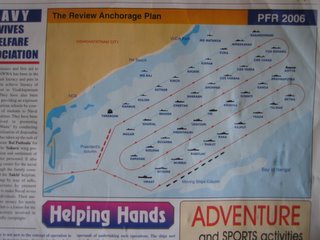 Of course, it would take a particularly clueless landlubber who would need the anchorage plan to tell the Centaur, Kashin, Krivak and Leander classes apart. Apparently, such people exist. Tsk tsk.
Sunday morning was bright, warm, and hazy. One could only vaguely discern the shapes of the argosy in the distance. Nevertheless, the Prez boarded his "yacht" (we wants one!!) and went up and down the lines of ships, as the sailors manned the decks and cried
Rashtrapati Ki Jai! (3)
As the Presidential column steamed past the outermost line of ships on the seaward side, a number of other ships, submarines and aircraft propagated past at high speed.
Lunch was taken at 2:00. By now, to our astonishment, all the ships had vanished. Gone without a trace.
In the evening, many peepals converged on RK Beach. This was an enthralling sight. (Normally the peepals in Vizag stay rooted to the ground and twirl their leaves in the sunlight.) Be that as it may, the lucky ones with navy issue passes (us, my precious, us!!) found ourselves sitting on the strand, more or less right next to the Presidential stage thingumabob. The sun beat down on the throng. Busybodies were going about, asking people to sit down and stay calm. A vendor was selling cucumbers, "Fresh cucumbers, cool cucumbers." OK, that really didn't happen, but we could've used a cuc. or two.
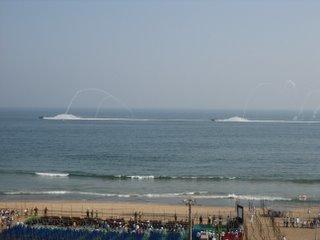
Proceedings began with the flying past of two power gliders that made a few low passes over the assemblage; the silhouettes of the pilots waving to us. Public was enraptured, and everyone craned their heads skywards and babbled, like so many pigeon chicks waiting for mama (We hate pigeons!!!!!! But this will take a whole post to explain...) Even as the gliders receded in the distance, the placid waters of the Bay of Bengal were churned into a frenzy, as a brace of Super Dvora Mk. II class fast patrol vessels strutted their stuff for drooling Vizagites. Up and down they went, zipzapzoom, tight turns, firing of flares. Very pretty.
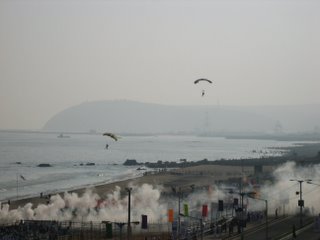
While this went on, unbeknownst to us, a bunch of paratroopy chappies had jumped off a Sea King at 8000 feet and started plumetting earthward. As their chutes opened, a collective gasp went up from the pigeon chicks. The fallschirmjaeger swooped down over public and landed right in front of the Prez's podium. They were guided by some smoke bomb type thingys.
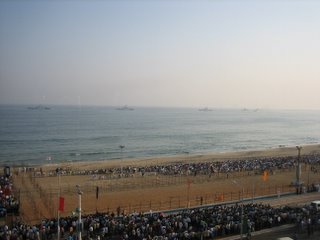
The Prez arrived, the Postmaster General presented him with a commemorative stamp, a pair of Chetaks flew past the podium carrying the Indian flag and naval ensign, Lt. Commander Rashmi Singh also dropped in (literally, mit parachute attached, merupu teega laaga in the words of the Telugu announcer) and presented Prez with a commemorative Eastern Naval Command coffee table book, and so on. Once all this hullaballoo had died down, we were free to turn our attention oceanwards, as more interesting things began to happen. Four Type 25 A Kora class guided missile corvettes steamed past in formation.
Everyone was engrossed in this corvettian display. All eyes were turned towards 2 o'clock. No one saw something emerge rapidly out of left field.
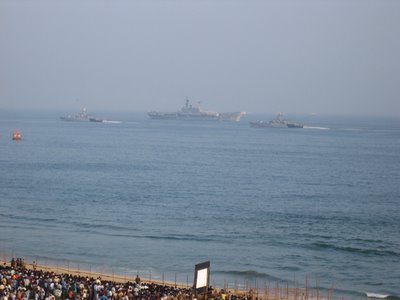
Glory be, she came back!!!! She was sailing right in front of our unbelieving eyes. She was gorgeous. She turned into the wind smartly, and launched 3 Harriers in short order. She landed one more, and slipped away towards the horizon.
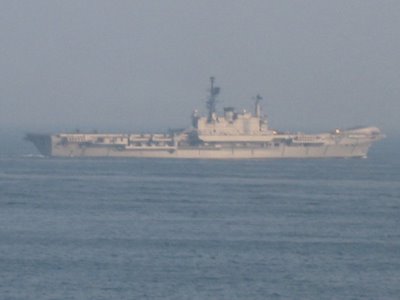
Not to be outdone by this ostentatious display of naval aviation, 1 nos. Delhi class, 1 nos. Krivak class, 1 nos. Kashin class and 1 nos. Leander class ships came out of the blue, and even as they passed (in staggered formation), 1 nos. Sea King and 3 nos. Kamov helicopters came flying in and hovered over the helipad on the poop deck.
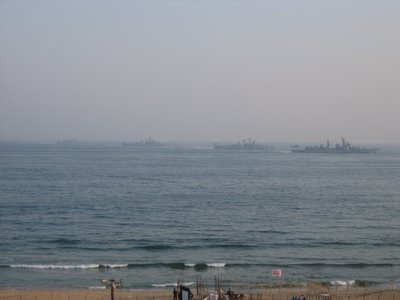
The boys from "Sagar Pavan", the naval aerial acrobatics fellows, showed up from behind us, and did a number of ridiculously dangerous and dangerously ridiculous things (because it was Valentine's day, 3 of them flew about "painting" a heart in the sky, complete with interesecting arrow) with their planes.
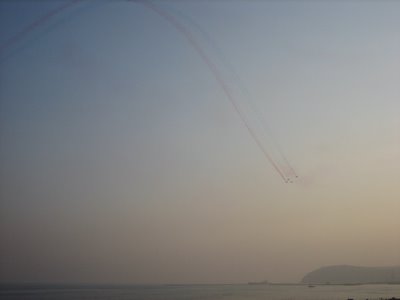
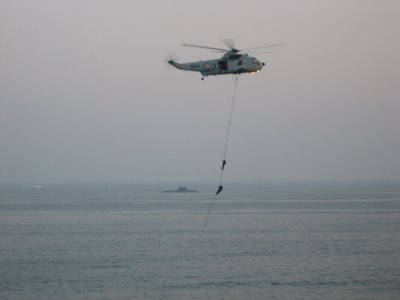
We were all wondering what the two oil rig like structures off the beach were. We found out soon enough. A bunch of marine commandos (MARCOs) shot off from the beach in a dinghy type thing, acted busy at the feet of the oil rigs, and a few moments later, they were blown away to kingdom come. A thoughtful Sea King picked them up mid-sea and flitted around with the MARCOs hanging off the rope.
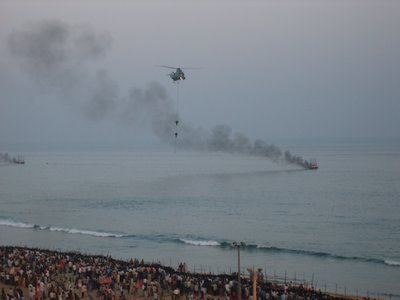
A Kilo class boat that had been coyly lurking in the background chose this moment to launch its own detachment of MARCOs.
These buggers advanced on the Prez, to the accompaniment of much rat-a-tat-boom, staging some sort of an Operation Overlord redux.
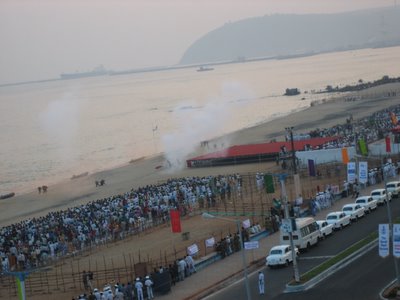
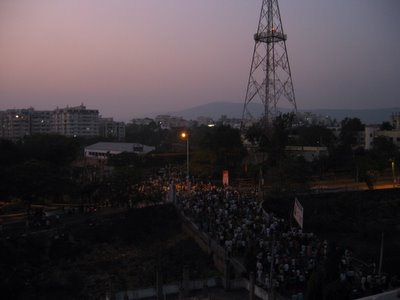
Beating of retreat occurred (they played Bolero), and everyone started trooping home, muchly satiated. Later, when it was dark, there was a splendid firing of guided missile, rockets, tracers and ack-ack.
And then the lighting of the lamps.
1. A most remarkable equine. Shows up in the news practically every day. Its always Onnu Onnu Onnu this, O. (3) that, nowadays. This may warrant a separate post.
2. More pictures here.

To smell the rising vapour of the coffee; to feel the crisp crinkliness of newsprint as one peels open the sports page (usually to find that Onnu Onnu Onnu has won again, praise the Lord 1); and to gaze upon the clean, unfussy lines of the Mumbai, as she waits silently on the navy's flagship whose grey bulk lowers a couple of boat lengths from her bows. Is this too much to ask of life?
The 9th Presidential Fleet Review happened last weekend at Vizag - home and headquarters of the Eastern Naval Command. Friday and Saturday were tiresome for the good people who live off Ramakrishna (RK) Beach. A quantity of "dignitaries" was due to land on top of this little city on Sunday. This sent the "authorities" into a tizzy of organization and reorganization, especially the police. One could almost feel the frissons of anticipatory excitement as SI Appa Rao stopped our car as we were about to turn into the street where home lies, "Traffic not allowed, please cooperate sir. Order from superior officer." We were barred from entering our own homes!! Sacre bleu! But then, it will be a long time before anything like this ever happens, so we said, c'est la vie and plodded on.
Some of us carefully studied the anchorage plan, so that later on we could rattle off the classes (if not the names) of the vessels parked outside our windows.
 Of course, it would take a particularly clueless landlubber who would need the anchorage plan to tell the Centaur, Kashin, Krivak and Leander classes apart. Apparently, such people exist. Tsk tsk.
Sunday morning was bright, warm, and hazy. One could only vaguely discern the shapes of the argosy in the distance. Nevertheless, the Prez boarded his "yacht" (we wants one!!) and went up and down the lines of ships, as the sailors manned the decks and cried
Rashtrapati Ki Jai! (3)
As the Presidential column steamed past the outermost line of ships on the seaward side, a number of other ships, submarines and aircraft propagated past at high speed.
Lunch was taken at 2:00. By now, to our astonishment, all the ships had vanished. Gone without a trace.
In the evening, many peepals converged on RK Beach. This was an enthralling sight. (Normally the peepals in Vizag stay rooted to the ground and twirl their leaves in the sunlight.) Be that as it may, the lucky ones with navy issue passes (us, my precious, us!!) found ourselves sitting on the strand, more or less right next to the Presidential stage thingumabob. The sun beat down on the throng. Busybodies were going about, asking people to sit down and stay calm. A vendor was selling cucumbers, "Fresh cucumbers, cool cucumbers." OK, that really didn't happen, but we could've used a cuc. or two.
Proceedings began with the flying past of two power gliders that made a few low passes over the assemblage; the silhouettes of the pilots waving to us. Public was enraptured, and everyone craned their heads skywards and babbled, like so many pigeon chicks waiting for mama (We hate pigeons!!!!!! But this will take a whole post to explain...) Even as the gliders receded in the distance, the placid waters of the Bay of Bengal were churned into a frenzy, as a brace of Super Dvora Mk. II class fast patrol vessels strutted their stuff for drooling Vizagites. Up and down they went, zipzapzoom, tight turns, firing of flares. Very pretty.
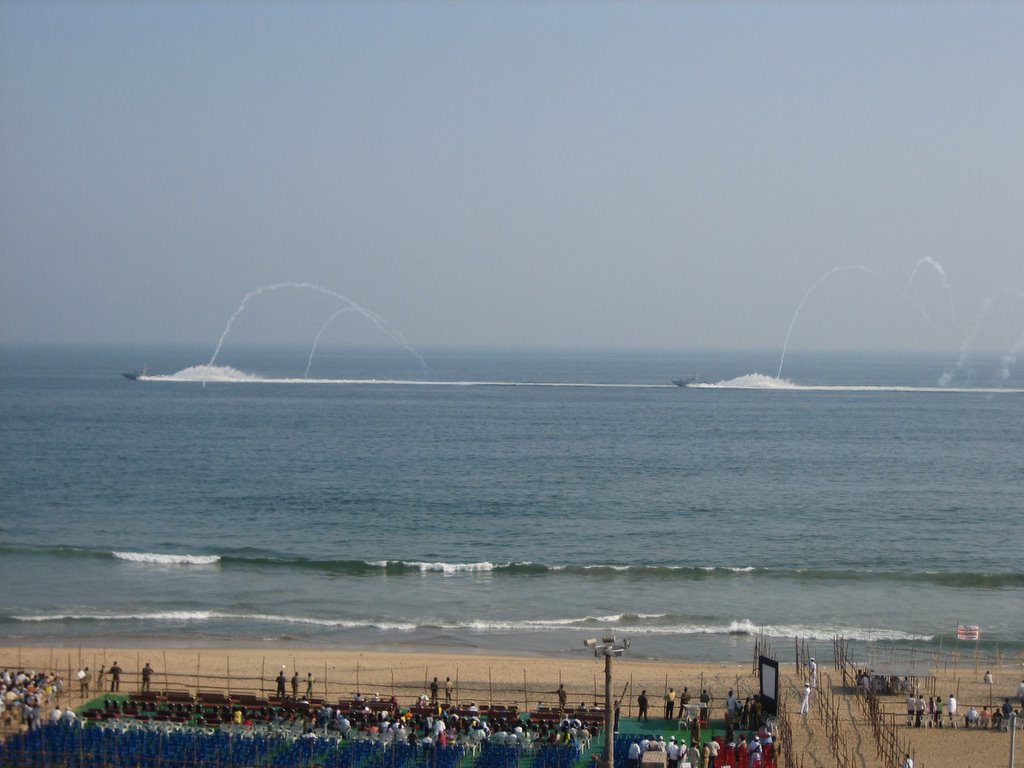
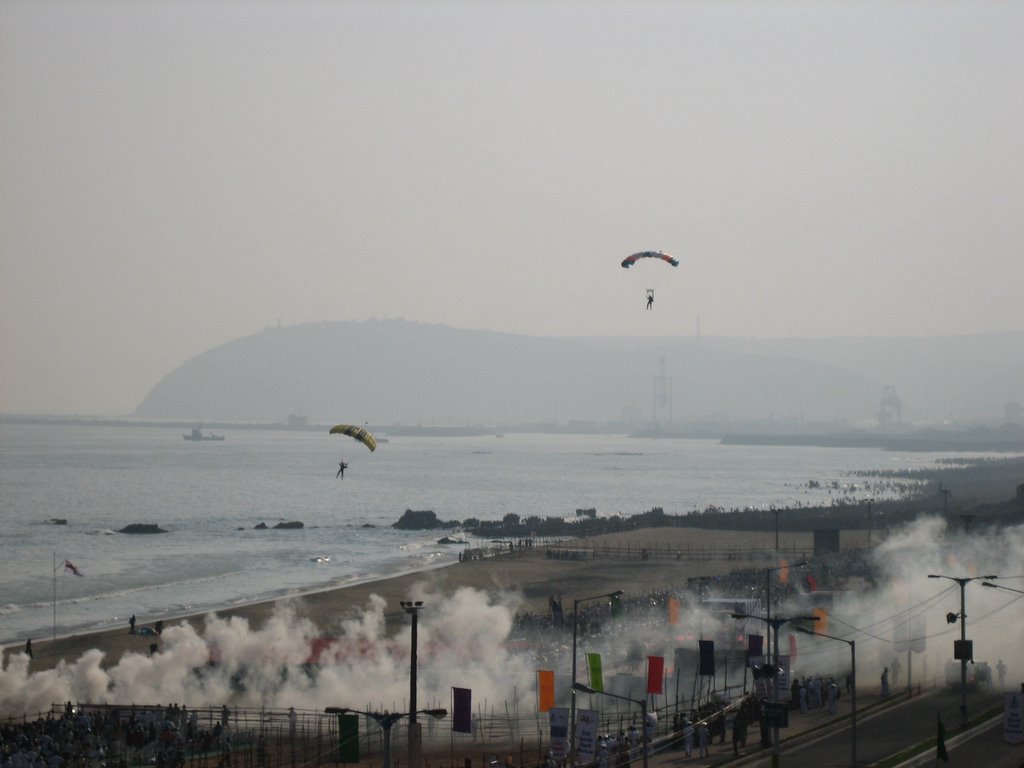
While this went on, unbeknownst to us, a bunch of paratroopy chappies had jumped off a Sea King at 8000 feet and started plumetting earthward. As their chutes opened, a collective gasp went up from the pigeon chicks. The fallschirmjaeger swooped down over public and landed right in front of the Prez's podium. They were guided by some smoke bomb type thingys.
The Prez arrived, the Postmaster General presented him with a commemorative stamp, a pair of Chetaks flew past the podium carrying the Indian flag and naval ensign, Lt. Commander Rashmi Singh also dropped in (literally, mit parachute attached, merupu teega laaga in the words of the Telugu announcer) and presented Prez with a commemorative Eastern Naval Command coffee table book, and so on. Once all this hullaballoo had died down, we were free to turn our attention oceanwards, as more interesting things began to happen. Four Type 25 A Kora class guided missile corvettes steamed past in formation.
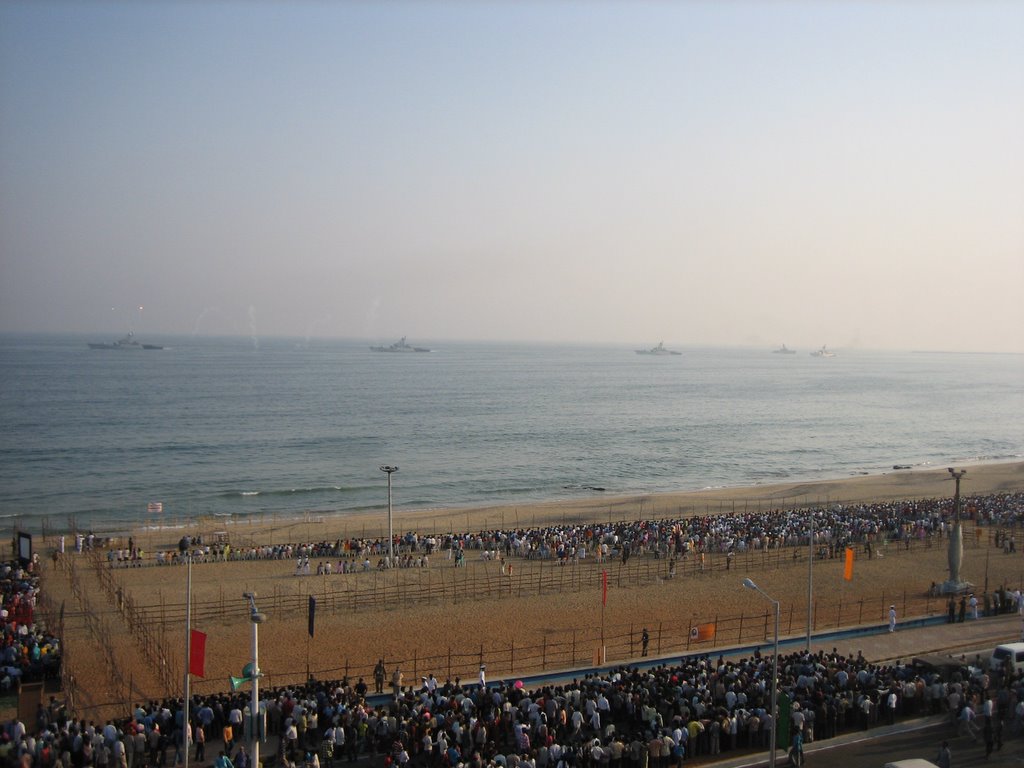
Everyone was engrossed in this corvettian display. All eyes were turned towards 2 o'clock. No one saw something emerge rapidly out of left field.

Glory be, she came back!!!! She was sailing right in front of our unbelieving eyes. She was gorgeous. She turned into the wind smartly, and launched 3 Harriers in short order. She landed one more, and slipped away towards the horizon.

Not to be outdone by this ostentatious display of naval aviation, 1 nos. Delhi class, 1 nos. Krivak class, 1 nos. Kashin class and 1 nos. Leander class ships came out of the blue, and even as they passed (in staggered formation), 1 nos. Sea King and 3 nos. Kamov helicopters came flying in and hovered over the helipad on the poop deck.
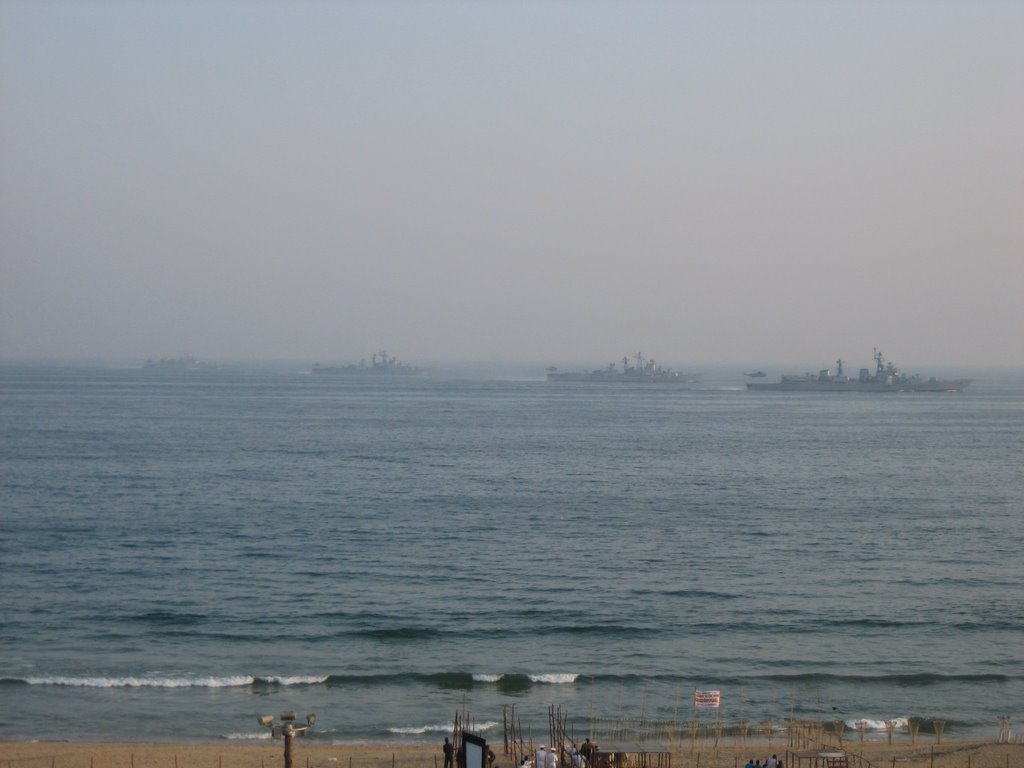
The boys from "Sagar Pavan", the naval aerial acrobatics fellows, showed up from behind us, and did a number of ridiculously dangerous and dangerously ridiculous things (because it was Valentine's day, 3 of them flew about "painting" a heart in the sky, complete with interesecting arrow) with their planes.

We were all wondering what the two oil rig like structures off the beach were. We found out soon enough. A bunch of marine commandos (MARCOs) shot off from the beach in a dinghy type thing, acted busy at the feet of the oil rigs, and a few moments later, they were blown away to kingdom come. A thoughtful Sea King picked them up mid-sea and flitted around with the MARCOs hanging off the rope.
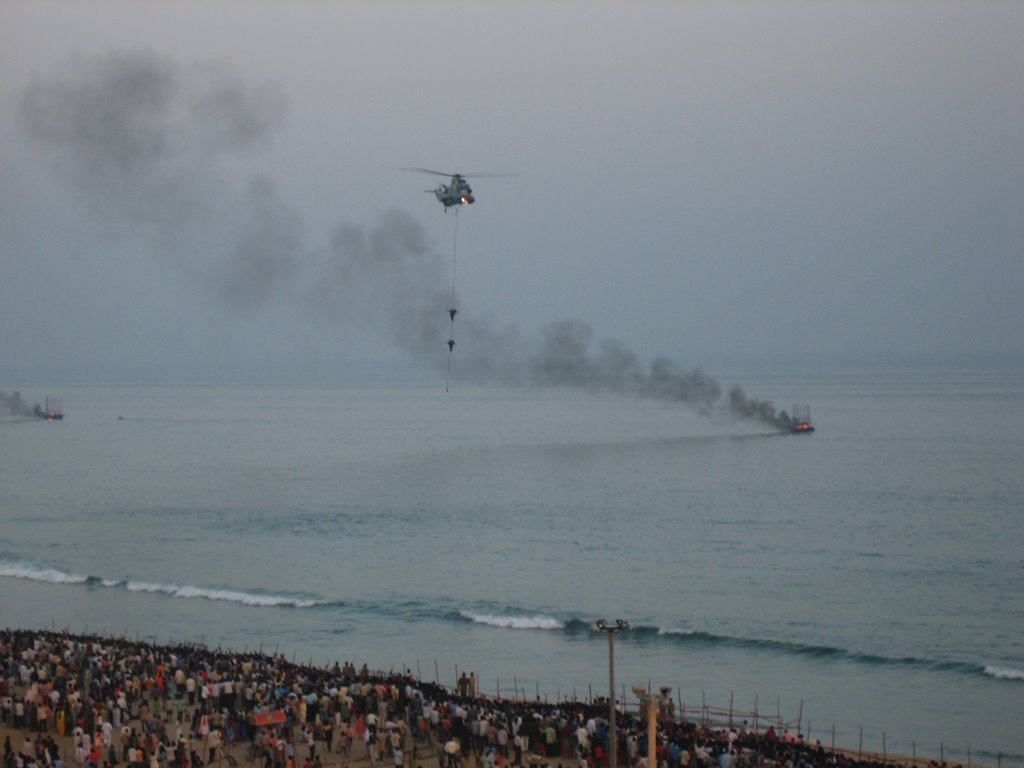
A Kilo class boat that had been coyly lurking in the background chose this moment to launch its own detachment of MARCOs.

These buggers advanced on the Prez, to the accompaniment of much rat-a-tat-boom, staging some sort of an Operation Overlord redux.
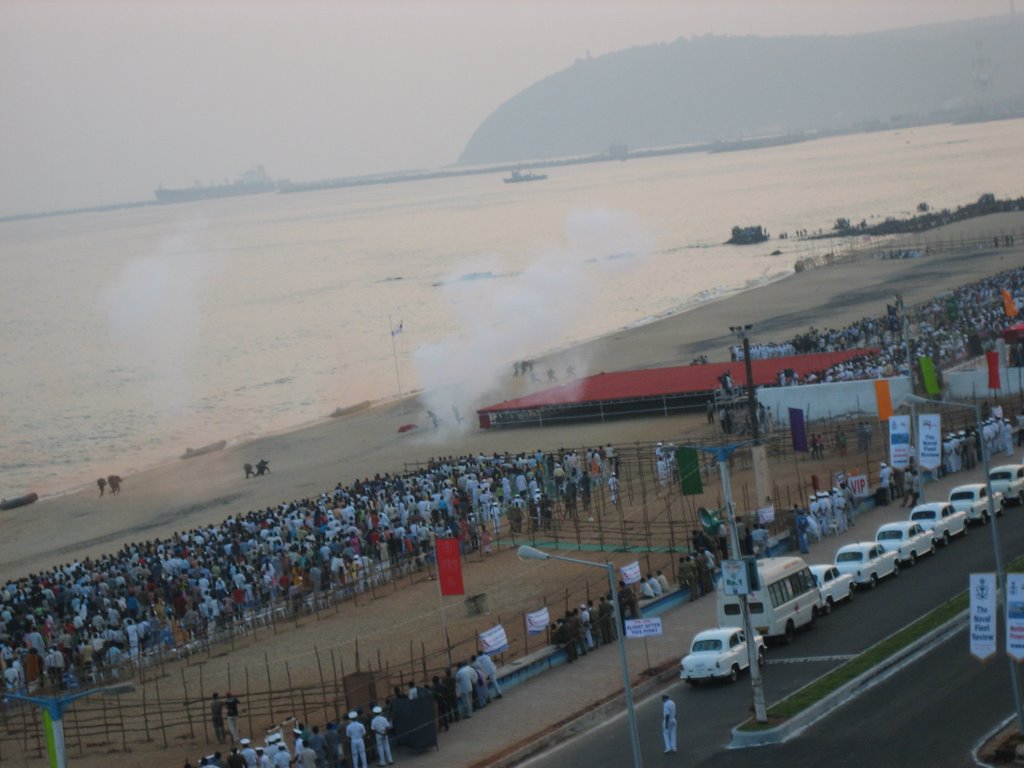
Beating of retreat occurred (they played Bolero), and everyone started trooping home, muchly satiated. Later, when it was dark, there was a splendid firing of guided missile, rockets, tracers and ack-ack.
And then the lighting of the lamps.

1. A most remarkable equine. Shows up in the news practically every day. Its always Onnu Onnu Onnu this, O. (3) that, nowadays. This may warrant a separate post.
2. More pictures here.
Thursday, February 09, 2006
शं नो वरुणः
It is upon us. We are seeking it, all our thought is bent on it. She will be there, they will wait on her, and these ones will be lurking. There will fireworks, and lighting and all.
And its all happening at home. We can sees it from the terrace. And we're going to.
mmm...
Thanks to these good fellas for transliteration facilities.
And its all happening at home. We can sees it from the terrace. And we're going to.
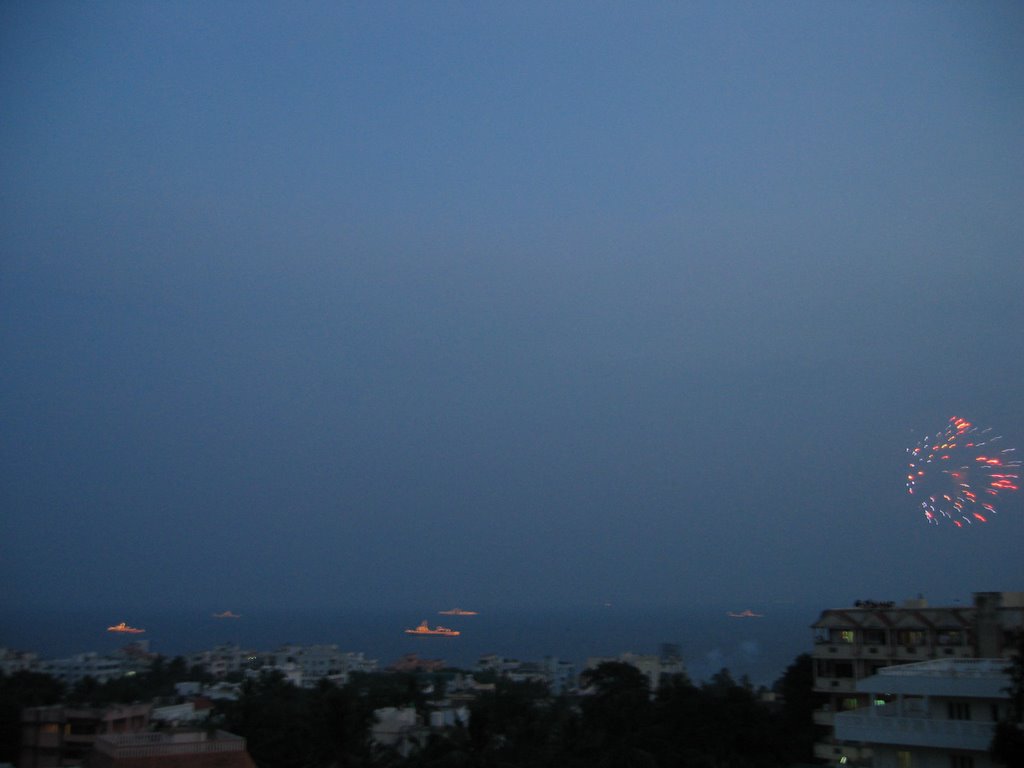
mmm...
Thanks to these good fellas for transliteration facilities.
Saturday, December 10, 2005
On Cyclones
If you grew up near the Coromandel Coast, in the Northern Circars for example, the the weather generally played a fair to middling part in your life. Indeed, evidence of this obsession with the ritus may be found elsewhere in these pages (here and here). In particular, one remembers those annual offerings that the Bay of Bengal used to dish out with impressive, metronomic frequency - the tropical cyclone.
Wotitis?
There was no telling where each one would end up. Would it try to diddle the good people of the Godavari-Krishna doab into staying at home, while it went and lavished its tender attentions on the good people the Madras, Nellore and Prakasam country? Would it feint a move towards Puri and Konark, but actually come storming through the N. Circars and extinguish itself in the Agency areas? Or would it bugger off in a generally nor-noreasterly direction and do unspeakable things to the long suffering people of the Ganga-Brahmaputra-Irrawady deltas?
Equally, there was no telling how strong it would be. At the bottom of the scale, you had your depressions that stayed depressions, and lived up to their names. Annoying, gloomy, wet things that draped themselves over all the land and sobbed their guts out in slow motion. Some were made of sterner stuff. Vigorous demonstrations of strength and intent, in the form of rain, wind, whirling leaves and fallen pylons up and down the coast. Not enough to seriously interfere with life, other than plant the voluptuous maybe-no-school-tomorrow thought in impressionable minds, and disappoint. Mama Gaia saying, "I was here".
Once every few years, the elements would bestir themseles into putting up a real show of power, usually with tragic consequences. The Regional Meteorological Centre in Mumbai informs us that in October 1737 one of these whoppers hit the Calcutta deltaic region and took 300,000 lives to the accompaniment of a 12 metre storm surge. 12 metres!! In December 1964, the Rameswaram cyclone wiped out the town of Dhanushkodi, and en passant carried off a passenger train and a biggish bridge. The Bangladesh (then East Pakistan) storm of November 1970 tried to pip the 1737 one in the Lives Lost Stakes and seems to have given a good account of itself (this disaster's aftermath must surely have had something to do with the geo-political events of the next year). In November 1977, much of coastal Andhra Pradesh was hammered by a storm that took 10,000 lives. Even closer to our times (1990, 1999) there have been tastes of disaster. The Orissa Supercyclone of 1999 was the last really humongous event. Since then, things have been ominously quiet.
There are many places on the internet where you can find information on tropical storms and hurricanes. That stalwart newspaper, The Hindu publishes a satellite image every day, which you can use in your betting games. Don't worry, the one in this picture is Cyclone Fanoos (yes, they're naming them nowadays), which weakened in to a depression and crossed the Tamil Nadu coast at Vedaranyam a few hours back. The Indian Meteorological Department is slow, but purportedly has animated satellite and Doppler imagery (a la weather.com).
Hurricanealley has a Bay of Bengal section where you can track the progress of cyclones in the bay. But why settle for chaff when you can go directly to the motherlode? The US Navy's Joint Typhoon Warning Center provides eminently readable information on the path of cyclones around the world.

They also have a plain text message written by Tom Clancy.
MOVEMENT PAST SIX HOURS - 270 DEGREES AT 04 KTS
POSITION ACCURATE TO WITHIN 060 NM
POSITION BASED ON CENTER LOCATED BY SATELLITE
...
110600Z --- 11.0N 77.7E
MAX SUSTAINED WINDS - 020 KT, GUSTS 030 KT
DISSIPATED AS A SIGNIFICANT TROPICAL CYCLONE OVER LAND
...
TC 06B WILL CONTINUE ITS WESTERLY TRACK UNDER THE
SOUTHWESTERN PERIPHERY OF THE LOW TO MID LEVEL STEERING RIDGE
LOCATED OVER THE NORTHERN BAY OF BENGAL.
and so on. They even have a ship avoidance graphic.
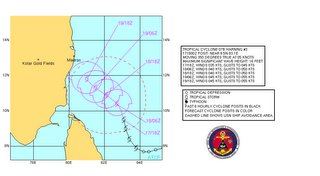
So if you happen to be driving a US Navy warship in these waters (as some of us do during weekends), you might want to take a gander at this ever so often. Note that Baaz and Fanoos having departed for their Meteorological Abodes, the corresponding graphics and warnings are no longer available on the website, but they do track Bay of Bengal cyclones too.
One has noticed recently that the stalwart newspaper has 'lifted' the graphic verbatim (pictoratim?) from the JTWC website and planted it on their front page. One is not sure if all sources were credited or not. Finally, we have the National Hurricane Center. The spelling of 'center' should help you identify the nation in question.
TAILPIECE
They're naming the Bay of Bengal storms using names from countries in this region. We recently had Baaz, and Fanoos. Strangely enough, both these storms hit Tamil Nadu, leaving many a scrawny Dravidian scratching his head in bewilderment, "Ennaaya idhu, indha Baaj, Fanoos? Onnume puriyillai." In certain quarters, voice has been lent to the Unspoken Thought that the names should be more sensitive to culture and geography. Therefore, we hereby declare, that all TN bound storms will submit to the following naming ordeal this year: Arumugam, Balasubramaniam, Chokkalingam, Dayanidhi, Elangovan ... Pachaiyyappan ... Thirunavukkarasu(!!) ...Venktachalapathi ... Yenkatachalapathi ... Zebra. Being the state animal of TN. If you take a close look at some of the better designed intersections in Madras.
OK, enough.
Wotitis?
In meteorology, a tropical cyclone (or tropical depression, tropical storm, typhoon, or hurricane, depending on strength and geographical context) is a type of low pressure system which generally forms in the tropics. While they can be highly destructive, tropical cyclones are an important part of the atmospheric circulation system, which moves heat from the equatorial region toward the higher latitudes.These things used to be phenomenally regular (in the late 80s and through the 90s, anyway). From April/May to September/October, one after the other, they would show up. They were moderately predictable, like salespeople who ring the bell in the middle of your Sunday nap. You knew they would show up once or twice a month, but you were never sure exactly when. The sky would start to turn leaden, battleshippy. You would read in the paper, or listen to the AIR newsreader's dire tones, that there was a "depression in the Bay".
There was no telling where each one would end up. Would it try to diddle the good people of the Godavari-Krishna doab into staying at home, while it went and lavished its tender attentions on the good people the Madras, Nellore and Prakasam country? Would it feint a move towards Puri and Konark, but actually come storming through the N. Circars and extinguish itself in the Agency areas? Or would it bugger off in a generally nor-noreasterly direction and do unspeakable things to the long suffering people of the Ganga-Brahmaputra-Irrawady deltas?
Equally, there was no telling how strong it would be. At the bottom of the scale, you had your depressions that stayed depressions, and lived up to their names. Annoying, gloomy, wet things that draped themselves over all the land and sobbed their guts out in slow motion. Some were made of sterner stuff. Vigorous demonstrations of strength and intent, in the form of rain, wind, whirling leaves and fallen pylons up and down the coast. Not enough to seriously interfere with life, other than plant the voluptuous maybe-no-school-tomorrow thought in impressionable minds, and disappoint. Mama Gaia saying, "I was here".
Once every few years, the elements would bestir themseles into putting up a real show of power, usually with tragic consequences. The Regional Meteorological Centre in Mumbai informs us that in October 1737 one of these whoppers hit the Calcutta deltaic region and took 300,000 lives to the accompaniment of a 12 metre storm surge. 12 metres!! In December 1964, the Rameswaram cyclone wiped out the town of Dhanushkodi, and en passant carried off a passenger train and a biggish bridge. The Bangladesh (then East Pakistan) storm of November 1970 tried to pip the 1737 one in the Lives Lost Stakes and seems to have given a good account of itself (this disaster's aftermath must surely have had something to do with the geo-political events of the next year). In November 1977, much of coastal Andhra Pradesh was hammered by a storm that took 10,000 lives. Even closer to our times (1990, 1999) there have been tastes of disaster. The Orissa Supercyclone of 1999 was the last really humongous event. Since then, things have been ominously quiet.
There are many places on the internet where you can find information on tropical storms and hurricanes. That stalwart newspaper, The Hindu publishes a satellite image every day, which you can use in your betting games. Don't worry, the one in this picture is Cyclone Fanoos (yes, they're naming them nowadays), which weakened in to a depression and crossed the Tamil Nadu coast at Vedaranyam a few hours back. The Indian Meteorological Department is slow, but purportedly has animated satellite and Doppler imagery (a la weather.com).
Hurricanealley has a Bay of Bengal section where you can track the progress of cyclones in the bay. But why settle for chaff when you can go directly to the motherlode? The US Navy's Joint Typhoon Warning Center provides eminently readable information on the path of cyclones around the world.

They also have a plain text message written by Tom Clancy.
MOVEMENT PAST SIX HOURS - 270 DEGREES AT 04 KTS
POSITION ACCURATE TO WITHIN 060 NM
POSITION BASED ON CENTER LOCATED BY SATELLITE
...
110600Z --- 11.0N 77.7E
MAX SUSTAINED WINDS - 020 KT, GUSTS 030 KT
DISSIPATED AS A SIGNIFICANT TROPICAL CYCLONE OVER LAND
...
TC 06B WILL CONTINUE ITS WESTERLY TRACK UNDER THE
SOUTHWESTERN PERIPHERY OF THE LOW TO MID LEVEL STEERING RIDGE
LOCATED OVER THE NORTHERN BAY OF BENGAL.
and so on. They even have a ship avoidance graphic.

So if you happen to be driving a US Navy warship in these waters (as some of us do during weekends), you might want to take a gander at this ever so often. Note that Baaz and Fanoos having departed for their Meteorological Abodes, the corresponding graphics and warnings are no longer available on the website, but they do track Bay of Bengal cyclones too.
One has noticed recently that the stalwart newspaper has 'lifted' the graphic verbatim (pictoratim?) from the JTWC website and planted it on their front page. One is not sure if all sources were credited or not. Finally, we have the National Hurricane Center. The spelling of 'center' should help you identify the nation in question.
TAILPIECE
They're naming the Bay of Bengal storms using names from countries in this region. We recently had Baaz, and Fanoos. Strangely enough, both these storms hit Tamil Nadu, leaving many a scrawny Dravidian scratching his head in bewilderment, "Ennaaya idhu, indha Baaj, Fanoos? Onnume puriyillai." In certain quarters, voice has been lent to the Unspoken Thought that the names should be more sensitive to culture and geography. Therefore, we hereby declare, that all TN bound storms will submit to the following naming ordeal this year: Arumugam, Balasubramaniam, Chokkalingam, Dayanidhi, Elangovan ... Pachaiyyappan ... Thirunavukkarasu(!!) ...Venktachalapathi ... Yenkatachalapathi ... Zebra. Being the state animal of TN. If you take a close look at some of the better designed intersections in Madras.
OK, enough.
Monday, August 29, 2005
Nauti Stuff - The Sinking
The title says it all. Gazing at the dying day, as the trackless plains of Andhra Pradesh rolled past the windows of the Hyderabad-Chennai Express (or, the Hyderabad-Chennai Express rolled past the trackless plains of India, as the case may be, if you're a stickler for these things), it is hard to keep thoughts of sinking ships out of one's mind. Your is not to ask why, yours is but to do or die. Die, die, die...[extricates ice pick]
Since we have not done a list in aeons, we will do a list. Famous ships that stank. Sank. Or were otherwise tragically interrupted as they went about their maritime activities. And the nominees are
Since we have not done a list in aeons, we will do a list. Famous ships that stank. Sank. Or were otherwise tragically interrupted as they went about their maritime activities. And the nominees are
- The Titanic - this ship unfortunately has to top the list. Hated the movie, will not say anything more about this disaster, everyone and their aunty Akhilandeswari knows everything about this. You only have to say "Tit..." and people's arms just go up and glazed look colonizes visage, as though they were Leo and Kate coochicooing on the prow.
- The Lusitania - The world's first quadruple screw steamer, and also the first ship to exceed 30,000 tons.
On 7 May 1915, while heading east off the Old Head of Kinsale, Ireland...Lusitania was torpedoed without warning by U-20 and sank within 18 minutes. ..
The Lusitania incident was later used by Woodrow Wilson (who was officially keeping the US out of the First World War), as a propaganda tool.
...Of those on board, 761 were rescued, while 1,198 perished. Lusitania's sinking, and the sinking of White Star's Arabic a few months later, vividly demonstrated that prior concepts of the rules of war no longer prevailed, and that unarmed merchant ships were no longer safe from attack. - The Kursk disaster - The Russian Typhoon (?) class SSBN sank with all hands off the coasts of Norway and Russia in 2000. He (the Russians use the male pronoun for ships, apparently) was part of military exercises, when it is believed that leaking fuel from a torpedo ignited and caused an explosion in the forward sections. Some 23 sailors survived the explosion and flooding in the aftmost compartment, and slowly asphyxiated, as rescue attempts to reach them, first by the Russians and later by an international team, failed. RIP.
- The Exxon Valdez incident - No loss of life this time, but a lot of fishies and birdies and other cuties paid the price for this balls up.
Exxon Valdez was the original name of an oil tanker owned by the Exxon oil company. The ship was renamed to "Sea River Mediterranean" after the March 24, 1989 oil spill in which the tanker hit Prince William Sound's Bligh Reef and spilled between 11 million and 35 million U.S. gallons (42,000 and 132,000 m³) of crude oil that killed billions of animals: the Exxon Valdez oil spill, or the EVOS. As a result of the spill, 10% of the wildlife died and 50% of the season catch of fish were killed. The captain of the Exxon Valdez was then found guilty of negligence, and in 1991 a federal judge rejected a $1.1 billion settlement reached by Exxon, the federal government, and Alaska.
Interestingly, the ship makes a cameo appearance in a movie. - The Cheat List - Here we will bunch a list of World War II sinkings and be done...
- HMS Royal Oak - Battleship. Torpedoed in Scapa Flow by Obertleutnant Gunther Prien
- HMS Hood - Battlecruiser. Sunk by gunfire from the German battleship Bismark, in the course of The Battle Of The Denmark Strait" on May 24, 1941. There were 1400+ crew. 3 survived.
- The Bismarck - Followed up her brief and spectacular success (above), by proceeding to be battered by the British Home Fleet, and was finally torpedoed by the HMS Dorsetshire. About 2200 died.
- HMS Prince Of Wales and HMS Repulse" - Sunk by Japanese aircraft within an hour of each other off the east coast of Malaya on 10 December, 1941. The question of the battleship versus the bomber was answered.
- TODO: USS Arizona and Pearl Harbor, the whole Pacific theater shebang, IJNS Yamato and IJNS Musashi, and so on...
Tuesday, March 02, 2004
Tall Ships
Latest fascination. Ever since I started reading Patrick O' Brian's "Master and Commander" stuff. Another book (tangentially connected) is The Honourable Company. Fascinating history of the East India Company, very nice narrative history. Got to remember to read more by John Keay.
The web is full of tantalizing bits of information on this subject, nothing really does full justice. The British Library has a 101 version Trading Places which is a pretty useful starting point. Google turned up with this digital version of the Oriental Navigator circa 1794 at the Mystic Seaport museum. Good stuff includes: blow by blow information on how to navigate the murky waters near "The Coast Of Orissa - Vizagapatnam - Bimilipatnam - Chickacole - Ganjam - False Point and Point Palmiras" :-) Interesting for obvious reasons.
obvious reason = not so obvious. I grew up in "Vizagapatnam"
Respectable number of links for a first blog eh, old chap?
The web is full of tantalizing bits of information on this subject, nothing really does full justice. The British Library has a 101 version Trading Places which is a pretty useful starting point. Google turned up with this digital version of the Oriental Navigator circa 1794 at the Mystic Seaport museum. Good stuff includes: blow by blow information on how to navigate the murky waters near "The Coast Of Orissa - Vizagapatnam - Bimilipatnam - Chickacole - Ganjam - False Point and Point Palmiras" :-) Interesting for obvious reasons.
obvious reason = not so obvious. I grew up in "Vizagapatnam"
Respectable number of links for a first blog eh, old chap?
Subscribe to:
Posts (Atom)