Quiet Night Thoughts
-Li Po
Before my bed
there is bright moonlight
So that it seems
like frost on the ground:
Lifting my head
I watch the bright moon,
Lowering my head
I dream that I'm home.
Untitled
-Hafiz
I have a thousand brilliant lies
For the question:
How are you?
I have a thousand brilliant lies
For the question:
What is God?
If you think that the Truth can be known
From words,
If you think that the Sun and the Ocean
Can pass through that tiny opening
Called a mouth,
O someone should start laughing!
Someone should start wildly Laughing --
Now!
III
-Neruda, from the Book of Questions
Tell me, is the rose naked
or is that her only dress?
Why do trees conceal
the splendor of their roots?
Who hears the regrets
of the thieving automobile?
Is there anything in the world sadder
than a train standing in the rain?
That last question, I just realized, is satisfactorily answered here.
Showing posts with label poetry. Show all posts
Showing posts with label poetry. Show all posts
Friday, August 26, 2011
Saturday, July 02, 2011
Poems From 10 Years Back - I
In the process of backing up various online email accounts to disk, several old emails/forwards with poetry content have been discovered, and are now presented without comment.
Prandial Plaint
- Vikram Seth
My love, I love your breasts. I love your nose.
I love your accent and I love your toes.
I am your slave. One word and I obey.
But please don't slurp your coffee in that way.
(from 'All You Who Sleep Tonight')
Seth has featured in these pages before, and the excellent but sadly inactive Wondering Minstrels have a whole bunch of his stuff.
Prandial Plaint
- Vikram Seth
My love, I love your breasts. I love your nose.
I love your accent and I love your toes.
I am your slave. One word and I obey.
But please don't slurp your coffee in that way.
(from 'All You Who Sleep Tonight')
Seth has featured in these pages before, and the excellent but sadly inactive Wondering Minstrels have a whole bunch of his stuff.
Friday, March 25, 2011
Friday Verse Thingy
After a long, long time. Via 3 Quarks Daily, we arrive at Kenneth Patchen's As We Are So Wonderfully Done with Each Other.
As We Are So Wonderfully Done with Each Other
BY KENNETH PATCHEN
As we are so wonderfully done with each other
We can walk into our separate sleep
On floors of music where the milkwhite cloak of childhood lies
O my lady, my fairest dear, my sweetest, loveliest one
Your lips have splashed my dull house with the speech of flowers
My hands are hallowed where they touched over your
soft curving.
It is good to be weary from that brilliant work
It is being God to feel your breathing under me
A waterglass on the bureau fills with morning . . .
Don’t let anyone in to wake us.
Similar-ish past posts - To Manijeh - Vikram Seth, To His Lost Lover - Simon Armitage, Sex Without Love - Sharon Olds
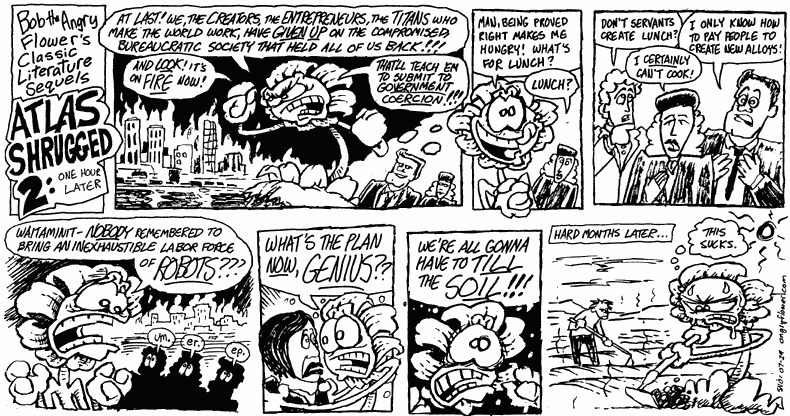
Have you seen Bob - The Angry Flower? He is most hilarious. Self described as "An irritable flower takes on aliens and wheelchair basketball." The first one I saw was this sequel to "Atlas Shrugged".
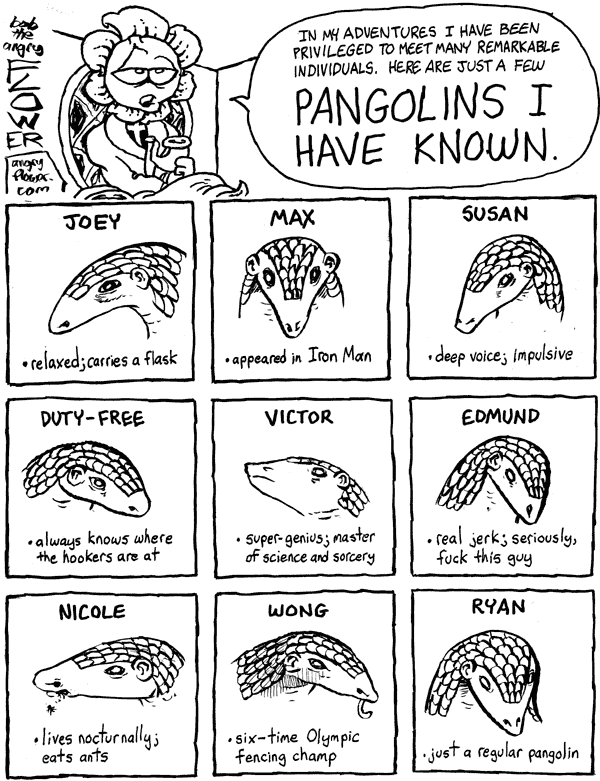
Today's Pangolins I Have Known is ridiculously funny. Can't help staring at it for a few seconds and bursting into giggles, in a loop.
As We Are So Wonderfully Done with Each Other
BY KENNETH PATCHEN
As we are so wonderfully done with each other
We can walk into our separate sleep
On floors of music where the milkwhite cloak of childhood lies
O my lady, my fairest dear, my sweetest, loveliest one
Your lips have splashed my dull house with the speech of flowers
My hands are hallowed where they touched over your
soft curving.
It is good to be weary from that brilliant work
It is being God to feel your breathing under me
A waterglass on the bureau fills with morning . . .
Don’t let anyone in to wake us.
Similar-ish past posts - To Manijeh - Vikram Seth, To His Lost Lover - Simon Armitage, Sex Without Love - Sharon Olds
Have you seen Bob - The Angry Flower? He is most hilarious. Self described as "An irritable flower takes on aliens and wheelchair basketball." The first one I saw was this sequel to "Atlas Shrugged".
Today's Pangolins I Have Known is ridiculously funny. Can't help staring at it for a few seconds and bursting into giggles, in a loop.
Wednesday, March 03, 2010
Random Juvenile Humour
The below might be construed as poking fun at short people, disabled people, gay people and poets. It may disgust or offend you, to varying degrees. You have been warned.
Last week, That Man Keynes And His Homosexual Intrigues, self and S were lounging in TMKAHHI's house in Bangalore. Two somewhat dissimilar threads of conversation interleaved. On the one hand, all of us had lived in Amherst, MA at some point in our lives, and so we were therefore talking about Robert Frost. On the other hand, TMKAHHI was, in the way he does, telling us about the time a deformed midget (a flipper for one arm or something, his words) of some sort had accosted him while he was waiting at a Bangalore traffic signal and attempted to fondle him.
In the usual manner, we attempted a synthesis so that we could braid the two threads into one and save us the trouble of surreal context switching. Of course, the following resulted:
Stopping By An Autorickshaw At A Noisy Signal
-- Lewd Short Person
Whose wood this is I think I know.
Isn't his auto going rather slow?
He will not mind me stopping here
To watch his wood grow and grow.
...
And so on. At the time it seemed very clever and we nearly died of ROFLMAO. Perhaps only the fact that TMKAHHI had cremated his mother that morning kept things in check.
Last week, That Man Keynes And His Homosexual Intrigues, self and S were lounging in TMKAHHI's house in Bangalore. Two somewhat dissimilar threads of conversation interleaved. On the one hand, all of us had lived in Amherst, MA at some point in our lives, and so we were therefore talking about Robert Frost. On the other hand, TMKAHHI was, in the way he does, telling us about the time a deformed midget (a flipper for one arm or something, his words) of some sort had accosted him while he was waiting at a Bangalore traffic signal and attempted to fondle him.
In the usual manner, we attempted a synthesis so that we could braid the two threads into one and save us the trouble of surreal context switching. Of course, the following resulted:
Stopping By An Autorickshaw At A Noisy Signal
-- Lewd Short Person
Whose wood this is I think I know.
Isn't his auto going rather slow?
He will not mind me stopping here
To watch his wood grow and grow.
...
And so on. At the time it seemed very clever and we nearly died of ROFLMAO. Perhaps only the fact that TMKAHHI had cremated his mother that morning kept things in check.
Friday, April 17, 2009
Distant Storm
Tucked away in the midst of the quotidian in today's newspaper, was an interesting picture. Is it our imagination, or is the Bay of Bengal fomenting a nice and juicy cyclone for Coromandel coast consumption?
We've spoken about the weather before at the Choultry, more specifically the obsession with cyclones and the monsoon, so we will not rinse and repeat the experiment. We merely wish to record that frissons were felt today at the prospect of a jolly good Force 10 style blow.
En passant, we quote 1 nos. sher from "Garam Hawa":
Jo door se kartein hain toofaan ka nazara,
Unke liye toofaan udhar bhi hai idhar bhi,
Beh jaoge jo dhaare mein to ban jaoge dhara,
Yeh waqt ka aayelaan udhar bhi hai idhar bhi
We've spoken about the weather before at the Choultry, more specifically the obsession with cyclones and the monsoon, so we will not rinse and repeat the experiment. We merely wish to record that frissons were felt today at the prospect of a jolly good Force 10 style blow.
En passant, we quote 1 nos. sher from "Garam Hawa":
Jo door se kartein hain toofaan ka nazara,
Unke liye toofaan udhar bhi hai idhar bhi,
Beh jaoge jo dhaare mein to ban jaoge dhara,
Yeh waqt ka aayelaan udhar bhi hai idhar bhi
Tuesday, December 09, 2008
On Living
Which we post mainly so that we don't lose this poem
On LivingFound over at Kafila at the end of a very readable piece by Nivedita Menon.
- Nazim Hikmet
Living is no laughing matter:
You must live with great seriousness
Like a squirrel, for example -
I mean without looking for something beyond and above living,
I mean living must be your whole occupation.
Living is no laughing matter…
I mean, you must take living so seriously
that even at seventy for example, you’ll plant olive trees -
and not just for your children either,
but because although you fear death you don’t believe it,
because living, I mean, weighs heavier... .
Let’s say we’re at the front -
for something worth fighting for, say.
There, in the first offensive, on that very day,
We might fall on our face, dead.
We’ll know this with a curious anger,
But we’ll still worry ourselves to death
About the outcome of the war, which could last years.
Let’s say we’re in prison
And close to fifty,
And we have eighteen more years, say,
Before the iron doors will open.
We’ll still live with the outside,
With its people and animals, struggle and wind - I mean with the outside beyond the walls.
I mean, however and wherever we are,
We must live as if we will never die.
This earth will grow cold,
a star among stars, and one of the smallest,
a gilded mote on blue velvet -
I mean this, our great earth.
This great earth will grow cold one day...
Like an empty walnut it will roll along
in pitch-black space...
You must grieve for this right now
- you have to feel this sorrow now -
for the world must be loved this much
if you’re going to say, "I lived"...
Translated by Randy Basing and Mutlu Konuk
Thursday, November 27, 2008
What I Talk About When I Talk About Running
Exhibit A
The book is (thankfully) back. Phew. Excerpt:
Exhibit B
From the last scene:
Exhibit C
All of which is a timely cue to revisit Sex Without Love.
The book is (thankfully) back. Phew. Excerpt:
I'm often asked what I think about as I run. Usually the people who ask this have never run long distances themselves. I always ponder the question. What exactly do I think about when I'm running? I don't have a clue.Almost Ruskin Bond-esque in its simplicity, but touches several chords.
On cold days I guess I think a little about how cold it is. And about the heat on hot days. When I'm sad I think a little about sadness. When I'm happy I think a little about happiness. As I mentioned before, random memories come to me too. And occasionally, hardly ever, really, I get an idea to use in a novel. But really as I run, I don't think much of anything worth mentioning.
I just run. I run in a void. Or maybe I should put it the other way. I run in order to acquire a void. But as you might expect, an occasional thought will slip into this mind. People's minds can't be a complete blank. Human beings' emotions are not strong or consistent enough to sustain a vacuum. What I mean is, the kinds of thoughts and ideas that invade my emotions as I run remain subordinate to that void. Lacking content, they are just random thoughts that gather around that central void.
The thoughts that occur to me while I'm running are like clouds in the sky. Clouds of all different sizes. They come and they go, while the sky remains the same sky as always. The clouds are mere guests in the sky that pass away and vanish, leaving behind the sky. The sky both exists and doesn't exist. It has substance and at the same time it doesn't. And we merely accept that vast expanse and drink it in.
Exhibit B
From the last scene:
So where does the power come from, to see the race to its end? From within. Jenny, I believe that God made me for a purpose. He also made me fast. And when I run, I feel his pleasure.
Exhibit C
All of which is a timely cue to revisit Sex Without Love.
Thursday, August 21, 2008
Ghazal Du Jour
Why write something when someone has already said it and you can copy-paste?
itanii muddat baad mile ho
kin socho.n me.n gum rahate ho
tez havaa ne mujh se puuchhaa
ret pe kyaa likhate rahate ho
kin socho.n me.n gum rahate ho
kaun sii baat hai tum me.n aisii
itane achchhe kyo.n lagate ho
kin socho.n me.n gum rahate ho
ham se na puuchho hijr ke qisse
apanii kaho ab tum kaise ho
kin socho.n me.n gum rahate ho
-- Mohsin Naqvi
Ghulam Ali sings.
The most famous Mohsin-Ghulam Ali combo offer is of course ye dil ye paagal dil mera, kyon bujh gayaa avaargii. Video.
But itanii muddat has more kashish for us, what to say?
itanii muddat baad mile ho
kin socho.n me.n gum rahate ho
tez havaa ne mujh se puuchhaa
ret pe kyaa likhate rahate ho
kin socho.n me.n gum rahate ho
kaun sii baat hai tum me.n aisii
itane achchhe kyo.n lagate ho
kin socho.n me.n gum rahate ho
ham se na puuchho hijr ke qisse
apanii kaho ab tum kaise ho
kin socho.n me.n gum rahate ho
-- Mohsin Naqvi
Ghulam Ali sings.
The most famous Mohsin-Ghulam Ali combo offer is of course ye dil ye paagal dil mera, kyon bujh gayaa avaargii. Video.
But itanii muddat has more kashish for us, what to say?
Friday, April 18, 2008
Richard Stalkey
Which pun whoever deciphers will get a sandwich (see below)
Life has been somewhat hectic, to say the least. First however, lunch. We made lunch. Observe.

Ham, egg and cheese sandwich. Juice. Fruit. Pretty bloody fantastic, even if we say so ourselves. This was a workday lunch. Below, is the weekend game version of lunch.

Not very different at all, no? This "food tableaux" photo business has potential that needs exploring.
Also, we will make sandwiches for anyone who can guess which saliva inducing sandwich making movie scene inspired this bout of sandwich making.
Wall poster in Begumpet, today:

Subhash asks us to tell you that if he doesn't answer the phone, please leave a masaj after the peep.
A poem. No particular reason.
Stalker
Silouwettes.they.follow.me.
Wherever.I.go.
Watching.me.
Hunting.me.
Tormenting.my.soul.
Joy Davis
Which poem lets us segue nicely into the link fest.
Why Modern Poems Don't Rhyme, Etc.: Frequently asked questions about the business of verse, by Robert Pinsky.
Q9: Well, I like poetry that is amusing, that maybe makes me chuckle a little. I'd rather read something reassuring and light than something complicated or gloomy. Is that bad? Does that mean I am a jerk?
A9: Yes.
:)
Via Richard Dawkins, Evolution: 24 Myths and Misconceptions. Evolution cannot be disproved and is therefore not science seems most promising.
Horribly poignant story. Gen Peter van Uhm took command of Dutch forces in Afghanistan on Thursday. His son Lt Dennis van Uhm (23) was killed by a roadside bomb in southern Afghanistan on Friday. Friday's attack is not thought to have specifically targeted the new military commander. Is that good? Or bad?
On a related note, Andrew Olmsted, a US soldier in Iraq left a blog post that was to be published in the event of his death. It's up now.
If you haven't, Google up Randy Pausch and see "The Last Lecture".
Physics on women.

Points for identifying the equations.
In other education related news, the Supreme Court of India recently issued a judgment upholding reservations for OBCs in India. In general terms we're quite happy with this, no complaints. Now if only they'd do away with the death penalty, Section 377 of the IPC, and other such monstrosities.
In general, the desi blog world has been pretty solidly against reservations, and you can find as many posts as you feel like. Posts in favour on the other hand, have been far and few in between. As usual, a good starting point is Abi. Of particular interest may be a paper titled "Affirmative Action in Education: Evidence From Engineering College Admissions in India" by Marianne Bertrand (University of Chicago), Rema Hanna (New York University), and Sendhil Mullainathan (Harvard University). Mullainathan has featured in these pages before for the paper Are Emily and Greg More Employable than Lakisha and Jamal? (PDF)
kuffir as usual is very powerful. His latest posts have been about the "creamy layer" (low fat, apparently). This link appears to be broken at the moment, but it leads you to kuffir's quest to find blogs about both sides of the issue.
Speaking of Abi, he has started The Hindu Death Spiral Watch along the lines of Brad DeLong's New York Times Death Spiral Watch. Currently featured in The Hindu watch is their fairly icky news (as opposed to their insane editorial) coverage of the protests in Tibet. Nandigram started it all off, and Ludwig humbly submits this one as another example of faff passing off as news.
A heartening (if old) piece about The Girls of Bihar. Read all of them ('I stole Rs 5 from my home to buy a pen and a note book' for example). Or
We began swimming in the village pond when we were very young and people began telling us we were good. We trained in our village against the wishes of many villagers and try to be our best with whatever resources we have.
We wake up at 3 am every day and go to the pond to swim. We run and swim to build our stamina and swim for two-and-a-half hours every day. Then we come home, eat vegetable and roti and walk to school. It takes us an hour to reach school.
I don't eat anything during lunch because I am not eligible for the mid day meal scheme (the free lunch given to children up to Class V), so I stay hungry till I get back for dinner.
The Delhi Walla follows Sadia Dehlvi around on her new three wheeler!
Apparently Yale has 40,000 and not 4,000 artifacts from Machhu Picchu as previously believed. What are they on? Ayahuasca?
Life has been somewhat hectic, to say the least. First however, lunch. We made lunch. Observe.

Ham, egg and cheese sandwich. Juice. Fruit. Pretty bloody fantastic, even if we say so ourselves. This was a workday lunch. Below, is the weekend game version of lunch.

Not very different at all, no? This "food tableaux" photo business has potential that needs exploring.
Also, we will make sandwiches for anyone who can guess which saliva inducing sandwich making movie scene inspired this bout of sandwich making.
Wall poster in Begumpet, today:

Subhash asks us to tell you that if he doesn't answer the phone, please leave a masaj after the peep.
A poem. No particular reason.
Stalker
Silouwettes.they.follow.me.
Wherever.I.go.
Watching.me.
Hunting.me.
Tormenting.my.soul.
Joy Davis
Which poem lets us segue nicely into the link fest.
Why Modern Poems Don't Rhyme, Etc.: Frequently asked questions about the business of verse, by Robert Pinsky.
Q9: Well, I like poetry that is amusing, that maybe makes me chuckle a little. I'd rather read something reassuring and light than something complicated or gloomy. Is that bad? Does that mean I am a jerk?
A9: Yes.
:)
Via Richard Dawkins, Evolution: 24 Myths and Misconceptions. Evolution cannot be disproved and is therefore not science seems most promising.
Horribly poignant story. Gen Peter van Uhm took command of Dutch forces in Afghanistan on Thursday. His son Lt Dennis van Uhm (23) was killed by a roadside bomb in southern Afghanistan on Friday. Friday's attack is not thought to have specifically targeted the new military commander. Is that good? Or bad?
On a related note, Andrew Olmsted, a US soldier in Iraq left a blog post that was to be published in the event of his death. It's up now.
If you haven't, Google up Randy Pausch and see "The Last Lecture".
Physics on women.
Points for identifying the equations.
In other education related news, the Supreme Court of India recently issued a judgment upholding reservations for OBCs in India. In general terms we're quite happy with this, no complaints. Now if only they'd do away with the death penalty, Section 377 of the IPC, and other such monstrosities.
In general, the desi blog world has been pretty solidly against reservations, and you can find as many posts as you feel like. Posts in favour on the other hand, have been far and few in between. As usual, a good starting point is Abi. Of particular interest may be a paper titled "Affirmative Action in Education: Evidence From Engineering College Admissions in India" by Marianne Bertrand (University of Chicago), Rema Hanna (New York University), and Sendhil Mullainathan (Harvard University). Mullainathan has featured in these pages before for the paper Are Emily and Greg More Employable than Lakisha and Jamal? (PDF)
kuffir as usual is very powerful. His latest posts have been about the "creamy layer" (low fat, apparently). This link appears to be broken at the moment, but it leads you to kuffir's quest to find blogs about both sides of the issue.
Speaking of Abi, he has started The Hindu Death Spiral Watch along the lines of Brad DeLong's New York Times Death Spiral Watch. Currently featured in The Hindu watch is their fairly icky news (as opposed to their insane editorial) coverage of the protests in Tibet. Nandigram started it all off, and Ludwig humbly submits this one as another example of faff passing off as news.
A heartening (if old) piece about The Girls of Bihar. Read all of them ('I stole Rs 5 from my home to buy a pen and a note book' for example). Or
We began swimming in the village pond when we were very young and people began telling us we were good. We trained in our village against the wishes of many villagers and try to be our best with whatever resources we have.
We wake up at 3 am every day and go to the pond to swim. We run and swim to build our stamina and swim for two-and-a-half hours every day. Then we come home, eat vegetable and roti and walk to school. It takes us an hour to reach school.
I don't eat anything during lunch because I am not eligible for the mid day meal scheme (the free lunch given to children up to Class V), so I stay hungry till I get back for dinner.
The Delhi Walla follows Sadia Dehlvi around on her new three wheeler!
Apparently Yale has 40,000 and not 4,000 artifacts from Machhu Picchu as previously believed. What are they on? Ayahuasca?
Friday, April 11, 2008
On The Road - Funda, The Fifth
More RaamaayaNaa, geekiness, no science (haven't had time to trough at the feeds), and so on
One more trip to Madras. Phew. Time to move? Not much this time by way of audio-visual media. Almost duffilled again, this time in Kavali. Completely forgot that the Madras-Tenali line is a double line, was blissfully waiting for the crossing train to cross, and wham, off she went. Made it back on board in one piece, as you can see. Almost slept all the way through to Hyderabad, luckily the pandemonium at Sec'bad was pandemoniacal.
This picture, of a tired Coromandel Express gliding into Central should soothe you.
.jpg)
The RaamaayaNa is suddenly all over the place. We pointed to one source in funda IV. We come back to find (via this Passion for Cinema post) that there's an animated movie called Mahayoddha Rama that's in the making apparently. The trailer shows a glimpse of what RaavaNa is going to look like. Most disappointing.
There seems to be (i.e. some (mostly North Indian) friends and acquaintances have told us) that this whole RaavaNa-as-a-sympathetic character is a figment of the loony Dravidian chauvinist fringe imagination. How then, to explain, that at least some of mainstream pauraNic Telugu cinema is very sympathetic to the dude? See any of the YouTube clips of Bhookailas, for example. RaavaNa is played by NTR, no less!
Or Falstaff's interpretation, more power to him. And also Nina Paley's (via Samanth).
In 2002, Nina Paley got dumped by her husband, over email. But instead of reaching for the nearest bottle of Prozac, Paley began to sketch. The result: Sita Sings the Blues, an animated retelling of the Ramayana and of Paley’s own break-up, set to the 1920s jazz of Annette Hanshaw.
...
I didn’t understand why my husband had dumped me, or why I still loved him and wanted him back, but apparently Valmiki was writing about such things 3,000 years ago.
The Hackszine has a post on "Relational database using jQuery and HTML tables" i.e. a relational database implementation (joins and all!) that runs inside a web browser thanks to HTML and some voodoo called jQuery! Seems wayy too cool.
There is a somewhat intimidating discussion going on at Space Bar's. Positively terrifying, actually. Wovon mann nicht sprechen kann and all. There's something about writing poetry in a programming language or something that caught the eye, and we beg to drag everyone's attention to Perl Poetry.
Jacob Cass has 2 fantastic posts (1, 2) about "Awe Inspiring Must See Creative Photographs".
Sepia Mutiny has been most interesting, lately. Ennis points us to the "Kenya sings *" series. For example, Kenya sings India, i.e. Jana Gana Mana. Absolutely fantastic to see a bunch of Kenyans give it a go. National anthems don't do much for us, seeing as we're horribly afraid of nationalism and patriotism, but this is somehow different.
Abhi writes about the Washington Post's much talked about Pearls Before Breakfast experiment (wasn't this on NPR some time back?). The idea:
Writer Gene Weingarten helped orchestrate a brilliant “stunt” on commuters passing through L’Enfant Plaza last January in order to take a stab at settling the debate above. He took one of the most gifted violin players in the world, dressed him up as a humble busker in jeans, and asked him to play his 3.5 million dollar violin on the metro platform. Who would recognize brilliance? Who would even stop?
Go on, read the whole thing. All sorts of questions about art and taste will emerge.
Abhi also has a post provocatively titled Don't let your desi mom read this post.
Especially if you are a smart, attractive, single desi woman.
...
Slate.com recently published, The Eligible-Bachelor Paradox, which makes use of game theory to explain why the best women often end up single and alone if they wait "too long" to get married.
Don't shoot the messenger.
We've either lost or lent out our copy of "A Poem at the Right Moment: Remembered Verses from Premodern South India".
:(
One more trip to Madras. Phew. Time to move? Not much this time by way of audio-visual media. Almost duffilled again, this time in Kavali. Completely forgot that the Madras-Tenali line is a double line, was blissfully waiting for the crossing train to cross, and wham, off she went. Made it back on board in one piece, as you can see. Almost slept all the way through to Hyderabad, luckily the pandemonium at Sec'bad was pandemoniacal.
This picture, of a tired Coromandel Express gliding into Central should soothe you.
.jpg)
The RaamaayaNa is suddenly all over the place. We pointed to one source in funda IV. We come back to find (via this Passion for Cinema post) that there's an animated movie called Mahayoddha Rama that's in the making apparently. The trailer shows a glimpse of what RaavaNa is going to look like. Most disappointing.
There seems to be (i.e. some (mostly North Indian) friends and acquaintances have told us) that this whole RaavaNa-as-a-sympathetic character is a figment of the loony Dravidian chauvinist fringe imagination. How then, to explain, that at least some of mainstream pauraNic Telugu cinema is very sympathetic to the dude? See any of the YouTube clips of Bhookailas, for example. RaavaNa is played by NTR, no less!
Or Falstaff's interpretation, more power to him. And also Nina Paley's (via Samanth).
In 2002, Nina Paley got dumped by her husband, over email. But instead of reaching for the nearest bottle of Prozac, Paley began to sketch. The result: Sita Sings the Blues, an animated retelling of the Ramayana and of Paley’s own break-up, set to the 1920s jazz of Annette Hanshaw.
...
I didn’t understand why my husband had dumped me, or why I still loved him and wanted him back, but apparently Valmiki was writing about such things 3,000 years ago.
The Hackszine has a post on "Relational database using jQuery and HTML tables" i.e. a relational database implementation (joins and all!) that runs inside a web browser thanks to HTML and some voodoo called jQuery! Seems wayy too cool.
There is a somewhat intimidating discussion going on at Space Bar's. Positively terrifying, actually. Wovon mann nicht sprechen kann and all. There's something about writing poetry in a programming language or something that caught the eye, and we beg to drag everyone's attention to Perl Poetry.
Jacob Cass has 2 fantastic posts (1, 2) about "Awe Inspiring Must See Creative Photographs".
Sepia Mutiny has been most interesting, lately. Ennis points us to the "Kenya sings *" series. For example, Kenya sings India, i.e. Jana Gana Mana. Absolutely fantastic to see a bunch of Kenyans give it a go. National anthems don't do much for us, seeing as we're horribly afraid of nationalism and patriotism, but this is somehow different.
Abhi writes about the Washington Post's much talked about Pearls Before Breakfast experiment (wasn't this on NPR some time back?). The idea:
Writer Gene Weingarten helped orchestrate a brilliant “stunt” on commuters passing through L’Enfant Plaza last January in order to take a stab at settling the debate above. He took one of the most gifted violin players in the world, dressed him up as a humble busker in jeans, and asked him to play his 3.5 million dollar violin on the metro platform. Who would recognize brilliance? Who would even stop?
Go on, read the whole thing. All sorts of questions about art and taste will emerge.
Abhi also has a post provocatively titled Don't let your desi mom read this post.
Especially if you are a smart, attractive, single desi woman.
...
Slate.com recently published, The Eligible-Bachelor Paradox, which makes use of game theory to explain why the best women often end up single and alone if they wait "too long" to get married.
Don't shoot the messenger.
We've either lost or lent out our copy of "A Poem at the Right Moment: Remembered Verses from Premodern South India".
:(
Monday, September 17, 2007
Fapjprid - An Experiment in Collaborative Verse
In which Ludwig dredges up a almost forgotten work of art from the depths of his hard disk
In the Spring of 1998 we were young and restless. We had more or less just decanted off the Air India 747 at JFK and wended our circuitous way to Amherst, MA. We had successfully negotiated one semester at grad school via masterful inactivity, learned how to prevent the fire alarm from going off when cooking Indian food (wet towel, duct tape), stuck our tongue out at falling snowflakes, and located the closest desi store (Hartford, CT - unless you counted sketchy tinned stuff peddled by our kin from Kamboja on Route 9 in Hadley, MA). We had done our first road trip in the freezing winter of '97, gawked at the stupid ball falling at Times Square, "gambled" (20$!) at the Taj Mahal (misguided nostalgic patriotism) in Atlantic City, and survived close encounters of the wetting pants kind with a number of semis during the course of an icy January night somewhere between Pittsburgh, PA and Hartford, CT.
In short, to sum it up, we were feeling rather content. The s. was on the t. and the l., having astutely observed the advent of Spring, was airborne. As the sun's rays crept into long frozen nooks and crannies of the land and the thaw set in and life sprung anew, like so many gorgeous toadstools after a monsoon, a quantity of undergrad women had begun to appear on the lawns of Puffton Village. Whatever fill-in-the-blanks (umm...unfill-the-unblanks, rather) they left to the imagination could easily be filled in by referring to certain reliable textual and online resources.
Such was the nature of the space-time continuum that Spring, and Ludwig's creative juices were raring to go. Certain sundered but unforgotten friends were contacted, the talk turned to matters of days gone by, and of long and utterly pointless conversations under the Tarams tree, at the dead of night, in a miasma of cigarette smoke, under the influence of several "cup sp. coffees". Three friends decided to try and see if they could recreate some of that insanity.
Thus was born the idea of writing a "chain mail poem". We set to with gusto, and the entire saga follows without major changes. This masterpiece was actually on the web at one point and then removed, but is now emerging after a shelved existence of 7 years.
NOTE: The way to read this poem is to read a line, and then refer to the corresponding footnote (if any). Think of the footnotes as running commentary. It will help immensely if you think of the authors as three 20 year old geeks from a certain kind of institute, possibly suffering from a touch of insanity. If you, in fact, were acquainted with the authors during they time they spent on campus, you will have no need to imagine the insanity, you would've seen first-hand demonstrations. Also remember that this was written in 1998.
Fapjprid
In the Spring of 1998 we were young and restless. We had more or less just decanted off the Air India 747 at JFK and wended our circuitous way to Amherst, MA. We had successfully negotiated one semester at grad school via masterful inactivity, learned how to prevent the fire alarm from going off when cooking Indian food (wet towel, duct tape), stuck our tongue out at falling snowflakes, and located the closest desi store (Hartford, CT - unless you counted sketchy tinned stuff peddled by our kin from Kamboja on Route 9 in Hadley, MA). We had done our first road trip in the freezing winter of '97, gawked at the stupid ball falling at Times Square, "gambled" (20$!) at the Taj Mahal (misguided nostalgic patriotism) in Atlantic City, and survived close encounters of the wetting pants kind with a number of semis during the course of an icy January night somewhere between Pittsburgh, PA and Hartford, CT.
In short, to sum it up, we were feeling rather content. The s. was on the t. and the l., having astutely observed the advent of Spring, was airborne. As the sun's rays crept into long frozen nooks and crannies of the land and the thaw set in and life sprung anew, like so many gorgeous toadstools after a monsoon, a quantity of undergrad women had begun to appear on the lawns of Puffton Village. Whatever fill-in-the-blanks (umm...unfill-the-unblanks, rather) they left to the imagination could easily be filled in by referring to certain reliable textual and online resources.
Such was the nature of the space-time continuum that Spring, and Ludwig's creative juices were raring to go. Certain sundered but unforgotten friends were contacted, the talk turned to matters of days gone by, and of long and utterly pointless conversations under the Tarams tree, at the dead of night, in a miasma of cigarette smoke, under the influence of several "cup sp. coffees". Three friends decided to try and see if they could recreate some of that insanity.
Thus was born the idea of writing a "chain mail poem". We set to with gusto, and the entire saga follows without major changes. This masterpiece was actually on the web at one point and then removed, but is now emerging after a shelved existence of 7 years.
NOTE: The way to read this poem is to read a line, and then refer to the corresponding footnote (if any). Think of the footnotes as running commentary. It will help immensely if you think of the authors as three 20 year old geeks from a certain kind of institute, possibly suffering from a touch of insanity. If you, in fact, were acquainted with the authors during they time they spent on campus, you will have no need to imagine the insanity, you would've seen first-hand demonstrations. Also remember that this was written in 1998.
Fapjprid
This poem was written by three of the weirdest, coolest guys I know, Deski, Prosh and Ludwig. If one of them ever asks you, "How big is spider?", "Some spiders eat birds." would probably be the right thing to say. You get the idea.
It's a really interesting poem, especially if you know the details about its evolution. Click on the line numbers to jump to explanations for the line.
Introduction
The three of us had long contemplated writing nonsense verse. We thought that it would not be too difficult, because this is almost the exact pattern into which our conversations used to fall most of the time.
The interesting thing about this work is that we rotated lines so that each one of us would pen (or rather key) every third line. Ergo Deski wrote lines 1, 4, 7 etc., Prosh wrote lines 2, 5, 8 etc. and I chipped in with 3, 6, 9 etc. The entire poem was written over e-mail during the spring of 1998. Sometimes we would dash off several lines a day. Sometimes it would be a week and several death threats later that one of us would set the ball rolling again.
There are, of course, several pretentious things about Fapjprid like the deliberate creation of new words a-la-Jabberwocky and the references to other great works of yore (Grond ring a bell?). But what the hell, it was great fun and the result isn't too bad.
I have attempted to provide an glossary of sorts and explanations for several features, atleast from the lines I wrote. I'm waiting for the other guys to tell me what they were thinking of so that I can present a complete picture.
The Poem
1. The fapjprid sang a merry tune, a-walking thro' the glade,
2. In one hand she had her rolling pin, and in the other two her spade
3. The fourth was digging thrimungles, her beak was hammering Gronds
4. She hopped upon her only foot, and squawked "My pant's too long."
5. With a tear, and a chokgling cry did the pants take to the air,
6. The fapjprid's endless wailing, was more than they could bear.
7. I'm off to find my better half, the jirwoc's suit of gold.
8. Or perhaps I should meet a sage, or a thimble which is bold."
9. O'er Dorkil Mountain they went, they dived into the Ecsta Sea
10. A soggy and untimely end...alas, nor sweet nor savour-y
11. The oysters sleeping below on their heads got quite a shock,
12. And, out of shame, the fapjprid took to wearing a frock.
13. All clad anew in purple hue, she sallied forth once more.
14. (But ask her not about her pants, about 'em she's still quite sore !)
15. Ere she came to Dorkil Mountain, she met a jirwoc fierce,
16. She turned not pale, a horn of ale gave she to him. Said "cheers!".
17. The knavish ale, laced with poison fierce, at once took its toll,
18. Laid the jirwoc flat, that was that, and skyward rose his soul.
19. She stood on land, saw soul in sky and pants in sea, and laughed
20. And all at once found her head knocked off by a shy B'zaft.
21. But glory be to bark and tree, like a Phoenix she arose,
22. Our twice born friend that cannot end s'long as Ecsta Sea flows,
23. Lingering on like a fermenting wound that reeks of rotting fish,
24. Unharmed, unscathed, unmarked, unchained, no scar or blemish.
25. "Adventure" gumphed the fapjprid "is verily what I need
26. Thrimungles 'n Gronds are rather nice, tho I hate aniseed."
27. She passed o'er Dorkil Mount and came to the edge of Tijus wood,
28. Where three roads forked and a doleful sign read "Go which way you would"
29. Searching in the trees nearby, she caught a four faced coin,
30. One face said head, one said tail, the others were hair and groin.
31. Up spun the coin and landed on her forty 'leventh toe
32. Silence followed, the head then said "Them wood's the way to go!"
33. So she grit her feet and set her teeth and plunged down Middle Way,
34. ("But fapjprids have beak and foot, pray explain!" you may say
35. The reason's simple - 'tis a feat indeed to be fleet with one foot.
36. Ere she'd taken twenty steps, her cerebellum went ka-put.)
37. No matter that...ere long she met a consanguineous har
38. The eyes on his patch made him look really quite bizzare.
39. He was striped, which was odd, for he most surely wasn't a tiger,
40. He twirled his legs, beamed at an X, and went to raid her Geiger.
41. The fapjprid, outraged at this attack on her modesty,
42. Threw a thrimungle at that har which was nobbut lusty
43. "Das har dass war" exploded white and turned into a spider
44. A cutlass in one hand, the others with tankards of cider.
45. Tis' with tender heart and moist eye that we come to this final scene,
46. The sword puts end to jolly breast, alas, God save the bilious spleen,
47. And what of the spider? A more ill-fated creature I have yet to meet,
48. End of tale of jirwoc and ale, and linger thoughts of thrimungles sweet.
Annotations 1. Deski writes the first line. The word fapjprid is obtained by hitting keys at random. We contemplate changing the name to something more pronounceable, but later decide against altering what Fate has ordained. Not only do we use poetic license in creating the word, but we agree to give you, Gentle Reader, the linguistic license to pronounce it as you will. This makes fapjprid the first of its kind in the English language. 2. Here we begin to get an idea about the anatomy of this curious creature. We also learn its sex...or so we think. 3. This is the first line I wrote. Another hand is added to an already well-limbed f. and a beak is thrown in for good measure. Grond is the hammer of Melkor in the Silmarillion and also the name given to the battering ram that the Lord of the Nazgul directs against the gates of Minas Tirith in The Lord of the Rings. My Tolkien fetish makes itself evident in the early stages. What a beak the fapjprid must have to hammer Gronds of any sort... 4. To make matters worse for a fapjprid that is in imminent danger of turning into an octopus, Deski proceeds to give it a foot and pants. Though we are unaware at this moment, this foot will go on to play another, more controversial role in the future. 5. Chokgling, Prosh? Perhaps this is a vague reference that Prosh's subconscious has dredged up, to the Chokkalingam who sells aananda maNakkam outside Guindy railway station, Madras, India? 7. The jirowc now gate crashes the party... 9. Another pathetic attempt by yours truly to introduce new things into the poem. Ecsta Sea is actually a solution of LSD in water, which is why everyone wants to dive into it. 11. The oysters are a veiled tribute to Lewis Carroll's The Walrus and the Carpenter. We are all great fans of Do-do Dodgson and we salute the master. 12. At this point, the fapjprid is clearly confused about its sexuality. It started off being a "she", went on to wear pants, and now is ashamed (in spite of being a "she") to wear a frock? Or else, to retain sanity, one could imagine the fapjprid joining the clergy (frock, capisce?) to overcome the shame it felt. 18. This line is of no particular significance, except that my friend Sujit was peering over my shoulder when I typed it, and he expressed amazement at my great poetic skills. 19. This is really where the fapjprid loses it. It must have been a fairly traumatizing and existential moment. To see your clothes (your outside) and your soul (your inside) leave you, you must be a pretty mean sort of thing in the first place. A hitherto absent philosophical spin is added to the poem. 20. In what he claims is the humanitarian thing to do, Prosh does away with our wonderful creation with a single stroke of a "shy B'zaft". Me and Deski are outraged. Things were just beginning to look good for f. A war of e-mails erupts. 21. In desperate attempt to keep the insanity going, I resurrect the fapjprid from doom. Arthur Conan Doyle needed a whole story to bring Holmes back from the dead, we achieve it in one line with a classical allusion. 22. Deski lends his support to my efforts to revive our protagonist. 23. Prosh reluctantly comes around to our way of thinking. He expresses his disgust with the state of affairs in an eloquent and olfactorily stimulating line. 24. Secretly overjoyed that Prosh is back, I pen this inspirational line. My way of saying, "Prosh, friend! We forgive you!". 27. I decide to immortalize Sujit for complimenting my poetical genius by reversing his name and sticking it into the poem. 6 years later, the guy in the purple jacket who knows this fact, wins the Saarang main quiz in a tiebreak and Rs. 10,000 and is deified in Indian quizzing circles. Abraham Thomas is relegated to a footnote. 28. A nice pun there from Deski...How much wood would a fapjprid prid if a fapjrid could and would prid wood? 29. Prosh has a party on Friday which involves inhalation, injection and drinking of several classified substances. He wakes up at four in the evening on Saturday and writes this line, which is probably an accurate portrayal of his state of mind. 30. I toss tempestuously in bed for a night, trying to come up with a polite word that rhymes with coin. Next day, under duress and out of sheer desperation, I decide to go ahead with groin. I am burnt in effigy in Purdue University, West Lafayette, IN - home of Deski and Prosh. 31. More anatomical complications... 33. I make a cardinal error in referring to the fapjprid's "feet". Remember, the fapjprid as originally conceived has just the one foot (line 4)? Deski sends me e-mail with a few choice abuses that are popular in the more relaxed civilizations on the Outer Rim of the Eastern Spiral Arm of the galaxy. A reference to Buddhism, to add more philosophical color. 34. Deski attempts to salvage factual integrity by the ancient method of posing rhetorical questions to an imaginary audience, in brackets. 35. Prosh comes up with this perfect riposite to Deski's question. Somehow, we agree to agree that the matter has sorted itself out. 36. In a fit of shame, I kill the fapjprid, in German. 37. Deski decides to ignore my efforts and introduces a har into the scheme of things. A har is something me and Deski conjured up while chatting over the web. I am no longer sure about what it is. It must have been a pretty neat concept. 38. Now we know what the "patch" on the har looks like. 39. I add stripes to the har. This line too (like line 11) is a veiled reference to The Walrus and the Carpenter. The tiger causes problems. I receive hate mail from Deski enquiring of me, "How the $%@& do you expect me to find a word that rhymes with tiger, you $%^$^&&)(!*@^%#%$?" A detailed description, too obscene and violent to be recorded here, of his plans for my body follows. I buy a ticket for Timbuctoo, Mali and spend a week lying low and enjoy sub-Saharan Africa. 40. Deski, smart young chap that he is, finally does come up with a rhyming word. Life goes on. 42. Nobbut is how someone from Yorkshire would say "Nothing but". I picked this tidbit up from James Herriot's stories. A thrimungle turns out to be some sort of throwable object, like a paper weight or a ball. An error of omission occurs when I do not refer to >The Hitchhiker's Guide to the Galaxy, it being line 42 and all that... 43. Deski exhibits his German skills and we also see the beginnings of his arachnomania. 44. Prosh continues to display the effects of substance abuse. 45. We agree that there can be too much of a good thing and decide to put an end to things. This time its all very civil. I am particularly keen on stopping at this point because it will mean that all of us will have written the same number of lines and more significantly, I will have the last word! 47. Prosh joins Deski on the spider bandwagon. Its a good thing we have agreed to stop, or else this might end up looking like a cobweb. 48. A nice sentimental line to end it all.
Saturday, March 03, 2007
Na Jaane Kahaan Dill Kho Gayaa
In which Ludwig speaks of matters of heart
After many moons, today we made our first batch of tzatziki. Now there is a school of thought which unequivocally holds that you can't make a tzatziki without dill. Dill, as far as we can tell, is not be found in India. We have searched high and low, in river and vale and so on. Well...we looked in several Food Worlds scattered across Hyderabad, Q-Mart in Banjara Hills and Amma Naana in Raja Annamalaipuram in Madras.
Parsley, you will find, in pestilential quantities. Sage, definitely. Rosemary, most assuredly. The thyme has come for at least one of these places to stock dill. dill, dill, dill, main tere pyaar mein khoyaa..., and so on. We will be very grateful if someone can tell us where dill is to be found in peninsular India. The Orthodox School of tzatziki also holds that you need red wine vinegar. Whence, pray, are we who live in Begumpet to produce red wine vinegar from? We settled for a dash of regular vinegar.
Nothing ventured, nothing gained. With this maxim in mind, and a recipe at hand, we started. The Ludwig Heresy in the art of tzatziki making is like so:
- Make curds. That is, boil milk, allow it to cool to body temperature, skim off the cream, add previous generation curd, let it set overnight.
- Take a piece of fine cloth. Cheesecloth is recommended, we settled for a section of superannuated veshti. Tie the curd in it, and hang contraption over sink or a bowl, and let all the water out. This will also take a night or so. At the end, you'll be left with a very pasty kind of 'dry' curd.
- Now more or less follow the steps in the recipe.
- At the last moment, instead of dill, add mint. Or somesuch.
Done.
We just sampled the first batch. Must say it came out rather well, given all the dill type constraints. Maybe a little bit too much of garlic. All the better to keep Lucy Westenra at bay. If one desires to keep Lucy Westenra at bay, that is.
Anyway, we ramble. So that's that. tzatziki - check. In celeberation of matters of dill, we give you a pome.
To Manijeh
-Vikram Seth
O Scorpio-cat
When you have gone
My eyes will turn
To lumps of stone.
I'll look at ice
And think of how
You called it 'bairf'.
I'll eat pilao
And taste your touch
Where it won't be.
How will I bear
To read Rumi?
Raga Darbari,
The taste of dill
And all clean mirrors
Will make me ill.
Windex will lie
Where it was laid,
The record player
Sit unplayed,
And dill may grow
Ten feet in height
But will no longer
Yield delight.
At reference to
Shirazi Turks
My stricken heart
Will beat in jerks -
But worst, some random
Woman's clear laugh
Will neatly cut
My liver in half.
Nice, no? We likes.
UPDATE: Inspired by Indu and co. (see comments), we have embarked on a virtual search for dill in India. The following nuggets exist:
- Sabakshi Soppu Curry - Apparently the damn 'erb has been around for dogs years, posing as Sabakshi or Kamakshi or somesuch
- This page is disturbingly titled "Dill(Soya)". It goes on to say that there are two kinds of dill, Indian and European. It has the chemical composition of dill! And to really prove how crazy they are, they tell us that
On steam distillation, Indian Dill yields 1.5 to 4.0 % volatile oil, while European Dill grown under Indian conditions yields 2.5 to 4.0 %.
Steam distillation, it seems. "On steam distillation, a kitten yields 200% 20,000 decibel yowls..." Ouch. - All India Spice Exporters Forum - Their dill page is probably the most authoritative in all the land...
- answers.com doesn't add a whole lot of new information, but check this out:
India is the primary producer of dill seed for culinary use.
No kidding! - Gernot Katzer's spice pages also have a page on the elusive dill. The etymology section is fascinating.
The search continues. Dill dhoondta hai...
Sunday, November 19, 2006
Rumi
Recycling a very old post we did, aeons ago, in a different place, in a different avatar.
Born in the 13th century AD in Balkh, Afghanistan, Jelaluddin Balkhi's family fled the invading Mongols to Roman Anatolia (hence "Rumi") in modern day Turkey sometime between 1215 and 1220. Rumi was a Sufi sage, professor of religion, philosopher, poet all rolled into one. More about Rumi at the following sites:
The following verses are from Coleman Barks' translation of Rumi and his book is quite well done.
#1
We have a huge barrel of wine, but no cups.
That's fine with us. Every morning
we glow and in the evening we glow again.
They say there's no future for us. They're right.
Which is fine with us.
#2
I would love to kiss you.
The price of kissing is your life.
Now my loving is running toward my life shouting,
What a bargain, let's buy it.
#3
Come to the orchard in Spring.
There is light and wine, and sweethearts
in the pomegranate flowers.
If you do not come, these do not matter.
If you do come, these do not matter.
#4
The mystery does not get clearer by repeating the question,
nor is it bought with going to amazing places.
Until you've kept your eyes
and your wanting still for fifty years,
you don't begin to cross over from confusion.
#5
Listen to presences inside poems,
Let them take you where they will.
Follow those private hints,
and never leave the premises.
Listen to the story told by the reed,
of being separated.
"Since I was cut from the reedbed,
I have made this crying sound.
Anyone apart from someone he loves
understands what I say.
Anyone pulled from a source
longs to go back.
At any gathering I am there,
mingling in the laughing and grieving,
a friend to each, but few
will hear the secrets hidden
within the notes. No ears for that.
Body flowing out of spirit,
Spirit up from body: no concealing
that mixing. But it's not given us
to see the soul. The reed flute
is fire, not wind. Be that empty."
Hear the love fire tangled
in the reed notes, as bewilderment
melts into wine. The reed is a friend
to all who want that fabric torn
and drawn away. The reed is hurt
and salve combining. Intimacy
and longing for intimacy, one
song. A disastrous surrender
and a fine love, together. The one
who secretly hears this is senseless.
A tongue has one customer, the ear.
A sugarcane flute has such effect
because it was able to make sugar
in the reedbed. The sound it makes
is for everyone. Days full of wanting,
let them go by without worrying
that they do. Stay where you are
inside such a pure, hollow note.
Every thirst gets satisfied except
hat of these fish, the mystics,
who swim a vast ocean of grace
still somehow longing for it!
No one lives in that without
being nourished every day.
But if someone doesn't want to hear
the song of the reed flute,
it's best to cut conversation
short, say good-bye, and leave.
1. Reminds us rather of a Hillaire Belloc nugget:
How did the party go in Portman Square?
I cannot tell you: Juliet was not there.
And how did Lady Gaster's party go?
Juliet was next to me and I do not know.
Born in the 13th century AD in Balkh, Afghanistan, Jelaluddin Balkhi's family fled the invading Mongols to Roman Anatolia (hence "Rumi") in modern day Turkey sometime between 1215 and 1220. Rumi was a Sufi sage, professor of religion, philosopher, poet all rolled into one. More about Rumi at the following sites:
- The "official" website, maintained by his descendants
- A biography
- Another site
- There's an annual festival in Chapel Hill, North Carolina, USA
The following verses are from Coleman Barks' translation of Rumi and his book is quite well done.
#1
We have a huge barrel of wine, but no cups.
That's fine with us. Every morning
we glow and in the evening we glow again.
They say there's no future for us. They're right.
Which is fine with us.
#2
I would love to kiss you.
The price of kissing is your life.
Now my loving is running toward my life shouting,
What a bargain, let's buy it.
#3
Come to the orchard in Spring.
There is light and wine, and sweethearts
in the pomegranate flowers.
If you do not come, these do not matter.
If you do come, these do not matter.
#4
The mystery does not get clearer by repeating the question,
nor is it bought with going to amazing places.
Until you've kept your eyes
and your wanting still for fifty years,
you don't begin to cross over from confusion.
#5
Listen to presences inside poems,
Let them take you where they will.
Follow those private hints,
and never leave the premises.
Listen to the story told by the reed,
of being separated.
"Since I was cut from the reedbed,
I have made this crying sound.
Anyone apart from someone he loves
understands what I say.
Anyone pulled from a source
longs to go back.
At any gathering I am there,
mingling in the laughing and grieving,
a friend to each, but few
will hear the secrets hidden
within the notes. No ears for that.
Body flowing out of spirit,
Spirit up from body: no concealing
that mixing. But it's not given us
to see the soul. The reed flute
is fire, not wind. Be that empty."
Hear the love fire tangled
in the reed notes, as bewilderment
melts into wine. The reed is a friend
to all who want that fabric torn
and drawn away. The reed is hurt
and salve combining. Intimacy
and longing for intimacy, one
song. A disastrous surrender
and a fine love, together. The one
who secretly hears this is senseless.
A tongue has one customer, the ear.
A sugarcane flute has such effect
because it was able to make sugar
in the reedbed. The sound it makes
is for everyone. Days full of wanting,
let them go by without worrying
that they do. Stay where you are
inside such a pure, hollow note.
Every thirst gets satisfied except
hat of these fish, the mystics,
who swim a vast ocean of grace
still somehow longing for it!
No one lives in that without
being nourished every day.
But if someone doesn't want to hear
the song of the reed flute,
it's best to cut conversation
short, say good-bye, and leave.
1. Reminds us rather of a Hillaire Belloc nugget:
How did the party go in Portman Square?
I cannot tell you: Juliet was not there.
And how did Lady Gaster's party go?
Juliet was next to me and I do not know.
Sunday, August 06, 2006
A Poem
To His Lost Lover
-Simon Armitage
Now they are no longer
any trouble to each other
he can turn things over, get down to that list
of things that never happened, all of the lost
unfinishable business.
For instance ... for instance,
how he never clipped and kept her hair, or drew a hairbrush
through that style of hers, and never knew how not to blush
at the fall of her name in close company.
How they never slept like buried cutlery -
two spoons or forks cupped perfectly together,
or made the most of heavy weather -
walked out into hard rain under sheet lightning,
or did the gears while the other was driving.
How he never raised his fingertips
to stop the segments of her lips
from breaking the news,
or tasted the fruit,
or picked for himself the pear of her heart,
or lifted her hand to where his own heart
was a small, dark, terrified bird
in her grip. Where it hurt.
Or said the right thing,
or put it in writing.
And never fled the black mile back to his house
before midnight, or coaxed another button of her blouse,
then another,
or knew her
favourite colour,
her taste, her flavour,
and never ran a bath or held a towel for her,
or soft-soaped her, or whipped her hair
into an ice-cream cornet or a beehive
of lather, or acted out of turn, or misbehaved
when he might have, or worked a comb
where no comb had been, or walked back home
through a black mile hugging a punctured heart,
where it hurt, where it hurt, or helped her hand
to his butterfly heart
in its two blue halves.
And never almost cried,
and never once described
an attack of the heart,
or under a silk shirt
nursed in his hand her breast,
her left, like a tear of flesh
wept by the heart,
where it hurts,
or brushed with his thumb the nut of her nipple,
or drank intoxicating liquors from her navel.
Or christened the Pole Star in her name,
or shielded the mask of her face like a flame,
a pilot light,
or stayed the night,
or steered her back to that house of his,
or said 'Don't ask me to say how it is
I like you.
I just might do.'
How he never figured out a fireproof plan,
or unravelled her hand, as if her hand
were a solid ball
of silver foil
and discovered a lifeline hiding inside it,
and measured the trace of his own alongside it.
But said some things and never meant them -
sweet nothings anybody could have mentioned.
And left unsaid some things he should have spoken,
about the heart, where it hurt exactly, and how often.
-Simon Armitage
Now they are no longer
any trouble to each other
he can turn things over, get down to that list
of things that never happened, all of the lost
unfinishable business.
For instance ... for instance,
how he never clipped and kept her hair, or drew a hairbrush
through that style of hers, and never knew how not to blush
at the fall of her name in close company.
How they never slept like buried cutlery -
two spoons or forks cupped perfectly together,
or made the most of heavy weather -
walked out into hard rain under sheet lightning,
or did the gears while the other was driving.
How he never raised his fingertips
to stop the segments of her lips
from breaking the news,
or tasted the fruit,
or picked for himself the pear of her heart,
or lifted her hand to where his own heart
was a small, dark, terrified bird
in her grip. Where it hurt.
Or said the right thing,
or put it in writing.
And never fled the black mile back to his house
before midnight, or coaxed another button of her blouse,
then another,
or knew her
favourite colour,
her taste, her flavour,
and never ran a bath or held a towel for her,
or soft-soaped her, or whipped her hair
into an ice-cream cornet or a beehive
of lather, or acted out of turn, or misbehaved
when he might have, or worked a comb
where no comb had been, or walked back home
through a black mile hugging a punctured heart,
where it hurt, where it hurt, or helped her hand
to his butterfly heart
in its two blue halves.
And never almost cried,
and never once described
an attack of the heart,
or under a silk shirt
nursed in his hand her breast,
her left, like a tear of flesh
wept by the heart,
where it hurts,
or brushed with his thumb the nut of her nipple,
or drank intoxicating liquors from her navel.
Or christened the Pole Star in her name,
or shielded the mask of her face like a flame,
a pilot light,
or stayed the night,
or steered her back to that house of his,
or said 'Don't ask me to say how it is
I like you.
I just might do.'
How he never figured out a fireproof plan,
or unravelled her hand, as if her hand
were a solid ball
of silver foil
and discovered a lifeline hiding inside it,
and measured the trace of his own alongside it.
But said some things and never meant them -
sweet nothings anybody could have mentioned.
And left unsaid some things he should have spoken,
about the heart, where it hurt exactly, and how often.
Tuesday, January 31, 2006
Mast Nazaron Se Allah Bachaaye
Long time, no post.
Long post, no time.
So copy-paste will have to suffice for this one. Of late, we have been listening to the Mast Nazaron Se Allah Bachaaye qawwali (by Nusrat) and we find it quite delicious.
Mast Nazaron Se Allah Bachaaye
mast nazron se Allah bachaye
maah-jamalon se Allah bachaye
har bala sar peh aa jaye lekin
husn-walon se Allah bachaye
in ki maasomiat per na jaana
in ke dhoke mein hargiz na aana
loot lete hain ye muskara kar
in ki chaalon se Allah bachaye
bholi surat hai baatein hain bholi
moonh mein kuch hai magar dil mein kuch hai
lakh chehra sahi chand jaisa
dil ke kaalon se Allah bachaye
dil mein hai khwahish-e-hoor-o-jannat
aur zaahir mein shauq-e-ibadat
bas hamein shaikh ji aap jaise
Allah walon se Allah bachaye
in ki fitrat mein be-wafaii
jaanti hai ye saari Khudaii
acche acchon ko dete hain dhokha
bhole bhalon se Allah bachaye
Although one can't easily tell by just listening to the song, this is one of those 'competition' qawwali type things (think Teri mahafil mein kismat aazmaakar hum bhi dekhenge). The first 3 shers appear to the words of some prude shaikhji type person, a puritan. The remaining 2 shers are riposites from the husn waale, cautioning that the Allah waale are more dangerous than most, they doth protest too loudly. This might be quite delightful, if done on stage, with costumes and all. Lyrics and translation are available.
Another qawwali that has recently shown up on the radar screen, is by Amir Khusrau. This one is actually very old, circa 13th century. We first heard this in the soundtrack of the filmGhulam (an old one, not the kya bolti tu one) Ghulami. Gulzar modified the lyrics so that khaas-o-aam could understand the song, but much was lost in this modification. The music is also rather kitschy 80s Hindi fillumi.
A much better version is the original combination of Farsi and Hindi (the lyrics are on the same page), as sung by the Warsi brothers. The song shifts delightfully from Farsi to Hindi and back. In this day and age, both the languages (even the Hindi as used in the song) are somewhat inaccessible, but somehow the song speaks to us across the centuries.
Zihaal-e-miskeen mukon taghaful (Persian)
doraaye nainaan banaye batyaan (Brij)
Ke taab-e-hijraah nadarum-e-jaan (Persian)
Na laihyo kaahe lagaye chatyaan (Brij)
Isn't it amazing that something written 700 years ago is still sung and understood today and brings so much pleasure? Will anything of this age endure?
Finally, lest our readers think we've gone all serious and dotty, what did god tell Noah as she sent the Deluge?
"Long time, no sea."
Long post, no time.
So copy-paste will have to suffice for this one. Of late, we have been listening to the Mast Nazaron Se Allah Bachaaye qawwali (by Nusrat) and we find it quite delicious.
Mast Nazaron Se Allah Bachaaye
mast nazron se Allah bachaye
maah-jamalon se Allah bachaye
har bala sar peh aa jaye lekin
husn-walon se Allah bachaye
in ki maasomiat per na jaana
in ke dhoke mein hargiz na aana
loot lete hain ye muskara kar
in ki chaalon se Allah bachaye
bholi surat hai baatein hain bholi
moonh mein kuch hai magar dil mein kuch hai
lakh chehra sahi chand jaisa
dil ke kaalon se Allah bachaye
dil mein hai khwahish-e-hoor-o-jannat
aur zaahir mein shauq-e-ibadat
bas hamein shaikh ji aap jaise
Allah walon se Allah bachaye
in ki fitrat mein be-wafaii
jaanti hai ye saari Khudaii
acche acchon ko dete hain dhokha
bhole bhalon se Allah bachaye
Although one can't easily tell by just listening to the song, this is one of those 'competition' qawwali type things (think Teri mahafil mein kismat aazmaakar hum bhi dekhenge). The first 3 shers appear to the words of some prude shaikhji type person, a puritan. The remaining 2 shers are riposites from the husn waale, cautioning that the Allah waale are more dangerous than most, they doth protest too loudly. This might be quite delightful, if done on stage, with costumes and all. Lyrics and translation are available.
Another qawwali that has recently shown up on the radar screen, is by Amir Khusrau. This one is actually very old, circa 13th century. We first heard this in the soundtrack of the film
A much better version is the original combination of Farsi and Hindi (the lyrics are on the same page), as sung by the Warsi brothers. The song shifts delightfully from Farsi to Hindi and back. In this day and age, both the languages (even the Hindi as used in the song) are somewhat inaccessible, but somehow the song speaks to us across the centuries.
Zihaal-e-miskeen mukon taghaful (Persian)
doraaye nainaan banaye batyaan (Brij)
Ke taab-e-hijraah nadarum-e-jaan (Persian)
Na laihyo kaahe lagaye chatyaan (Brij)
Isn't it amazing that something written 700 years ago is still sung and understood today and brings so much pleasure? Will anything of this age endure?
Finally, lest our readers think we've gone all serious and dotty, what did god tell Noah as she sent the Deluge?
"Long time, no sea."
Thursday, November 24, 2005
Zug Poems
It is a well-known fact that we are train freaks. We have spent the endless hours at IRFCA, like others of our persuasion. We have taken trips that have left Others flabbergasted and flummoxed at our enthusiasm. And, some time back, we said we will attempt a post on railway poetry. And since the days between the posts are turning into trackless wastes, and we are too lazy to actually write something ourselves, we take the slimy way out, and post other peoples works. So, railway poems.
Turns out that the most unlikely people have written poems about the railroad. Knew about Eliot, Heaney, and Stevenson. But never knew that Nash and Dickinson were in the market. You Google and you learn, eh?
I
The Winged Ones
- Ogden Nash
Nash's cribs are very valid, especially if you've ever taken a train on the US East Coast in a winter snowstorm, when the planes are grounded. You, of course, being train freak, did plan to take the train all along. These other aerodynamic slimeballs that ooze in from Logan or JFK are a bit much.
II
The Railway Train
- Emily Dickinson
Dickinson lived in Amherst, MA. We were...ah...neighbours, so to speak. In fact she lived very close to the railway line that runs through Amherst. Maybe she saw the Vermonter thunder by, and was inspired.
III
From A Railway Carriage
- Robert Louis Stevenson
Quintessential railway pome, a must in a railway pome list.
IV
The Railway Children
- Seamus Heaney
Quite possibly, the best railway poem ever. Even though, strangely enough, there is no mention of trains in the damn thing.
V
Skimbleshanks: The Railway Cat
- T.S.Eliot
Utterly delightful, hummable, singable, danceable rhyme. The Broadway version is a totally enjoyable experience.
VI
Piggy
- Anonymous
Piggy on the Railway, picking up stones,
Down came an Engine, and broke Piggy's bones.
"Ah!", said Piggy, "THAT'S NOT FAIR!!",
"Oh," said the Engine Driver, "I don't care!"
' "Ah!" said Piggy '? One suspects Piggy said a lot more than that when Piggy was plastered by a locomotive. This remarkable poem on non-violence and compassion towards our fellow beings is possibly the first railway poem we all learnt. When your education starts off like this, you don't have to seek far to find the reasons for the world being the state it is in!
TAILPIECE: India is a train-crazy country. Are there Indian poems or poems by Indians on trains? Surely, the Seths and the Ezekiels must have tried their hand at this. Wait...remembered a train poem...but will have to wait till the morrow (being Scherezade).
Turns out that the most unlikely people have written poems about the railroad. Knew about Eliot, Heaney, and Stevenson. But never knew that Nash and Dickinson were in the market. You Google and you learn, eh?
I
The Winged Ones
- Ogden Nash
Nash's cribs are very valid, especially if you've ever taken a train on the US East Coast in a winter snowstorm, when the planes are grounded. You, of course, being train freak, did plan to take the train all along. These other aerodynamic slimeballs that ooze in from Logan or JFK are a bit much.
II
The Railway Train
- Emily Dickinson
Dickinson lived in Amherst, MA. We were...ah...neighbours, so to speak. In fact she lived very close to the railway line that runs through Amherst. Maybe she saw the Vermonter thunder by, and was inspired.
III
From A Railway Carriage
- Robert Louis Stevenson
Quintessential railway pome, a must in a railway pome list.
IV
The Railway Children
- Seamus Heaney
Quite possibly, the best railway poem ever. Even though, strangely enough, there is no mention of trains in the damn thing.
V
Skimbleshanks: The Railway Cat
- T.S.Eliot
Utterly delightful, hummable, singable, danceable rhyme. The Broadway version is a totally enjoyable experience.
VI
Piggy
- Anonymous
Piggy on the Railway, picking up stones,
Down came an Engine, and broke Piggy's bones.
"Ah!", said Piggy, "THAT'S NOT FAIR!!",
"Oh," said the Engine Driver, "I don't care!"
' "Ah!" said Piggy '? One suspects Piggy said a lot more than that when Piggy was plastered by a locomotive. This remarkable poem on non-violence and compassion towards our fellow beings is possibly the first railway poem we all learnt. When your education starts off like this, you don't have to seek far to find the reasons for the world being the state it is in!
TAILPIECE: India is a train-crazy country. Are there Indian poems or poems by Indians on trains? Surely, the Seths and the Ezekiels must have tried their hand at this. Wait...remembered a train poem...but will have to wait till the morrow (being Scherezade).
Friday, September 16, 2005
Poems From Phillums
Before we do the Light Brigade act into the pomes, a delightful discovery needs to be shared. Terry Mordue (may his tribe increase) is trying to annotate as many allusions as he can from the works of P.G.Wodehouse. And from the notes on The Clicking Of Cuthbert, we learn about this absolutely delightful lady, Jael the wife of Heber. Read on. Its absolutely deliciously cute. Might have to slip a little something in Heber's drink and live happily ever after with Jael.
Poems from fillums. First of all, before you Google experts scuttle away to your little searches, in the manner of roaches when the light is turned on, a very decent list is available. So no nenu cheppanu kadaas from you. Secondly, we have already spoken of some of these here and here. And finally, perhaps we should try to avoid being lazy by resorting to such stratagems as including Shakespeare poems from "Shakespeare movies", Neruda poems from Neruda movies or even including Paul Verlaine's tragic sounding Song Of Autumn, just because the verses were used by the Allies to advise the French Resistance about the impending Normandy landings (and this was later depicted in The Longest Day.
Caveats having been dispensed with,
I
A very favourite movie has a couple of very favourite poems. First, Robert washes Meryl's hair to the pace of the fantastic Rime Of The Ancient Mariner. Very apt poem for such an activity. Also a great poem to mug up during long runs. Then, near the end, Meryl reads A.E.Housman's To An Athlete Dying Young over Robert's grave.
II
Surely, we must include The Hollow Men, read so chillingly by Marlon in Apocalypse Now.
III
The very very entertaining Dreamcatcher apparently has this one thrown in there somewhere.
More can be added.
Poems from fillums. First of all, before you Google experts scuttle away to your little searches, in the manner of roaches when the light is turned on, a very decent list is available. So no nenu cheppanu kadaas from you. Secondly, we have already spoken of some of these here and here. And finally, perhaps we should try to avoid being lazy by resorting to such stratagems as including Shakespeare poems from "Shakespeare movies", Neruda poems from Neruda movies or even including Paul Verlaine's tragic sounding Song Of Autumn, just because the verses were used by the Allies to advise the French Resistance about the impending Normandy landings (and this was later depicted in The Longest Day.
Caveats having been dispensed with,
I
A very favourite movie has a couple of very favourite poems. First, Robert washes Meryl's hair to the pace of the fantastic Rime Of The Ancient Mariner. Very apt poem for such an activity. Also a great poem to mug up during long runs. Then, near the end, Meryl reads A.E.Housman's To An Athlete Dying Young over Robert's grave.
II
Surely, we must include The Hollow Men, read so chillingly by Marlon in Apocalypse Now.
III
The very very entertaining Dreamcatcher apparently has this one thrown in there somewhere.
More can be added.
Friday, July 15, 2005
Friday Verse Thingy (Redux) - 2
Non-English pomes. A bit maudlin' (some would go so far as to say Mawkish). Popular ones, but (as Mr. W.T.Srinivasan was wont to advise Master W.S.Swaminathan), it doesn't hurt to revise the syllabus ever so often.
I
Had never heard of the poet, till that fateful day when we watched a film in which Rani Mukherjee recites a few verses of another poem by him...umm...on (as it were) Kamal Haasan. The pome presented here is perhaps the poet's most famous, although he has written several others.
Banalata Sen
- Jibanananda Das
For thousands of years I roamed the paths of this earth,
From waters round Ceylon in dead of night to Malayan seas.
Much have I wandered. I was there in the grey world of Asoka
And Bimbisara, pressed on through darkness to the city of Vidarbha.
I am a weary heart surrounded by life's frothy ocean.
To me she gave a moment's peace -- Banalata Sen from Natore.
Her hair was like an ancient darkling night in Vidisa,
Her face, the craftsmanship of Sravasti. As the helmsman,
His rudder broken, far out upon the sea adrift,
Sees the grass-green land of a cinnamon isle, just so
Through darkness I saw her. Said she, "Where have you been so long?"
And raised her bird's nest-like eyes -- Banalata Sen from Natore.
At day's end, like hush of dew
Comes evening. A hawk wipes the scent of sunlight fom its wings.
When earth's colors fade and some pale design is sketched,
Then glimmering fireflies paint in the story.
All birds come home, all rivers, all of this life's tasks finished.
Only darkness remains, as I sit there face to face with Banalata Sen.
The poem in Bengali is available, and a transliteration also exists. There is even a sequel to Banalata Sen, but not by Das.
II
Another old chestnut. See the movie, if you haven't already. Transliteration of this one, particularly hard to find, been, has.
Saddest Poem
- Pablo Neruda
I can write the saddest poem of all tonight.
Write, for instance: "The night is full of stars,
and the stars, blue, shiver in the distance."
The night wind whirls in the sky and sings.
I can write the saddest poem of all tonight.
I loved her, and sometimes she loved me too.
On nights like this, I held her in my arms.
I kissed her so many times under the infinite sky.
She loved me, sometimes I loved her.
How could I not have loved her large, still eyes?
I can write the saddest poem of all tonight.
To think I don't have her. To feel that I've lost her.
To hear the immense night, more immense without her.
And the poem falls to the soul as dew to grass.
What does it matter that my love couldn't keep her.
The night is full of stars and she is not with me.
That's all. Far away, someone sings. Far away.
My soul is lost without her.
As if to bring her near, my eyes search for her.
My heart searches for her and she is not with me.
The same night that whitens the same trees.
We, we who were, we are the same no longer.
I no longer love her, true, but how much I loved her.
My voice searched the wind to touch her ear.
Someone else's. She will be someone else's. As she once
belonged to my kisses.
Her voice, her light body. Her infinite eyes.
I no longer love her, true, but perhaps I love her.
Love is so short and oblivion so long.
Because on nights like this I held her in my arms,
my soul is lost without her.
Although this may be the last pain she causes me,
and this may be the last poem I write for her.
III
Three rather interesting blokes ran their operations out of Persia and Anatolia. One poet/philosopher/mystic became the founder of his own sect/order. Another is apparently "...well known for inventing the method of solving cubic equations by intersecting a parabola with a circle..." and for his astronomical observations. Eventually, he made Eddie famous for translating his magnum opus into the English. Here, we deal with #3.
What Should We Do about that Moon?
- Khwajeh Shams al-Din Muhammad Hafez-e Shirazi
A wine bottle fell from a wagon
And broke open in a field.
That night hundred beetles and all their cousins
Gathered
And did some serious binge drinking.
They even found some seed husks nearby
And began to play them like drums and whirl.
This made God very happy.
Then the 'night candle' rose into the sky
And one drunk creature, laying down his instrument
Said to his friend - for no apparent
Reason,
"What should we do about that moon?"
Seems to Hafiz
Most everyone has laid aside the music
Tackling such profoundly useless
Questions.
I
Had never heard of the poet, till that fateful day when we watched a film in which Rani Mukherjee recites a few verses of another poem by him...umm...on (as it were) Kamal Haasan. The pome presented here is perhaps the poet's most famous, although he has written several others.
Banalata Sen
- Jibanananda Das
For thousands of years I roamed the paths of this earth,
From waters round Ceylon in dead of night to Malayan seas.
Much have I wandered. I was there in the grey world of Asoka
And Bimbisara, pressed on through darkness to the city of Vidarbha.
I am a weary heart surrounded by life's frothy ocean.
To me she gave a moment's peace -- Banalata Sen from Natore.
Her hair was like an ancient darkling night in Vidisa,
Her face, the craftsmanship of Sravasti. As the helmsman,
His rudder broken, far out upon the sea adrift,
Sees the grass-green land of a cinnamon isle, just so
Through darkness I saw her. Said she, "Where have you been so long?"
And raised her bird's nest-like eyes -- Banalata Sen from Natore.
At day's end, like hush of dew
Comes evening. A hawk wipes the scent of sunlight fom its wings.
When earth's colors fade and some pale design is sketched,
Then glimmering fireflies paint in the story.
All birds come home, all rivers, all of this life's tasks finished.
Only darkness remains, as I sit there face to face with Banalata Sen.
The poem in Bengali is available, and a transliteration also exists. There is even a sequel to Banalata Sen, but not by Das.
II
Another old chestnut. See the movie, if you haven't already. Transliteration of this one, particularly hard to find, been, has.
Saddest Poem
- Pablo Neruda
I can write the saddest poem of all tonight.
Write, for instance: "The night is full of stars,
and the stars, blue, shiver in the distance."
The night wind whirls in the sky and sings.
I can write the saddest poem of all tonight.
I loved her, and sometimes she loved me too.
On nights like this, I held her in my arms.
I kissed her so many times under the infinite sky.
She loved me, sometimes I loved her.
How could I not have loved her large, still eyes?
I can write the saddest poem of all tonight.
To think I don't have her. To feel that I've lost her.
To hear the immense night, more immense without her.
And the poem falls to the soul as dew to grass.
What does it matter that my love couldn't keep her.
The night is full of stars and she is not with me.
That's all. Far away, someone sings. Far away.
My soul is lost without her.
As if to bring her near, my eyes search for her.
My heart searches for her and she is not with me.
The same night that whitens the same trees.
We, we who were, we are the same no longer.
I no longer love her, true, but how much I loved her.
My voice searched the wind to touch her ear.
Someone else's. She will be someone else's. As she once
belonged to my kisses.
Her voice, her light body. Her infinite eyes.
I no longer love her, true, but perhaps I love her.
Love is so short and oblivion so long.
Because on nights like this I held her in my arms,
my soul is lost without her.
Although this may be the last pain she causes me,
and this may be the last poem I write for her.
III
Three rather interesting blokes ran their operations out of Persia and Anatolia. One poet/philosopher/mystic became the founder of his own sect/order. Another is apparently "...well known for inventing the method of solving cubic equations by intersecting a parabola with a circle..." and for his astronomical observations. Eventually, he made Eddie famous for translating his magnum opus into the English. Here, we deal with #3.
What Should We Do about that Moon?
- Khwajeh Shams al-Din Muhammad Hafez-e Shirazi
A wine bottle fell from a wagon
And broke open in a field.
That night hundred beetles and all their cousins
Gathered
And did some serious binge drinking.
They even found some seed husks nearby
And began to play them like drums and whirl.
This made God very happy.
Then the 'night candle' rose into the sky
And one drunk creature, laying down his instrument
Said to his friend - for no apparent
Reason,
"What should we do about that moon?"
Seems to Hafiz
Most everyone has laid aside the music
Tackling such profoundly useless
Questions.
Thursday, July 07, 2005
A is for Alexandria
By all accounts, a great city. Right up there in the "...age doth not wither, nor custom stale her infinite variety..." bracket [Aside: What other cities qualify? Damascus? Varanasi? Baghdad?]. Alexandria captures the imagination of peoples all around the world, in many different times and contexts. She (can a city be anything but a she?) has been used in history, wars, literature, poetry and so on.
Exhibit A - History & Conquest: a Macedonian yuppie created her, the Ptolemies and Cleopatra (Mykingdomforanos!) trod her streets (well, they were probably carried in a litter or something, but you get the picture), the Romans treasured her(but also massacred her children), Persians and Byzantines and Arabs conquered her, the Ottomans neglected her, Napoleon and the British bloodied the sands for her, Rommel tried to take her and failed... Clearly, a lot of to-ing and fro-ing for one bit of real estate.
Exhibit B - Literature: Perhaps we will speak only of the most famous work(s) about Alexandria: Lawrence Durrell's magnum opus, The Alexandria Quartet. While TAQ is populated by a set of fascinating characters, the city itself plays no small part in the tale, it is always there, lurking in the background, a canvas on which Durrell etches his sketches. Or whatever. The problem, of course, is that TAQ deals mostly with the lives of the Europeans and Westernized Egyptians of Alexandria, the hoi polloi don't make too many appearances. Nevertheless, all 4 books are eminently readable, employ some very clever narrative devices (in theory, you can read the first 3 books in any order you choose!), and must surely rank as one of the great literary achievements of the 20th century.
En passant, we may note that E.M.Forster lived and worked in Alexandria, and wrote Alexandria: A History And Guide.
Has Mahfouz written about Alexandria?
Exhibit C - Poetry: One name towers over the rest: Constantine P. Cavafy. Was born, and died, in Alex. More about him here. Although much of his work was not published when he was alive, it got people's attention when it was. Auden wrote an introduction to the English translations, and there is a Cavafy Museum in his city. Incidentally, Cavafy also lurks in the background in The Alexandria Quartet. The volumes are replete with references to "The Old Poet Of The City" and other such Voldemort type names, all referring to good 'ol Constantine.
About Alexandria and Egypt, there is much more to say,
But then the blog won't see, the light of the day,
To borrow a stanza, many poems rhyme
This one don't.
Exhibit A - History & Conquest: a Macedonian yuppie created her, the Ptolemies and Cleopatra (Mykingdomforanos!) trod her streets (well, they were probably carried in a litter or something, but you get the picture), the Romans treasured her(but also massacred her children), Persians and Byzantines and Arabs conquered her, the Ottomans neglected her, Napoleon and the British bloodied the sands for her, Rommel tried to take her and failed... Clearly, a lot of to-ing and fro-ing for one bit of real estate.
Exhibit B - Literature: Perhaps we will speak only of the most famous work(s) about Alexandria: Lawrence Durrell's magnum opus, The Alexandria Quartet. While TAQ is populated by a set of fascinating characters, the city itself plays no small part in the tale, it is always there, lurking in the background, a canvas on which Durrell etches his sketches. Or whatever. The problem, of course, is that TAQ deals mostly with the lives of the Europeans and Westernized Egyptians of Alexandria, the hoi polloi don't make too many appearances. Nevertheless, all 4 books are eminently readable, employ some very clever narrative devices (in theory, you can read the first 3 books in any order you choose!), and must surely rank as one of the great literary achievements of the 20th century.
En passant, we may note that E.M.Forster lived and worked in Alexandria, and wrote Alexandria: A History And Guide.
Has Mahfouz written about Alexandria?
Exhibit C - Poetry: One name towers over the rest: Constantine P. Cavafy. Was born, and died, in Alex. More about him here. Although much of his work was not published when he was alive, it got people's attention when it was. Auden wrote an introduction to the English translations, and there is a Cavafy Museum in his city. Incidentally, Cavafy also lurks in the background in The Alexandria Quartet. The volumes are replete with references to "The Old Poet Of The City" and other such Voldemort type names, all referring to good 'ol Constantine.
About Alexandria and Egypt, there is much more to say,
But then the blog won't see, the light of the day,
To borrow a stanza, many poems rhyme
This one don't.
Friday, July 01, 2005
Friday Verse Thingy (Redux) - 1
Some poems we love, re-posted from other lists and sites. This post may open a can of worms and come back to haunt us, so desu ne, precious?
I
This is a poem about an addiction that is healthy, non-fattening (thinnening, actually) and fulfilling.
Sex Without Love
- Sharon Olds
How do they do it, the ones who make love
without love? Beautiful as dancers,
Gliding over each other like ice-skaters
over the ice, fingers hooked
inside each other's bodies, faces
red as steak, wine, wet as the
children at birth, whose mothers are going to
give them away. How do they come to the
come to the come to the God come to the
still waters, and not love
the one who came there with them, light
rising slowly as steam off their joined
skin? These are the true religious,
the purists, the pros, the ones who will not
accept a false Messiah, love the
priest instead of the God. They do not
mistake the lover for their own pleasure,
they are like great runners: they know they are alone
with the road surface, the cold, the wind,
the fit of their shoes, their over-all cardio
vascular health--just factors, like the partner
in the bed, and not the truth, which is the
single body alone in the universe
against its own best time.
A rather wonderfully crafted piece of work, no? Quite superb.
A couple of old, old, favourites.
II
Sea Fever
- John Masefield
I must go down to the sea again, to the lonely sea and the sky,
And all I ask is a tall ship and a star to steer her by;
And the wheel's kick and the wind's song and the white sail's shaking,
And a grey mist on the sea's face, and a grey dawn breaking.
I must go down to the seas again, for the call of the running tide
Is a wild call and a clear call that may not be denied;
And all I ask is a windy day with the white clouds flying,
And the flung spray and the blown spume, and the sea-gulls crying.
I must go down to the seas again, to the vagrant gypsy life,
To the gull's way and the whale's way where the wind's like a whetted knife;
And all I ask is a merry yarn from a laughing fellow-rover,
And quiet sleep and a sweet dream when the long trick's over.
If you've grown up close to a beach, and/or are remotely interested in affairs nautical, this rhyme cries out to you.
III
The Lake Isle Of Innisfree
- William Butler Yeats
I WILL arise and go now, and go to Innisfree,
And a small cabin build there, of clay and wattles made;
Nine bean rows will I have there, a hive for the honey bee,
And live alone in the bee-loud glade.
And I shall have some peace there, for peace comes dropping slow,
Dropping from the veils of the morning to where the cricket sings;
There midnight's all a glimmer, and noon a purple glow,
And evening full of the linnet's wings.
I will arise and go now, for always night and day
I hear lake water lapping with low sounds by the shore;
While I stand on the roadway, or on the pavements gray,
I hear it in the deep heart's core.
Makes you homesick, dunnit?
I
This is a poem about an addiction that is healthy, non-fattening (thinnening, actually) and fulfilling.
Sex Without Love
- Sharon Olds
How do they do it, the ones who make love
without love? Beautiful as dancers,
Gliding over each other like ice-skaters
over the ice, fingers hooked
inside each other's bodies, faces
red as steak, wine, wet as the
children at birth, whose mothers are going to
give them away. How do they come to the
come to the come to the God come to the
still waters, and not love
the one who came there with them, light
rising slowly as steam off their joined
skin? These are the true religious,
the purists, the pros, the ones who will not
accept a false Messiah, love the
priest instead of the God. They do not
mistake the lover for their own pleasure,
they are like great runners: they know they are alone
with the road surface, the cold, the wind,
the fit of their shoes, their over-all cardio
vascular health--just factors, like the partner
in the bed, and not the truth, which is the
single body alone in the universe
against its own best time.
A rather wonderfully crafted piece of work, no? Quite superb.
A couple of old, old, favourites.
II
Sea Fever
- John Masefield
I must go down to the sea again, to the lonely sea and the sky,
And all I ask is a tall ship and a star to steer her by;
And the wheel's kick and the wind's song and the white sail's shaking,
And a grey mist on the sea's face, and a grey dawn breaking.
I must go down to the seas again, for the call of the running tide
Is a wild call and a clear call that may not be denied;
And all I ask is a windy day with the white clouds flying,
And the flung spray and the blown spume, and the sea-gulls crying.
I must go down to the seas again, to the vagrant gypsy life,
To the gull's way and the whale's way where the wind's like a whetted knife;
And all I ask is a merry yarn from a laughing fellow-rover,
And quiet sleep and a sweet dream when the long trick's over.
If you've grown up close to a beach, and/or are remotely interested in affairs nautical, this rhyme cries out to you.
III
The Lake Isle Of Innisfree
- William Butler Yeats
I WILL arise and go now, and go to Innisfree,
And a small cabin build there, of clay and wattles made;
Nine bean rows will I have there, a hive for the honey bee,
And live alone in the bee-loud glade.
And I shall have some peace there, for peace comes dropping slow,
Dropping from the veils of the morning to where the cricket sings;
There midnight's all a glimmer, and noon a purple glow,
And evening full of the linnet's wings.
I will arise and go now, for always night and day
I hear lake water lapping with low sounds by the shore;
While I stand on the roadway, or on the pavements gray,
I hear it in the deep heart's core.
Makes you homesick, dunnit?
Subscribe to:
Posts (Atom)