Tucked away in the midst of the quotidian in today's newspaper, was an interesting picture. Is it our imagination, or is the Bay of Bengal fomenting a nice and juicy cyclone for Coromandel coast consumption?
We've spoken about the weather before at the Choultry, more specifically the obsession with cyclones and the monsoon, so we will not rinse and repeat the experiment. We merely wish to record that frissons were felt today at the prospect of a jolly good Force 10 style blow.
En passant, we quote 1 nos. sher from "Garam Hawa":
Jo door se kartein hain toofaan ka nazara,
Unke liye toofaan udhar bhi hai idhar bhi,
Beh jaoge jo dhaare mein to ban jaoge dhara,
Yeh waqt ka aayelaan udhar bhi hai idhar bhi
Showing posts with label weather. Show all posts
Showing posts with label weather. Show all posts
Friday, April 17, 2009
Monday, March 23, 2009
Monsters Lynx
There be monsters here
A survey of monsters (i.e. blogspawn) has been in progress. Sample size: 2. Images highly grainy owing to cell phone.
I. Spaniard has already posted about her's. Since it is after all a Spaniard child, we should call him El Cid, neh? All we have to add is photos of Glide Airlines, with the founder excavating pasta and drinking beer ('ginger' silent) in the background.

.jpg)
.jpg)
Apparently the undercarriage of the contraption is vitally important for obscure aeronautical reasons or something, and had to be photographed.
II. Kenny of course owns original copyright on the "monster" label. We provide photographic evidence. Here are mother and child doing homework. Points for guessing which is which.

III. No monsters here, but certain readers will be aware of how mawkish we got on a train ride a couple of weeks back. Somewhere in Karnataka, this thunderstorm descended on us. It was quite spectacular.

.jpg)
.jpg)
.jpg)
This is a good time to think once again about that obscure piece by Khushwant Singh about rain in India.
A survey of monsters (i.e. blogspawn) has been in progress. Sample size: 2. Images highly grainy owing to cell phone.
I. Spaniard has already posted about her's. Since it is after all a Spaniard child, we should call him El Cid, neh? All we have to add is photos of Glide Airlines, with the founder excavating pasta and drinking beer ('ginger' silent) in the background.

.jpg)
.jpg)
Apparently the undercarriage of the contraption is vitally important for obscure aeronautical reasons or something, and had to be photographed.
II. Kenny of course owns original copyright on the "monster" label. We provide photographic evidence. Here are mother and child doing homework. Points for guessing which is which.

III. No monsters here, but certain readers will be aware of how mawkish we got on a train ride a couple of weeks back. Somewhere in Karnataka, this thunderstorm descended on us. It was quite spectacular.

.jpg)
.jpg)
.jpg)
This is a good time to think once again about that obscure piece by Khushwant Singh about rain in India.
Thursday, November 15, 2007
Sidr
Which is about the weather, again. And about Bengal, because Srini asked.
As we speak, Tropical Cyclone Sidr (06B) is headed resolutely for the Ganga-Brahmaputra delta. Per usual, our friends at the Joint Typhoon Warning Center seem to be on top of things. The tropical cyclone warning graphic, ship avoidance graphic, satellite imagery, and Tom Clancy telegram are all in place.
Thanks to the wonders of remote sensing and satellite imagery and so on, this time we are hopefully a little better prepared. Unlike 1991 (Gorky), 1970 (Bhola (WTF!)) and before (1737 Calcutta, 1789 Coringa etc.).
As usual, Bong-land lies squarely in the path of this one. Hold tight.
P.S. We've rambled about cyclones before, it's a bit of an obsession. We even re-read "The Hungry Tide" recently, and that has refueled us a bit.
As we speak, Tropical Cyclone Sidr (06B) is headed resolutely for the Ganga-Brahmaputra delta. Per usual, our friends at the Joint Typhoon Warning Center seem to be on top of things. The tropical cyclone warning graphic, ship avoidance graphic, satellite imagery, and Tom Clancy telegram are all in place.


Thanks to the wonders of remote sensing and satellite imagery and so on, this time we are hopefully a little better prepared. Unlike 1991 (Gorky), 1970 (Bhola (WTF!)) and before (1737 Calcutta, 1789 Coringa etc.).
As usual, Bong-land lies squarely in the path of this one. Hold tight.
P.S. We've rambled about cyclones before, it's a bit of an obsession. We even re-read "The Hungry Tide" recently, and that has refueled us a bit.
Saturday, December 10, 2005
On Cyclones
If you grew up near the Coromandel Coast, in the Northern Circars for example, the the weather generally played a fair to middling part in your life. Indeed, evidence of this obsession with the ritus may be found elsewhere in these pages (here and here). In particular, one remembers those annual offerings that the Bay of Bengal used to dish out with impressive, metronomic frequency - the tropical cyclone.
Wotitis?
There was no telling where each one would end up. Would it try to diddle the good people of the Godavari-Krishna doab into staying at home, while it went and lavished its tender attentions on the good people the Madras, Nellore and Prakasam country? Would it feint a move towards Puri and Konark, but actually come storming through the N. Circars and extinguish itself in the Agency areas? Or would it bugger off in a generally nor-noreasterly direction and do unspeakable things to the long suffering people of the Ganga-Brahmaputra-Irrawady deltas?
Equally, there was no telling how strong it would be. At the bottom of the scale, you had your depressions that stayed depressions, and lived up to their names. Annoying, gloomy, wet things that draped themselves over all the land and sobbed their guts out in slow motion. Some were made of sterner stuff. Vigorous demonstrations of strength and intent, in the form of rain, wind, whirling leaves and fallen pylons up and down the coast. Not enough to seriously interfere with life, other than plant the voluptuous maybe-no-school-tomorrow thought in impressionable minds, and disappoint. Mama Gaia saying, "I was here".
Once every few years, the elements would bestir themseles into putting up a real show of power, usually with tragic consequences. The Regional Meteorological Centre in Mumbai informs us that in October 1737 one of these whoppers hit the Calcutta deltaic region and took 300,000 lives to the accompaniment of a 12 metre storm surge. 12 metres!! In December 1964, the Rameswaram cyclone wiped out the town of Dhanushkodi, and en passant carried off a passenger train and a biggish bridge. The Bangladesh (then East Pakistan) storm of November 1970 tried to pip the 1737 one in the Lives Lost Stakes and seems to have given a good account of itself (this disaster's aftermath must surely have had something to do with the geo-political events of the next year). In November 1977, much of coastal Andhra Pradesh was hammered by a storm that took 10,000 lives. Even closer to our times (1990, 1999) there have been tastes of disaster. The Orissa Supercyclone of 1999 was the last really humongous event. Since then, things have been ominously quiet.
There are many places on the internet where you can find information on tropical storms and hurricanes. That stalwart newspaper, The Hindu publishes a satellite image every day, which you can use in your betting games. Don't worry, the one in this picture is Cyclone Fanoos (yes, they're naming them nowadays), which weakened in to a depression and crossed the Tamil Nadu coast at Vedaranyam a few hours back. The Indian Meteorological Department is slow, but purportedly has animated satellite and Doppler imagery (a la weather.com).
Hurricanealley has a Bay of Bengal section where you can track the progress of cyclones in the bay. But why settle for chaff when you can go directly to the motherlode? The US Navy's Joint Typhoon Warning Center provides eminently readable information on the path of cyclones around the world.

They also have a plain text message written by Tom Clancy.
MOVEMENT PAST SIX HOURS - 270 DEGREES AT 04 KTS
POSITION ACCURATE TO WITHIN 060 NM
POSITION BASED ON CENTER LOCATED BY SATELLITE
...
110600Z --- 11.0N 77.7E
MAX SUSTAINED WINDS - 020 KT, GUSTS 030 KT
DISSIPATED AS A SIGNIFICANT TROPICAL CYCLONE OVER LAND
...
TC 06B WILL CONTINUE ITS WESTERLY TRACK UNDER THE
SOUTHWESTERN PERIPHERY OF THE LOW TO MID LEVEL STEERING RIDGE
LOCATED OVER THE NORTHERN BAY OF BENGAL.
and so on. They even have a ship avoidance graphic.
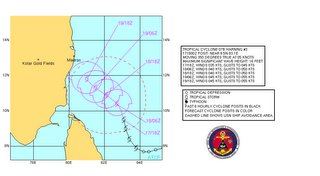
So if you happen to be driving a US Navy warship in these waters (as some of us do during weekends), you might want to take a gander at this ever so often. Note that Baaz and Fanoos having departed for their Meteorological Abodes, the corresponding graphics and warnings are no longer available on the website, but they do track Bay of Bengal cyclones too.
One has noticed recently that the stalwart newspaper has 'lifted' the graphic verbatim (pictoratim?) from the JTWC website and planted it on their front page. One is not sure if all sources were credited or not. Finally, we have the National Hurricane Center. The spelling of 'center' should help you identify the nation in question.
TAILPIECE
They're naming the Bay of Bengal storms using names from countries in this region. We recently had Baaz, and Fanoos. Strangely enough, both these storms hit Tamil Nadu, leaving many a scrawny Dravidian scratching his head in bewilderment, "Ennaaya idhu, indha Baaj, Fanoos? Onnume puriyillai." In certain quarters, voice has been lent to the Unspoken Thought that the names should be more sensitive to culture and geography. Therefore, we hereby declare, that all TN bound storms will submit to the following naming ordeal this year: Arumugam, Balasubramaniam, Chokkalingam, Dayanidhi, Elangovan ... Pachaiyyappan ... Thirunavukkarasu(!!) ...Venktachalapathi ... Yenkatachalapathi ... Zebra. Being the state animal of TN. If you take a close look at some of the better designed intersections in Madras.
OK, enough.
Wotitis?
In meteorology, a tropical cyclone (or tropical depression, tropical storm, typhoon, or hurricane, depending on strength and geographical context) is a type of low pressure system which generally forms in the tropics. While they can be highly destructive, tropical cyclones are an important part of the atmospheric circulation system, which moves heat from the equatorial region toward the higher latitudes.These things used to be phenomenally regular (in the late 80s and through the 90s, anyway). From April/May to September/October, one after the other, they would show up. They were moderately predictable, like salespeople who ring the bell in the middle of your Sunday nap. You knew they would show up once or twice a month, but you were never sure exactly when. The sky would start to turn leaden, battleshippy. You would read in the paper, or listen to the AIR newsreader's dire tones, that there was a "depression in the Bay".
There was no telling where each one would end up. Would it try to diddle the good people of the Godavari-Krishna doab into staying at home, while it went and lavished its tender attentions on the good people the Madras, Nellore and Prakasam country? Would it feint a move towards Puri and Konark, but actually come storming through the N. Circars and extinguish itself in the Agency areas? Or would it bugger off in a generally nor-noreasterly direction and do unspeakable things to the long suffering people of the Ganga-Brahmaputra-Irrawady deltas?
Equally, there was no telling how strong it would be. At the bottom of the scale, you had your depressions that stayed depressions, and lived up to their names. Annoying, gloomy, wet things that draped themselves over all the land and sobbed their guts out in slow motion. Some were made of sterner stuff. Vigorous demonstrations of strength and intent, in the form of rain, wind, whirling leaves and fallen pylons up and down the coast. Not enough to seriously interfere with life, other than plant the voluptuous maybe-no-school-tomorrow thought in impressionable minds, and disappoint. Mama Gaia saying, "I was here".
Once every few years, the elements would bestir themseles into putting up a real show of power, usually with tragic consequences. The Regional Meteorological Centre in Mumbai informs us that in October 1737 one of these whoppers hit the Calcutta deltaic region and took 300,000 lives to the accompaniment of a 12 metre storm surge. 12 metres!! In December 1964, the Rameswaram cyclone wiped out the town of Dhanushkodi, and en passant carried off a passenger train and a biggish bridge. The Bangladesh (then East Pakistan) storm of November 1970 tried to pip the 1737 one in the Lives Lost Stakes and seems to have given a good account of itself (this disaster's aftermath must surely have had something to do with the geo-political events of the next year). In November 1977, much of coastal Andhra Pradesh was hammered by a storm that took 10,000 lives. Even closer to our times (1990, 1999) there have been tastes of disaster. The Orissa Supercyclone of 1999 was the last really humongous event. Since then, things have been ominously quiet.
There are many places on the internet where you can find information on tropical storms and hurricanes. That stalwart newspaper, The Hindu publishes a satellite image every day, which you can use in your betting games. Don't worry, the one in this picture is Cyclone Fanoos (yes, they're naming them nowadays), which weakened in to a depression and crossed the Tamil Nadu coast at Vedaranyam a few hours back. The Indian Meteorological Department is slow, but purportedly has animated satellite and Doppler imagery (a la weather.com).
Hurricanealley has a Bay of Bengal section where you can track the progress of cyclones in the bay. But why settle for chaff when you can go directly to the motherlode? The US Navy's Joint Typhoon Warning Center provides eminently readable information on the path of cyclones around the world.

They also have a plain text message written by Tom Clancy.
MOVEMENT PAST SIX HOURS - 270 DEGREES AT 04 KTS
POSITION ACCURATE TO WITHIN 060 NM
POSITION BASED ON CENTER LOCATED BY SATELLITE
...
110600Z --- 11.0N 77.7E
MAX SUSTAINED WINDS - 020 KT, GUSTS 030 KT
DISSIPATED AS A SIGNIFICANT TROPICAL CYCLONE OVER LAND
...
TC 06B WILL CONTINUE ITS WESTERLY TRACK UNDER THE
SOUTHWESTERN PERIPHERY OF THE LOW TO MID LEVEL STEERING RIDGE
LOCATED OVER THE NORTHERN BAY OF BENGAL.
and so on. They even have a ship avoidance graphic.

So if you happen to be driving a US Navy warship in these waters (as some of us do during weekends), you might want to take a gander at this ever so often. Note that Baaz and Fanoos having departed for their Meteorological Abodes, the corresponding graphics and warnings are no longer available on the website, but they do track Bay of Bengal cyclones too.
One has noticed recently that the stalwart newspaper has 'lifted' the graphic verbatim (pictoratim?) from the JTWC website and planted it on their front page. One is not sure if all sources were credited or not. Finally, we have the National Hurricane Center. The spelling of 'center' should help you identify the nation in question.
TAILPIECE
They're naming the Bay of Bengal storms using names from countries in this region. We recently had Baaz, and Fanoos. Strangely enough, both these storms hit Tamil Nadu, leaving many a scrawny Dravidian scratching his head in bewilderment, "Ennaaya idhu, indha Baaj, Fanoos? Onnume puriyillai." In certain quarters, voice has been lent to the Unspoken Thought that the names should be more sensitive to culture and geography. Therefore, we hereby declare, that all TN bound storms will submit to the following naming ordeal this year: Arumugam, Balasubramaniam, Chokkalingam, Dayanidhi, Elangovan ... Pachaiyyappan ... Thirunavukkarasu(!!) ...Venktachalapathi ... Yenkatachalapathi ... Zebra. Being the state animal of TN. If you take a close look at some of the better designed intersections in Madras.
OK, enough.
Tuesday, August 02, 2005
We Were There
Extended break from blogging, thanks to an interminable week in Bombay. New Bombay, to be precise. Vashi-Mahape-Nerul to be more precise. In the manner of Alistair MacLean narrating H.M.S. Ulysses, we will describe the week:
Monday, a.m.: "Hey, those hills look so pretty in the rain, don't they? The mist, and the little cataracts tumbling off the Sahyadris. Its so pretty. I'm glad for the clouds, otherwise it would've been beastly hot and humid."
Monday, p.m.: "Ah, the smell of wet earth, and green growing things, and that wonderful feeling of moist things squelching as we walk over the verdure. I hope it stays this way for the rest of the week, love the rains in India, can't get enough of it."
Tuesday, a.m.: "Though it stopped last night, it seems to have started up again just now. Looks a bit heavy too. And the sky has that dull, metallic, grey look to it. Wish I'd thought of some way to waterproof the laptop backpack. Hope it doesn't rain too much. It'll probably stop by the time we have to leave the office."
Tuesday, early afternoon: "Hey, look at these Bombay locals machaan, they're ready to run home scared of a little rain. Ha ha ha."
"Its still raining, machaan."
Tuesday, a little later: "Did that guy just say that he was up to his chest in water outside the office gate?"
Tuesday, evening: "Oh well, if these wusses are all heading home, we might as well too. Its still raining, so lets not walk in the rain with the laptops. We'll call the hotel guy and ask him to send a car."
"Hey, the hotel guy says his car is in Chembur, and he'll send it over as soon as it gets to the hotel. That's not too bad, maybe 45 minutes or 1 hour of waiting?"
"Hmm...why again are we walking in the rain, sharing a borrowed umbrella, trying to catch a company bus that is clearly going to burst at the seams before it leaves?"
[Outside the office gates]: "Holy Fuck! Was that Maruti 800 really up to its roof in water??...Mommeeee!"
[In downtown Vashi]: "The hotel is only 1 k.m. away, we can easily wade through the knee-deep sludge and get there. If you go into a manhole, I'll scream, and vice versa."
Tuesday, night: "Shit. This stupid room doesn't have a fan. Only airconditioning. No TV. No phones. No cellphones. No radio. No power. What are we gonna do?"
Tuesday, 11 p.m.: "Its still raining, machaan. Do you think we'll be able to finish tomorrow and go home on Thursday?"
Wednesday, 2 a.m.: "Its still raining, machaan."
Wednesday, 8 a.m.: "Its still raining, machaan."
Wednesday, noon: "Its still raining, machaan. WTF. I think I saw something slimy crawl out of yesterdays clothes lying in the bathroom. Apparently everyone else on yesterday's bus reached home at 5 a.m. Things must be bad. Remind me never to rave about the rain again."
Wednesday, evening: "Ah, finally. Its stopped. Good thing we bought those umbrellas. They'll be really useful, now that the rains have stopped."
Thursday, a.m.: "Atleast we made it to the office. Where is everyone else? Slackers!"
Thursday, evening: "Phew! Done here. Do you think we'll be able to make it to the airport in time for the flight tomorrow? Do you think the airport exists? Do planes exist? What are planes? Hasn't civilization dissolved into a blob and flowed into Mahim Creek over the last two days?"
Friday, 4 a.m.: "Hey, its raining again. Hopefully we'll be able to take off."
Friday, 6 a.m. [Sakinaka] : "Was that really a bicycle in that tree?"
Friday, 8 a.m.: "Huzzah! Out of Bombay. Is it raining in Hyderabad?"
The rains have been horrendous in Bombay.
Monday, a.m.: "Hey, those hills look so pretty in the rain, don't they? The mist, and the little cataracts tumbling off the Sahyadris. Its so pretty. I'm glad for the clouds, otherwise it would've been beastly hot and humid."
Monday, p.m.: "Ah, the smell of wet earth, and green growing things, and that wonderful feeling of moist things squelching as we walk over the verdure. I hope it stays this way for the rest of the week, love the rains in India, can't get enough of it."
Tuesday, a.m.: "Though it stopped last night, it seems to have started up again just now. Looks a bit heavy too. And the sky has that dull, metallic, grey look to it. Wish I'd thought of some way to waterproof the laptop backpack. Hope it doesn't rain too much. It'll probably stop by the time we have to leave the office."
Tuesday, early afternoon: "Hey, look at these Bombay locals machaan, they're ready to run home scared of a little rain. Ha ha ha."
"Its still raining, machaan."
Tuesday, a little later: "Did that guy just say that he was up to his chest in water outside the office gate?"
Tuesday, evening: "Oh well, if these wusses are all heading home, we might as well too. Its still raining, so lets not walk in the rain with the laptops. We'll call the hotel guy and ask him to send a car."
"Hey, the hotel guy says his car is in Chembur, and he'll send it over as soon as it gets to the hotel. That's not too bad, maybe 45 minutes or 1 hour of waiting?"
"Hmm...why again are we walking in the rain, sharing a borrowed umbrella, trying to catch a company bus that is clearly going to burst at the seams before it leaves?"
[Outside the office gates]: "Holy Fuck! Was that Maruti 800 really up to its roof in water??...Mommeeee!"
[In downtown Vashi]: "The hotel is only 1 k.m. away, we can easily wade through the knee-deep sludge and get there. If you go into a manhole, I'll scream, and vice versa."
Tuesday, night: "Shit. This stupid room doesn't have a fan. Only airconditioning. No TV. No phones. No cellphones. No radio. No power. What are we gonna do?"
Tuesday, 11 p.m.: "Its still raining, machaan. Do you think we'll be able to finish tomorrow and go home on Thursday?"
Wednesday, 2 a.m.: "Its still raining, machaan."
Wednesday, 8 a.m.: "Its still raining, machaan."
Wednesday, noon: "Its still raining, machaan. WTF. I think I saw something slimy crawl out of yesterdays clothes lying in the bathroom. Apparently everyone else on yesterday's bus reached home at 5 a.m. Things must be bad. Remind me never to rave about the rain again."
Wednesday, evening: "Ah, finally. Its stopped. Good thing we bought those umbrellas. They'll be really useful, now that the rains have stopped."
Thursday, a.m.: "Atleast we made it to the office. Where is everyone else? Slackers!"
Thursday, evening: "Phew! Done here. Do you think we'll be able to make it to the airport in time for the flight tomorrow? Do you think the airport exists? Do planes exist? What are planes? Hasn't civilization dissolved into a blob and flowed into Mahim Creek over the last two days?"
Friday, 4 a.m.: "Hey, its raining again. Hopefully we'll be able to take off."
Friday, 6 a.m. [Sakinaka] : "Was that really a bicycle in that tree?"
Friday, 8 a.m.: "Huzzah! Out of Bombay. Is it raining in Hyderabad?"
The rains have been horrendous in Bombay.
Wednesday, June 15, 2005
Bhaarat's Varsha
The title of the post is borrowed from a very well written piece by Khushwant Singh, from his book, "India Without Humbug" (which now appears to be out of print). The article revolves around the weather, more specifically the monsoon and its vital role in Indian life. Singh touches upon agriculture, ornithology, poverty alleviation, music, and other ways in which life in India is impacted by this annual whim of the sun and the oceans.
For seven years, one ("perpendicular pronouns Bhaarat chodo", see previous post) looked at the weather at a tactical level. In Amherst and in Boston, this meant paying attention to daily weather reports for about 6 months of the year, and then deciding what to wear, what to do, and where and how to go. Careful attention to details such as predicted daily (non substance induced) highs and lows, wind chill and such. The more prolonged and always-looming-in-the-background wait for the spring thaw, and to some extent even the first snows around Thanksgiving were certainly there, but the waiting didn't seem to matter in a larger sense.
On the other hand, here in the heart of the dustbowl that is the Deccan plateau, the weather has a completely different meaning. Who cares whether the temperature is going to hit 43 degrees centigrade, or 45? Us well heeled types have airconditioning at work, anyway. What really matters, is the rains. When they'll come, whether they'll come, will it rain smaller vertebrata (cats, dogs, ferrets, cows (small)) or are we going to see something quite at the other end of the spectrum (saurians (extinct), cetaceans, Moby Dick)?
Around the middle of May, the real protracted waiting begins. Read Singh's book, he does a really good job of describing the atmosphere. The parched earth, the dusty streets, listless living things, the pathetic whirring of ceiling fans and their futile attempts to stir the soupy air into a breeze of some kind. And the waiting... We scan newspapers in the hope that our untrained eyes will be able to glean something from the satellite images that the much maligned meteorology folk haven't been able to see.
The monsoon, Bhaarat's Varsha is [begin-aside:
The point is, this whole monsoon thingy is pretty critical, and not just from the perspective of selling movies. The bigger point is that this year, so far, the monsoon has been a big no-show. This is worrisome. One has one's weather spies scattered across the peninsula and nearby archipelagos. Our correspondent from Kerala reports that the rains there haven't been like in the old days. The embedded reporter from the Nicobar islands says that its raining there, and is bewildered as to what all the griping from the mainland is all about. Here, in the dustbowl, the wait continues. Almost every day, the satellite picture shows serried ranks of white approaching the south-west coast of India, but it isn't raining yet. Are the worthy Meteorlogical Ones using Adobe Photoshop more than helium balloons nowadays? It should've been pouring a week ago.
We squint at the skies, crinkle our brows and sing, "And we wait, and we wait, for you...with or without you...we can't live..."
For seven years, one ("perpendicular pronouns Bhaarat chodo", see previous post) looked at the weather at a tactical level. In Amherst and in Boston, this meant paying attention to daily weather reports for about 6 months of the year, and then deciding what to wear, what to do, and where and how to go. Careful attention to details such as predicted daily (non substance induced) highs and lows, wind chill and such. The more prolonged and always-looming-in-the-background wait for the spring thaw, and to some extent even the first snows around Thanksgiving were certainly there, but the waiting didn't seem to matter in a larger sense.
On the other hand, here in the heart of the dustbowl that is the Deccan plateau, the weather has a completely different meaning. Who cares whether the temperature is going to hit 43 degrees centigrade, or 45? Us well heeled types have airconditioning at work, anyway. What really matters, is the rains. When they'll come, whether they'll come, will it rain smaller vertebrata (cats, dogs, ferrets, cows (small)) or are we going to see something quite at the other end of the spectrum (saurians (extinct), cetaceans, Moby Dick)?
Around the middle of May, the real protracted waiting begins. Read Singh's book, he does a really good job of describing the atmosphere. The parched earth, the dusty streets, listless living things, the pathetic whirring of ceiling fans and their futile attempts to stir the soupy air into a breeze of some kind. And the waiting... We scan newspapers in the hope that our untrained eyes will be able to glean something from the satellite images that the much maligned meteorology folk haven't been able to see.
The monsoon, Bhaarat's Varsha is [begin-aside:
- dark clouds,
- preliminary dust storms,
- wet earth, the smell of wet earth rising like steam from an idli,
- the hawk cuckoo (in Hindi sings pee kahaan ("Where is my Beloved?"), in Marathi sings paos aalaa ("The rains are coming!"), in English, somewhat morbidly, "Brain fever! Brain fever!"), peacocks strut,
- Raagamala paintings of the rain raagas,
- sari clad Bollywood starlets prancing in the gardens,
- a large and interesting selection of creepy crawlies materializes out of thin air, possessed by the most desperate Samwise Gamgeeish desire to give your dinner company, as it wends its way on a perilous journey down your oesophagus,
- and much much more
The point is, this whole monsoon thingy is pretty critical, and not just from the perspective of selling movies. The bigger point is that this year, so far, the monsoon has been a big no-show. This is worrisome. One has one's weather spies scattered across the peninsula and nearby archipelagos. Our correspondent from Kerala reports that the rains there haven't been like in the old days. The embedded reporter from the Nicobar islands says that its raining there, and is bewildered as to what all the griping from the mainland is all about. Here, in the dustbowl, the wait continues. Almost every day, the satellite picture shows serried ranks of white approaching the south-west coast of India, but it isn't raining yet. Are the worthy Meteorlogical Ones using Adobe Photoshop more than helium balloons nowadays? It should've been pouring a week ago.
We squint at the skies, crinkle our brows and sing, "And we wait, and we wait, for you...with or without you...we can't live..."
Subscribe to:
Posts (Atom)