Friday, March 31, 2006

Ugaadi Madness

0. Happy Ugaadi! Pachadi was had after ages, thanks to kindly neighbour. The Ugaadi pachadi, upon reflection, is a fantastic concept. Somewhat thrilled and glad to belong to a part of the world that could invent this concoction. What better way to begin a new year than to remind yourself that it won't always be rosy, and that the bitter, sour, salty, spicy, astringent and sweet all have their place in the scheme of things. A plausible excuse for eating neem, tamarind, salt, green chillies, mango and jaggery in one go. Peace to the world in Sri Vyaya Naama Ugaadi.

1. Carefully avoid music stores on weekday holidays. Money (too much) was blown yesterday on a weirdly messed up mixture of things.
  • Swathikiranam and Subhasankalpam - We admit it freely. We bought the first VCD to see (again?) what Mammootty looks like in a Telugu movie, and the second because we want to have the damn hailesso song close at hand. Besides, they were really cheap.

  • Ghalib ke kalam se - "Why?", you ask. Not really sure. One reason - to find out what baaziichaa-e-atfaal sounds like when Mohd. Rafi. sings it. Another - to find out what hazaaron khwaaishein aisi sounds like when Lata Mangeshkar sings it. That's about it, really.

  • Entharo Mahanubhavulu, Jon Higgins - Even more curious, why this one? Admittedly Higgins Bhaagavathar is an interesting character and all that. But we really have no clue about 7 out of 9 songs on the CD. But, 9 minus 7 = 2 and there lies the rub. Higgins' endaro mahaanubhaavulu is quite nice (whose isn't?) and we have come to know and love this thillana in Hindolam, so why not? All the krithis on the CD are available at Musicindiaonline.

  • Bluffmaster - That man Keynes and his homosexual intrigues are responsible for this one. The last time he was in Bangalore, he ended up filling our head with febrile visions of Priyanka Chopra's midriff. And then dragged us off to Belur, Halebid and parts west. Leaving us moderately thirsty in the matter of Priyanka Chopra's midriff. What to do? We are like this only.
2. We may have put the caboose before the locomotive, but ended up seeing our first Ingmar Bergman movie last night. It (unfortunately?) turned out to be Bergman's last feature film, Fanny and Alexander. In retrospect, this might be a cardinal mistake. To start off on a director with his last film, without knowing anything whatsoever about the man and his work, seems a bit nonsensical. The commentary track left us with some misgivings about this screwing up of chronology.

Nevertheless, "Fanny and Alexander" is a captivating (albeit rather long) movie, a somewhat autobiographical meditation. Bergman seems to use this film as a chance to tell the world about his formative years (with its fascination for the theatre, the moving image, story telling, fantasy), and also tries to convey what he thinks of life and art, and what is worthwhile and what isn't. A summing up of his own life and philosophy, one imagines. Various theatrical devices are used. Nostalgia, melodrama, horror - all play their part. On the whole, quite satisfying. May need to be borrowed again...

Monday, March 27, 2006

The Love You Take = The Love You Make

Just unbelievably unbelievable. Watch.

Friday, March 17, 2006

Histaree Lecher Undhi

At the choultry, we haven't looked at a proper list in what seems to be aeons. So, without much further ado, a list. On history books. The discerning Gult choultry reader (2 nos.?) will have undoubtedly noticed that we have borrowed from that classic song Botany paatham undi from that classic movie Shiva. Be that as it may, the list beckons...

First, a few words of caution:

(a) We will break our own rules very often, and instead of talking about history books, we will talk about historians themselves
(b) There is some overlap between this post and the book tag post
(c) We tend to be somewhat biased towards military affairs, unfortunately. Forgive us.
(d) We are talking strictly of narrative (mostly non-academic) history books. We do not have the grey matter or attention span necessary for venturing into and partaking of proper textbooks.

And the nominees are:
  • John Keay - You must've seen this coming, no? He is the flavour of the era. We like his stuff (a lot), and have written copiously about him here and here and here. Enough said.

  • The Second Creation (Robert P. Crease, Charles C. Mann) - "Makers of the Revolution in Twentieth-Century Physics". Amma had this lying at home and we read it by and by. We still haven't quite understood a decent chunk of it (on account of it being particle physics and muons and so on), but if you're interested in the history of science, this one is worth the money.

  • Battle Cry Of Freedom (James McPherson) - This single volume history of the American Civil War is quite possibly the best single volume history book on any broad historical subject. An amazing book, learned yet accesible. Don't take it from the choultry, read a review. If you're a history buff, and are even moderately interested in US history, please go and buy this book. Why don't all historians get together and draw chits on which various topics are written, and go off and quietly write a book like this one?

  • Velcheru Narayana Rao, David Shulman - They aren't historians, and between them, they've written mostly books on Dravidian literature and poetry, but more than their analysis of the art, we've come to like their prefaces and afterwords, where they talk about the evolution of their pet subjects. A Poem At The Right Moment: Remembered Verses From Premodern South India and (with Sanjay Subrahmanyam) Textures of Time: Writing History in South India 1600-1800 (this is a more proper historiographical book) are particularly noteworthy.

  • The War Against Hannibal (Titus Livius) - Surely an unexpected entry in the list! Livy wrote some 142 books during his lifetime, of which 35 have survived. Books XXI-XXX (you can read them all, in Latin, here) deal with the Punic wars. The first part has to do with that peerless Carthaginian general Hannibal Barca, and his European excursion, starting in modern-day Spain, into Transalpine and Cisalpine Gaul, and finally into the Italian peninsula proper. The second part has to do with the Roman riposite, in the form of Publius Cornelius Scipio and his expedition to North Africa, culminating in the landmark Battle of Zama.

    Polybius also wrote about the Punic wars, but Livy is particularly enchanting because he identifies so closely with the "good guys", and only has grudging respect for the adversaries. Livy's history is unabashedly partisan, you find him cheering his team on here, defending Roman atrocities there, bad-mouthing Carthage and in general behaving like a Tom Clancy of yore.
Well, that's that. Now we move on to the honourable mentions category:
  • A Short History of World War I (James L. Stokesbury) - A long time back, when our M.S. was dragging on ad infinitum, and we had momentarily tired of civil and uncivil engineering, we signed up for a World War I course and this was the prescribed textbook. Short, yet catholic (inasmuch as WWI is concerned); witty, yet poignant; abominable snowman, yet i. (Heh! Gotcha!!) We have tried to lay our paws on other books by the same author and failed.

  • The Conquest of the Incas (John Hemming) - This was (is?) the "standard" book on the antics of the conquistadores in Peru, and perhaps still is. Good reference value...

  • America: A Narrative History (George Tindall, David E. Shi) - The single volume version of this (even if it is 1000+ pages) could quite possibly compete with "Battle Cry of Freedom" for the top spot in the single volume stakes. Lucidly written, covers a lot of ground, with excellent and timely digressions into the American zeitgeist of whichever period they happen to be dealing with.

  • Alberuni's India (Al-Biruni) - Haven't read the whole thing (it is a bit boring and nitpicky), but Al-Biruni's foreword or preface to the book is memorable. This guy must have been quite something. Nearly a millenium back, he expresses his concern at how biased the book he is about to write might turn out to be, on account of his being an outsider to his subject (India). Several remarks on the pitfalls of writing history, on the notion of the disinterested observer, and on the notion of cultural prisms refracting history (not in so many words, but close 'nuff :)

  • Lords of the Horizons: A History of the Ottoman Empire (Jason Goodwin) - A most charming tome written in a fairly unique style; part whimsical brooding - part historical narrative. A fortunate and serendipitous "MacIntyre and Moore" discovery.

  • Assorted - Some random interesting ones: Stillwell and the American Experience in China (Barbara W. Tuchman) is a good read about the China-Burma-India theater of WWII; Raj: The Making and Unmaking of British India (Lawrence James) was interesting, but might also controversial; The Proudest Day: India's Long Road To Independence (Anthony Read, David Fisher) is also interesting and controversial.
As usual, we are open to interesting suggestions vis a vis narrative history books.

Tuesday, March 14, 2006

Yal

We can be succinctly described with the sound "Duh!", as far as our knowledge of things musical go. We are known widely to be tone-deaf, and manifestly devoid of iotae of that slippery quality, "good taste". We first heard The Beatles in 1996, and our all-time favourite album (rock and roll) continues to be Abbey Road. For this, many a time, we have been the stork (laughing). Hitherto, we have largely relied on more qualified and fortunate people to provide us with the gyaan necessary to have a non-paleolithic musical conversation ("Nahin yaar, 'Chura ke dil mera, goriya chali' mein Ayesha Jhulka nahin hai bey, tuu 'Gutar gutar' ki soch rahaa hai.").

It was such a one who once wandered over into the Virgin Megstore on Newbury Street, in the company of roomies, who were both vastly more qualified and talented. As we stood about and gazed vacuously at the stud in Christina's belly-button, in the distance, we descried said roomies standing at one of those music-listening-station thingumajigs, apparently having a good time. We trundled over, accepted headphones, and plonked them on melon. What was playing was incomprehensible, but utterly captivating and foot-tapping. We bought the CD, and recently dug it up from amongst the debris at home.

First, there was Raï. A form of folk music that originated in Oran from Bedouin shepherds, Raï (which means "opinion" in Arabic) mixed with Spanish, French, Arabic and other forms of music to give rise to its modern version. Among the more famous practitioners are Cheb Mami and Khaled (who obsessed about his elder sister and even wrote a very popular song about her).

Be that as it may, even as Rai was making waves around the world, unbeknownst to many, the improbably named Takfarinas was
...forging his own sound, a sort of musical esperantos deriving from the Kabyle songs of the last century. He named it "Yal music" after the rhythmic vocalized syllable "yal...laaa yal...lalala," which is inseparable from Kabyle song...
So Takfarinas' YAL was the CD that we bought many aeons ago, on a whim, and lived to not regret it. You can listen to samples on the Barnes & Noble website, and his most famous and excellent song Zaama Zaama (oddly enough very Rai-ish) is the one that had us foot-tapping on Newbury. The original Takfarinas was apparently some kind of Berber cheftain, who dished out an uncommon defeat to the Romans around 25 B.C. There is a review of the album at popmatters.com, and the CD should be easily available in the West.

"Yal" has a most unique sound, and it will surely appeal to desis, on account of its fusion of a relatively melody-centric North African art form, with what can concisely be described as dhingchak dhingchak.

With that, Secoues-toi comme si comme ça, zaama zaama C´est bon ! tu aimes ça, zaama zaama...

Wednesday, March 01, 2006

One Nation State's Freedom...

What really prompted this post ultimately, is the fact that a few months back, we extended a slimy tentacle and bought ourselves a Worldspace receiver and subscription. Unf. at the time, we had grandiose plans of buying a decent set of speakers, CD/DVD player and so on. So instead of buying a boombox type receiver, we bought the Diva. Its nice and compact, but one needs headphones. Which means that suddenly one has a (very small) radius of operation when one is listening to the radio.

Anyway, night after night, we lie prone on the bed next to this thing, and listen to some radio before dropping off into blissful, snory, slumber. A number of interesting channels are available, but old habits die hard and more often than not, we're listening to NPR. It isn't quite WBUR, but we've managed to catch some Fresh Air, All Things Considered, Day to Day, and even the Motely Fool fellas. No, have never heard Car Talk yet, maybe they don't broadcast it on the international edition of NPR or whatever, this remains crib #1 with NPR on Worldspace.

Be that as it may, a couple of days back, Day to Day carried a small segment on the ongoing DP World controversy. This set off a train of thought. "Whaaa...?", some of you say.

EXHIBIT A

DP World is a Dubai government owned undertaking that is in the business of port operations and stevedoring in a number of ports across the world. So far, they seem to have a more or less unblemished record of operating port and container facilities in places such as Adelaide, Shanghai, Hong Kong, Jeddah, Djibouti, Vizag, Cochin, and ports in Germany, Venezuela and the Dominican Republic. All this has been going on quietly for several years.

DP World is in the process of acquiring the British based port operator P&O for the neat sum of $6.85 billion. P&O of course, stands for the Peninsular and Oriental Steam Navigation Company, and appear to have been around since the Norman Conquest. If you were a young Brit officer, recently inducted into the Indian Civil Services or the Indian Army, chances were that you'd take a P&O liner from Southampton to Rangoon or wherever. Sofa, so good (said the furniture salesman).

The controversy stems from the fact that P&O has operations in several (6?) US ports. Critics of the deal say that if the DP World bid is successful, effectively an Arab government will be in control of American ports, and this could lead to security issues. There is an FAQ type thing on this. At the moment, there is a terrible ruckus about this in the US Congress. The people's representatives have all thrown up their hands in horror, while Bushy is saying he will torpedo any bid to torpedo the deal. Some interesting questions emerge.
  1. DP World has been running ports in a dozen other countries, so why the foofah now?
  2. Many months ago DP World bought the international terminal chunk CSX, a biggish transportation and logistics company with significant presence in the eastern US. This went through with nary a whimper.
  3. Finally, port security in the US has not been anything to write home about. The sheer volume of the problem is unbelievable. Only a fraction of the containers entering the US get examined by Customs or other security agencies, and you wouldn't need to spend $6.85 billion if your intention was to be naughty.
What to make of it?

EXHIBIT B

Perhaps this one is from more familiar territory - the Mittal-Arcelor takeover bid. In late January 2006, the world's largest steelmaker Mittal Steel announced their intention to buy Arcelor shares and take over that company. This resulted in the most almighty ballyhoo.

Arcelor's board rejected the bid, stating that the two companies' "business and cultural values" were incompatible. Takeovers usually involve job cuts, and are therefore inherently political, so Lakshmi Mittal (who heads Mittal Steel) had to meet French and Luxembourg politicians and offer assurances on the job front. Things began to get ugly-ish with impressive speed.

Arcelor started to spin the takeover as a "raider with foreign values".
Valery Giscard d'Estaing, the former French president, warned against giving into economic "laws of the jungle." A former French finance minister referred to Mr. Mittal as "an Indian predator," although his company is traded and based in Europe and he hasn't lived in India for 30 years. Mr. Dollé, the Arcelor boss, said Rotterdam-based Mittal Steel is a "company full of Indians" that wants to buy his with "monnaie de singe." The expression means "monopoly money"--Mittal's offer is mostly shares--but the literal translation is "monkey money." That double-entendre wasn't lost on people.

Sigh.

EXHIBIT C

Not so much in the realm of business and corporations, but tangentially related... David Irving has gained notoriety in recent years as a Holocaust denier. At one time, Irving was fairly well-known for the thoroughness and academic rigour that he brought to his work. In early 2000 (perhaps even earlier), he became a fairly controversial historian for denying the Holocaust. More specifically, for denying the existence of gas chambers at Auschwitz. This happened in the course of a libel trial, in which Irving sued Prof. Deborah Lipstadt and Penguin Books for claiming that he was a Holocaust denier and anti-Semite.

Irving lost the case, was defiant in defeat, received support from Iranian newspaper, was ordered to pay 150,000 GBP towards defence costs, and was soon bankrupt.

Things were quiet for about three years. In November 2005, while on a visit to Austria, Irving was arrested by ze Polizei. Now Austria, along with a number of European countries (including Germany), have laws which make Holocaust denial a criminal offence. He was charged, refused bail, amazingly admitted his mistake, and was jailed for 3 years.

All of this happened, fortuitously enough, at the same time that the EXHIBIT D tamasha was in full cry.

EXHIBIT D

The Danish cartoon tamasha. Enough said.

Consider A, B, C, and D above. Hypocrisy? Pragmatism? Sympathy? Racism? Who's to judge, and how?

Effin huge post. We are pooped. So, PJ.

"Who wrote 'The Spy Who Came In With The Cold'?"

"Iam Phlegming"

Urk. We actually invented this one, and are very proud.

Monday, February 27, 2006

Ich bin Tagged

Oooooooooo!!! We've been tagged, we've been tagged, we've been tagged!!! [Skips up and down] This is very flattering, we are positively shouting from the rooftops, I say. We have also been accused of making lists, we haven't made lists in ages! Time has lists, but do you see anyone tagging Time? No, sirree.

Be that as it may (and it is), this tag is an 'n' interesting. If you're wondering what 'n' means, we'll have to do '3-dimensional surrender', 'general Olympics' and deesh.

Total number of books owned

We make a distinction between 'owned', and 'bought'. Rough estimates on the latter are 300-350 in Hyderabad, maybe 2 dozen in Vizag, and about a dozen that have been 'borrowed'. If, however, we speak of 'owned', there is a whole wall of crumbly books that is sitting in Vizag that we will inherit. That is, shortly after we have gagged and bound the sibling and dropped her into one of her precious croc pits, and laced amma's tea with some suitably humane toxin.

Last book(s) we bought

This was on Saturday. At Walden, we bought John Keay's When Men and Mountains Meet : The Explorers of the Western Himalayas 1820-1875 and Confronting Love, edited by Jerry Pinto and Arundhati Subramaniam. We then proceeded to waddle over to Odyssey (mainly for the cafe), and mysteriously ended up buying India Discovered by a certain John Keay (Yes, we've decided to own all John Keays. Our recommendation to donors is that when that "Got to give Ludwig a book!!!" impulse seizes you, check with us, and give us a Keay we do not own yet. We will grovel at your Lotus feet in abject humility and gratitude.)

Last books(s) we read

The broken record continues. We read Sowing The Wind. We also re-read a bunch of books we'd already read, but what's the fun in that?

Books we are currently reading

Apart from dipping into the ones we bought this weekend, we are engaged in concurrently reading Pillars of Hercules by Paul Theroux and another book. We really like Theroux because he is observatory (yes, his pet name is Jantar Mantar) and sarcastic, and sympathetic when necessary. If we could, we would make a living out of doing what Theroux did. We also like Theroux because he grew up in Meffid, and he keeps referring to Meffid, and Summahville and Cambridge, and Baws'hn in his writings. We may have done some long runs near his house when we were circumambulating the Mystic Lakes in the summer of '03.

We are also re-dipping into The Riemann Hypothesis. One of these days, we'll understand the whole damn thing, prove (or disprove) it, pocket a cool million, and retire.

Five books that we have really enjoyed or influenced me

Five? Five??? This seems to be the response that all self respecting reader types seem to be giving to this koschan. Nevertheless, we will shamelessly plagiarize an idea floated by the jester and and idea floated by the individual under the influence of infusions made from an Amazonian giant vine, and implement here.

Fiction

Somerset Maugham - Of Human Bondage
Harper Lee - To Kill A Mockingbird
J.R.R.Tolkien - The Lord of the Rings, Silmarillon (when you're a certain age and are at certain institutes, this can't be helped, sorry)
Lawrence Durrell - The Alexandria Quartet
R.K.Narayan - Swami and Friends

Also Jack Kerouac - On The Road, Fyodor Dostoyevsky - Crime and Punishment, Michael Ondaatje - The English Patient, Kazuo Ishiguro - Remains of the Day, Haruki Murakami - Wild Sheep Chase, Kiran Nagarkar - Seven Sixes are Forty Three and so on. This is really pointless.

History

John Keay - The Honourable Company (well, this was the first, but needed to be read)
James McPherson - Battle Cry of Freedom
Jared Diamond - Guns, Germs and Steel
V. Narayana Rao, David Shulman, Sanjay Subrahmanyam - Textures of Time: Writing History in South India
Crease & Mann - The Second Creation

Poetry

Stephen Dobyns - Pallbearers Envy The One Who Rides
Coleman Barks's Rumi book
Various - Making Love To Marilyn Monroe
V. Narayana Rao, David Shulman - A Poem at the Right Moment: Remembered Verses from Pre-modern South India. This is a must have. [Nudges violently :)]
Constantine Cavafy - The Complete Poems of Constantine Cavafy

This is getting tiresome, we stop here. There are several other 'influential' books (Alistair Maclean who set off the whole Navy obsession, Commando comics which set off the whole Rommel obsession, Rani Mukherjee who set off the whole Jibanananda Das obsession, Ruskin Bond who set off the Himalaya obsession, Kenneth Anderson who set off the whole South Indian wildlife obsession and so on).

Books we plan to buy next

Bit of a mystery. Only definite ones in mind are the Keay books, and Kolatkar's Kala Ghoda poems. This one we've been looking for high and low and not been able to find in Hyderabad.

Books that caught our attention but we have never read

Oh God, so many.

James Joyce - Pretty much everything, but Ulysses mostly
F. Scott Fitzgerald - The Great Gatsby
Gabriel Garcia Marquez - Again, everything
Milan Kundera - Ditto
J.M.Coetzee - Ditto

And so on.

Books we own but have never got around to reading

Leo Tolstoy - War and Peace (Hello, Veena)
Douglas Hofstadter - Godel, Escher, Bach (started, but haven't finished, yet)
John Steinbeck - The Grapes of Wrath
Voltaire - Candide
Lawrence Durrell - The Avignon Quintet

People we are passing this on to

The loblolly, who never ceases to remind us how well-read she is; Srin, who with the addition of movie star hair has become a bona fide celebrity (even if she questions the existence of sepia); Deski, who has cooked a number of bun-omlettes and is waiting for public to consume; young Thos., maybe this will get him to post something finally; and Anand, because he will definitely have something interesting to say.

Friday, February 17, 2006

PFR 2006

It is comforting to know that one can wake up in the morning, ablute, accept a cup of steaming Chikmangalur coffee from amma, grab the newspaper, and saunter terraceward; and find the Indian Navy thoughtfully arranged in the roadstead (as it were), for one's kind perusal.


To smell the rising vapour of the coffee; to feel the crisp crinkliness of newsprint as one peels open the sports page (usually to find that Onnu Onnu Onnu has won again, praise the Lord 1); and to gaze upon the clean, unfussy lines of the Mumbai, as she waits silently on the navy's flagship whose grey bulk lowers a couple of boat lengths from her bows. Is this too much to ask of life?

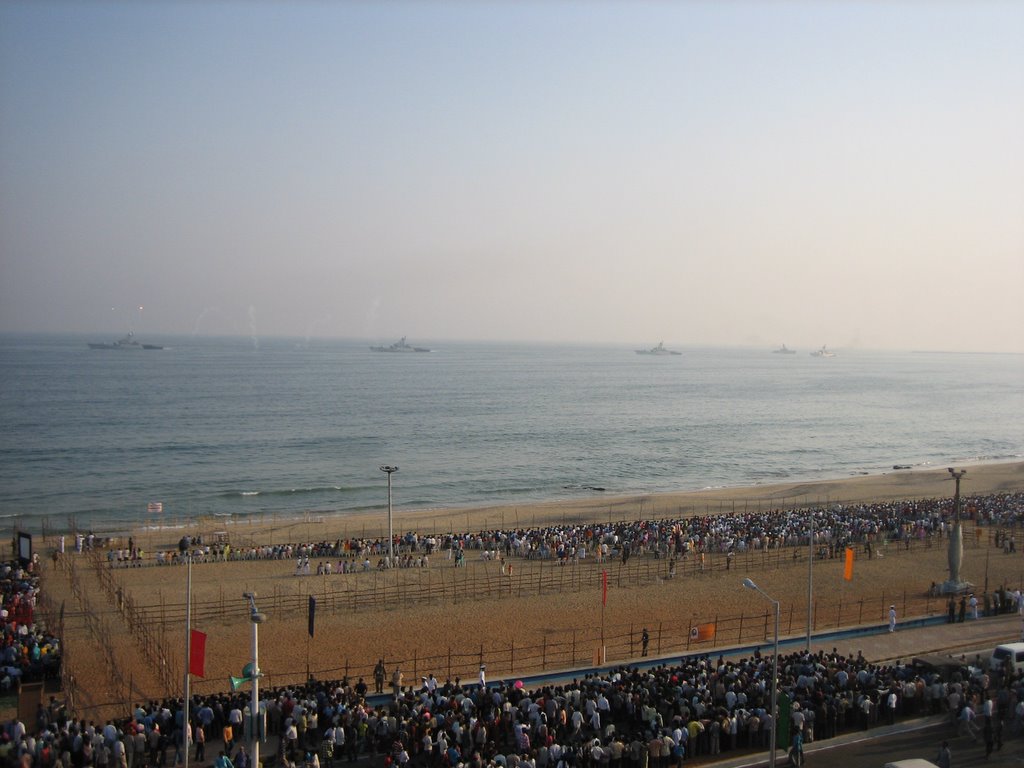
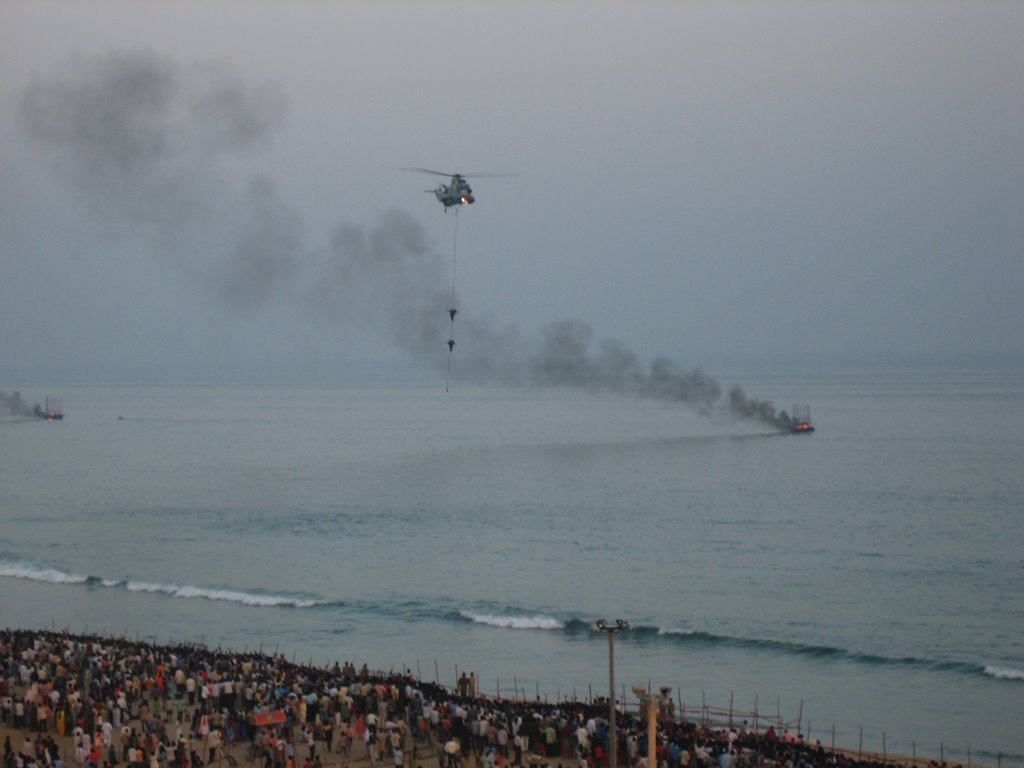
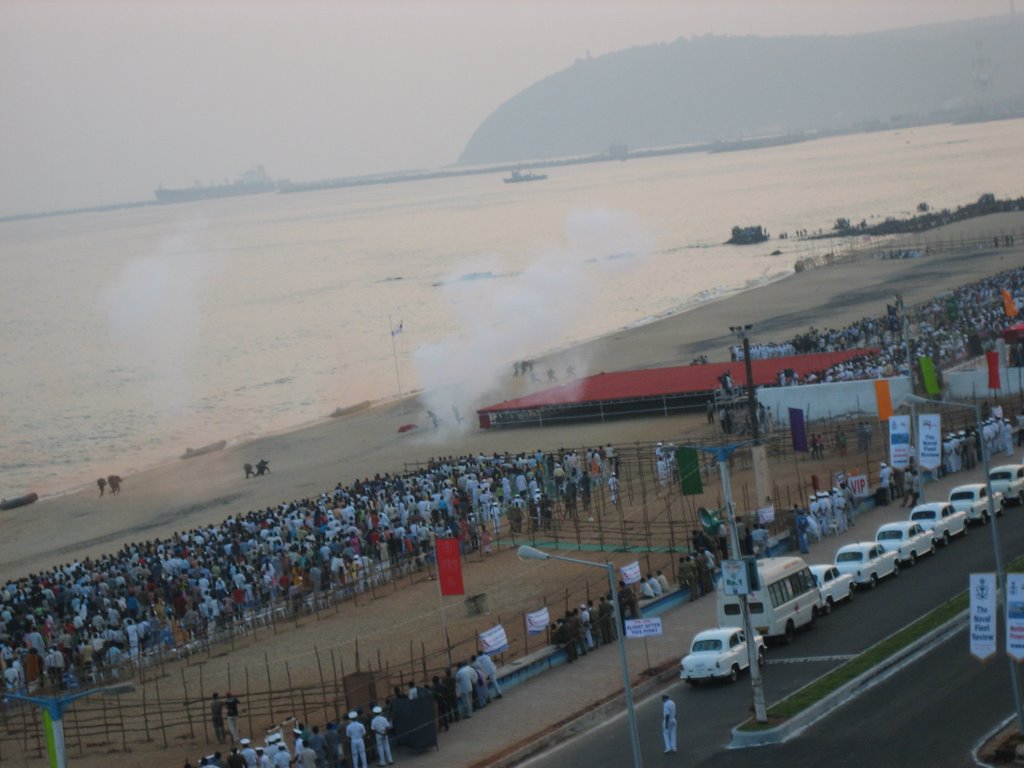
The 9th Presidential Fleet Review happened last weekend at Vizag - home and headquarters of the Eastern Naval Command. Friday and Saturday were tiresome for the good people who live off Ramakrishna (RK) Beach. A quantity of "dignitaries" was due to land on top of this little city on Sunday. This sent the "authorities" into a tizzy of organization and reorganization, especially the police. One could almost feel the frissons of anticipatory excitement as SI Appa Rao stopped our car as we were about to turn into the street where home lies, "Traffic not allowed, please cooperate sir. Order from superior officer." We were barred from entering our own homes!! Sacre bleu! But then, it will be a long time before anything like this ever happens, so we said, c'est la vie and plodded on.

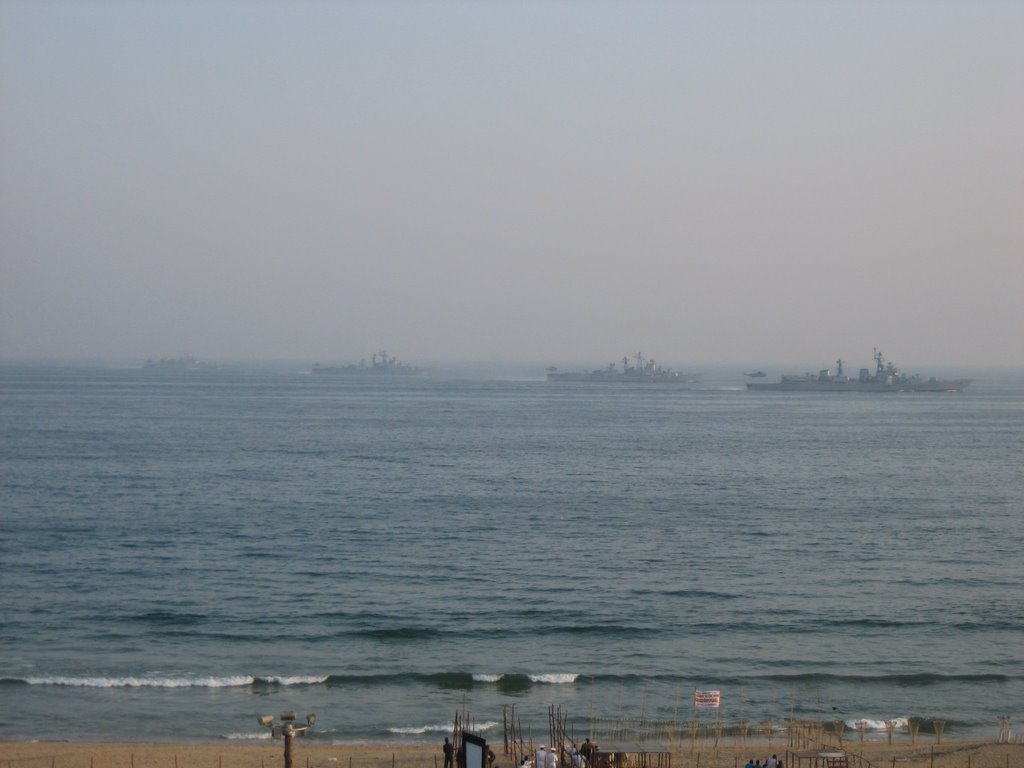
Some of us carefully studied the anchorage plan, so that later on we could rattle off the classes (if not the names) of the vessels parked outside our windows. Of course, it would take a particularly clueless landlubber who would need the anchorage plan to tell the Centaur, Kashin, Krivak and Leander classes apart. Apparently, such people exist. Tsk tsk.

Sunday morning was bright, warm, and hazy. One could only vaguely discern the shapes of the argosy in the distance. Nevertheless, the Prez boarded his "yacht" (we wants one!!) and went up and down the lines of ships, as the sailors manned the decks and cried

Rashtrapati Ki Jai! (3)

As the Presidential column steamed past the outermost line of ships on the seaward side, a number of other ships, submarines and aircraft propagated past at high speed.

Lunch was taken at 2:00. By now, to our astonishment, all the ships had vanished. Gone without a trace.

In the evening, many peepals converged on RK Beach. This was an enthralling sight. (Normally the peepals in Vizag stay rooted to the ground and twirl their leaves in the sunlight.) Be that as it may, the lucky ones with navy issue passes (us, my precious, us!!) found ourselves sitting on the strand, more or less right next to the Presidential stage thingumabob. The sun beat down on the throng. Busybodies were going about, asking people to sit down and stay calm. A vendor was selling cucumbers, "Fresh cucumbers, cool cucumbers." OK, that really didn't happen, but we could've used a cuc. or two.

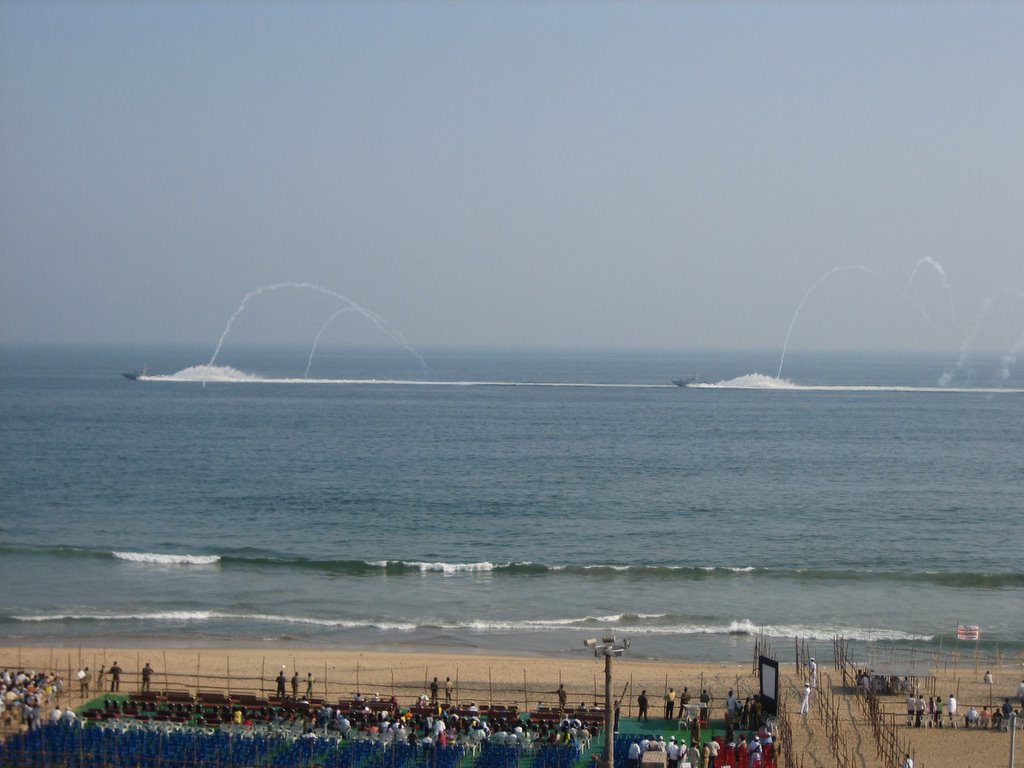
Proceedings began with the flying past of two power gliders that made a few low passes over the assemblage; the silhouettes of the pilots waving to us. Public was enraptured, and everyone craned their heads skywards and babbled, like so many pigeon chicks waiting for mama (We hate pigeons!!!!!! But this will take a whole post to explain...) Even as the gliders receded in the distance, the placid waters of the Bay of Bengal were churned into a frenzy, as a brace of Super Dvora Mk. II class fast patrol vessels strutted their stuff for drooling Vizagites. Up and down they went, zipzapzoom, tight turns, firing of flares. Very pretty.


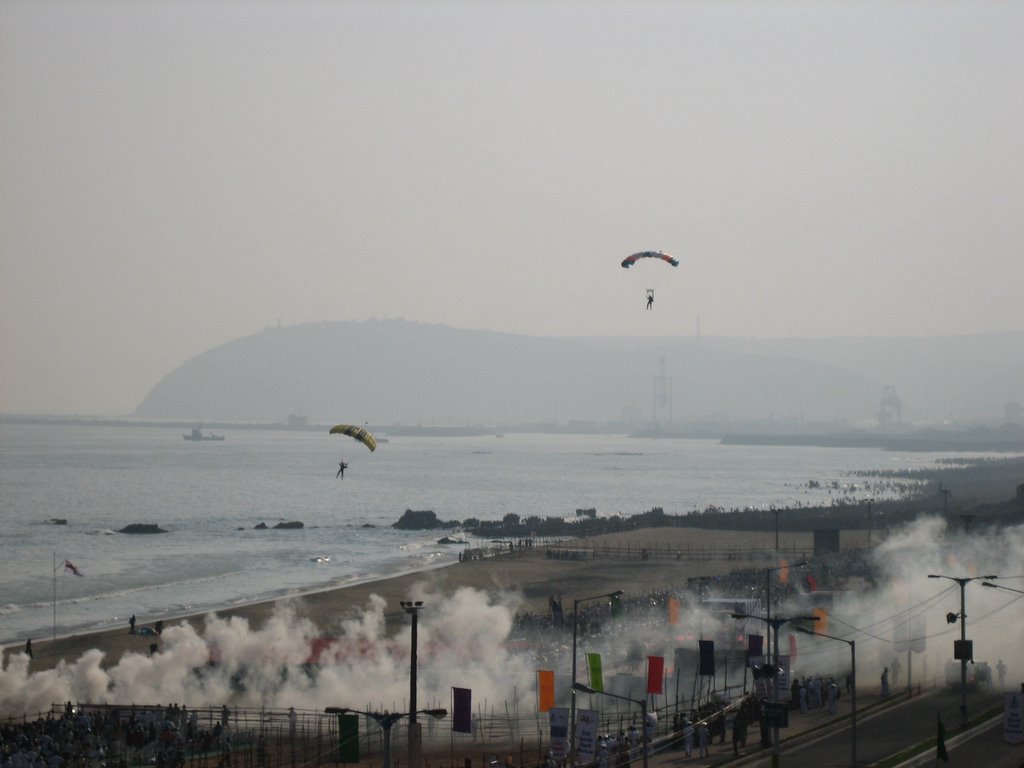
While this went on, unbeknownst to us, a bunch of paratroopy chappies had jumped off a Sea King at 8000 feet and started plumetting earthward. As their chutes opened, a collective gasp went up from the pigeon chicks. The fallschirmjaeger swooped down over public and landed right in front of the Prez's podium. They were guided by some smoke bomb type thingys.


The Prez arrived, the Postmaster General presented him with a commemorative stamp, a pair of Chetaks flew past the podium carrying the Indian flag and naval ensign, Lt. Commander Rashmi Singh also dropped in (literally, mit parachute attached, merupu teega laaga in the words of the Telugu announcer) and presented Prez with a commemorative Eastern Naval Command coffee table book, and so on. Once all this hullaballoo had died down, we were free to turn our attention oceanwards, as more interesting things began to happen. Four Type 25 A Kora class guided missile corvettes steamed past in formation.


Everyone was engrossed in this corvettian display. All eyes were turned towards 2 o'clock. No one saw something emerge rapidly out of left field.


Glory be, she came back!!!! She was sailing right in front of our unbelieving eyes. She was gorgeous. She turned into the wind smartly, and launched 3 Harriers in short order. She landed one more, and slipped away towards the horizon.


Not to be outdone by this ostentatious display of naval aviation, 1 nos. Delhi class, 1 nos. Krivak class, 1 nos. Kashin class and 1 nos. Leander class ships came out of the blue, and even as they passed (in staggered formation), 1 nos. Sea King and 3 nos. Kamov helicopters came flying in and hovered over the helipad on the poop deck.


The boys from "Sagar Pavan", the naval aerial acrobatics fellows, showed up from behind us, and did a number of ridiculously dangerous and dangerously ridiculous things (because it was Valentine's day, 3 of them flew about "painting" a heart in the sky, complete with interesecting arrow) with their planes.


We were all wondering what the two oil rig like structures off the beach were. We found out soon enough. A bunch of marine commandos (MARCOs) shot off from the beach in a dinghy type thing, acted busy at the feet of the oil rigs, and a few moments later, they were blown away to kingdom come. A thoughtful Sea King picked them up mid-sea and flitted around with the MARCOs hanging off the rope.


A Kilo class boat that had been coyly lurking in the background chose this moment to launch its own detachment of MARCOs.


These buggers advanced on the Prez, to the accompaniment of much rat-a-tat-boom, staging some sort of an Operation Overlord redux.


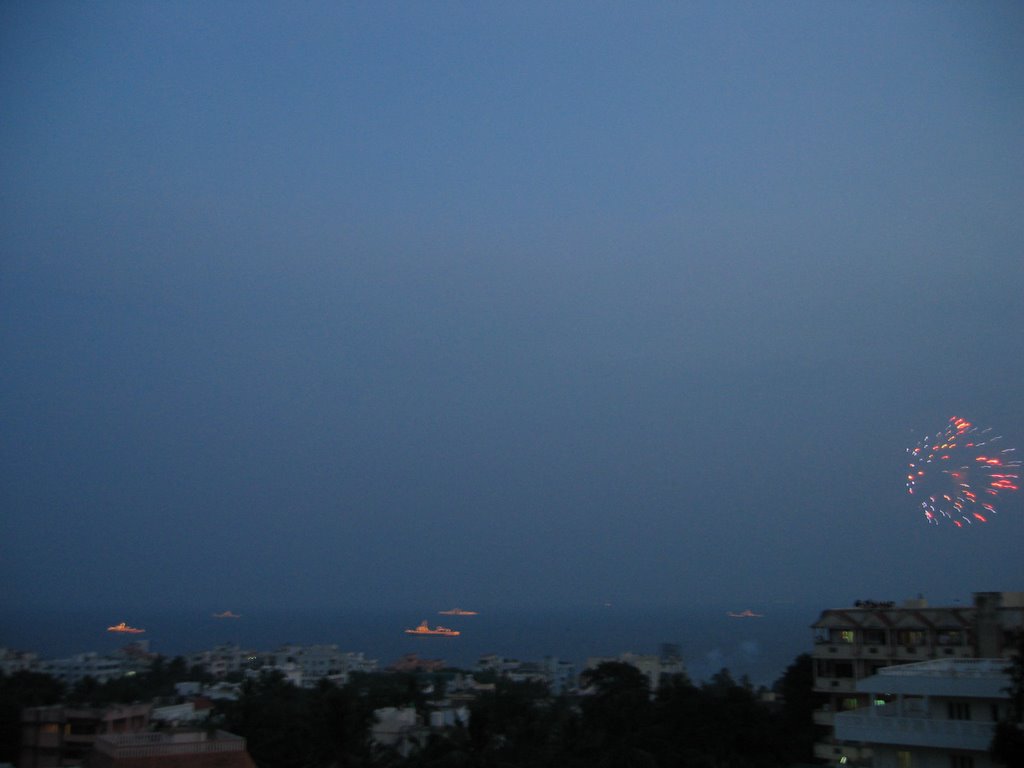
Beating of retreat occurred (they played Bolero), and everyone started trooping home, muchly satiated. Later, when it was dark, there was a splendid firing of guided missile, rockets, tracers and ack-ack.

And then the lighting of the lamps.


1. A most remarkable equine. Shows up in the news practically every day. Its always Onnu Onnu Onnu this, O. (3) that, nowadays. This may warrant a separate post.

2. More pictures here.

Thursday, February 09, 2006

शं नो वरुणः

It is upon us. We are seeking it, all our thought is bent on it. She will be there, they will wait on her, and these ones will be lurking. There will fireworks, and lighting and all.

And its all happening at home. We can sees it from the terrace. And we're going to.


mmm...

Thanks to these good fellas for transliteration facilities.

Friday, February 03, 2006

Ludwig Who?

A question that has oft been asked is, "Why Ludwig?". And, "Ludwig who?". And, "Who's Ludwig?". And "Whose Ludwig?". Clarifications are in order. In the Beginning, we assumed that the choultry would give rise to more questions than the Ludwig, but strangely enough, everyone seems to be very okay with the choultry.

Verily, the Poetess has said, "How many of you are there? Let me count the Ludwigs."
  • William F. L. (Sr.) - Born in 1879 in Germany, migrated to the US, set up a drum company which went on to be reasonably successful. No particular reason to take particular note for this Ludwig, if it were not for the salient fact that the best band ever happened to use this Ludwig's drums. Rock on, Ludwig.

  • L. Mies van der Rohe - German born, leading architect of the modernist flavour. Do not know too much about this gentleman, but he seems to be a nice sort of Ludwig to be.

  • UPDATE (16 Feb 2006) L. Friedrich Wilhelm - In a horrendous error of omission, we left out this other architecturally significant Ludwig from the list and have been suitably castigated. He built crazy castles, ornately decorated, was a great fan of Dick, and died mysteriously.

  • L. von Mises - Economist and social philosopher. Libertarian. This, unfortunately doesn't endear him very much to us. Not that there's much wrong with being a libertarian. While we're not very clear as to exactly what kind of a creature libertarianism is, we have read enough to suggest that we wouldn't agree with most of what most libertarians espouse. But then we have libertarian friends and family, so we get by with a little help from our friends.

  • L. Andreas Feuerbach - German philosopher. Apparently inventor of the phrase, "You are what you eat." This would make us a chicken biryani.

  • L. Eduard Boltzmann - Now we're dragging ourselves out of the realm of the Merely Great Ludwigs to the sphere of the Sublimely Immortal ones. Many will disagree with our characterization of Herr Boltzmann as a Sublimely I. Lud. But for heaven's sake, the man invented statistical mechanics. For someone who has not invented much beyond a new and interestingly gruesome way to pick one's nose, inventing a whole branch of science appears to be the Holy Grail. Bolty also has a constant named after him. If they name a constant after us, it will be defined as
    Ludwig's R is the constant governing the relationship between the number of biryanis consumed over a lifetime to the girth of the individual. In limiting cases, the girth may increase to such a magnitude that traditional bipedal locomotion becomes a physical impossibility. Once the limiting value is reached, the individual propagates non-rectilinearly by using one's girth as a tyre to roll in the desired direction. Discovered by Ludwig von Pizzathehutt while seated at a table in Paradise...
    We bow with deep respect to L. Eduard Boltzmann.

  • Beethoven - God. We wish we were like him. Deaf, insane, bitter.
But but but, Ladeej and Gentlebhainses, we present the winner of the Ludwig sweepstakes. There is simply too much information about Him on the internet, but suffice it to say that anyone who can come up with "Wovon man nicht sprechen kann, darüber muß man schweigen." has got to be in a class of his own. We will depart, with some quotes and stories about The Ludwig.
  1. Russell, on meeting Ludwig for the first time - "An unknown German appeared ... obstinate and perverse, but I think not stupid"

  2. Russell, one year later - "I shall certainly encourage him. Perhaps he will do great things ... I love him and feel he will solve the problems I am too old to solve"

  3. Ludwig's doctoral dissertation examination - It (his Ph.D. thesis) was examined by Russell and Moore; at the end of the thesis defence, Ludwig clapped the two examiners on the shoulder and said, "Don't worry, I know you'll never understand it." Moore commented in the examiner's report to the effect that: "In my opinion this is a work of genius; it is, in any case, up to the standards of a degree from Cambridge."

  4. Keynes, in a letter to his wife Lydia Lopokova - "Well, God has arrived. I met him on the 5.15 train."

  5. UPDATE(9 Feb 2006): Ludwig devoted his philosophical energies largely to identifying and combating what he regarded as insidiously disruptive forms of 'nonsense'. An anecdote from Fania Pascal
    I had my tonsils out and was in the Evelyn Nursing Home feeling sorry for myself. Wittgenstein called. "How are you?", he asked. I croaked: "I feel just like a dog that has been run over." Witggenstein sounded disgusted: "You don't know what a dog that has been run over feels like."
So, in short - we were looking for a nice tag line for the blog; "Whereof one cannot speak, thereof one must pass over in silence." seemed like a great one; and therefore Ludwig was adopted.

Finis.

Tuesday, January 31, 2006

Mast Nazaron Se Allah Bachaaye

Long time, no post.

Long post, no time.

So copy-paste will have to suffice for this one. Of late, we have been listening to the Mast Nazaron Se Allah Bachaaye qawwali (by Nusrat) and we find it quite delicious.

Mast Nazaron Se Allah Bachaaye

mast nazron se Allah bachaye
maah-jamalon se Allah bachaye
har bala sar peh aa jaye lekin
husn-walon se Allah bachaye

in ki maasomiat per na jaana
in ke dhoke mein hargiz na aana
loot lete hain ye muskara kar
in ki chaalon se Allah bachaye

bholi surat hai baatein hain bholi
moonh mein kuch hai magar dil mein kuch hai
lakh chehra sahi chand jaisa
dil ke kaalon se Allah bachaye

dil mein hai khwahish-e-hoor-o-jannat
aur zaahir mein shauq-e-ibadat
bas hamein shaikh ji aap jaise
Allah walon se Allah bachaye

in ki fitrat mein be-wafaii
jaanti hai ye saari Khudaii
acche acchon ko dete hain dhokha
bhole bhalon se Allah bachaye

Although one can't easily tell by just listening to the song, this is one of those 'competition' qawwali type things (think Teri mahafil mein kismat aazmaakar hum bhi dekhenge). The first 3 shers appear to the words of some prude shaikhji type person, a puritan. The remaining 2 shers are riposites from the husn waale, cautioning that the Allah waale are more dangerous than most, they doth protest too loudly. This might be quite delightful, if done on stage, with costumes and all. Lyrics and translation are available.

Another qawwali that has recently shown up on the radar screen, is by Amir Khusrau. This one is actually very old, circa 13th century. We first heard this in the soundtrack of the film Ghulam (an old one, not the kya bolti tu one) Ghulami. Gulzar modified the lyrics so that khaas-o-aam could understand the song, but much was lost in this modification. The music is also rather kitschy 80s Hindi fillumi.

A much better version is the original combination of Farsi and Hindi (the lyrics are on the same page), as sung by the Warsi brothers. The song shifts delightfully from Farsi to Hindi and back. In this day and age, both the languages (even the Hindi as used in the song) are somewhat inaccessible, but somehow the song speaks to us across the centuries.

Zihaal-e-miskeen mukon taghaful (Persian)
doraaye nainaan banaye batyaan (Brij)

Ke taab-e-hijraah nadarum-e-jaan (Persian)
Na laihyo kaahe lagaye chatyaan (Brij)


Isn't it amazing that something written 700 years ago is still sung and understood today and brings so much pleasure? Will anything of this age endure?

Finally, lest our readers think we've gone all serious and dotty, what did god tell Noah as she sent the Deluge?

"Long time, no sea."

Monday, January 16, 2006

Pongal O' Pongal

Exhausted. Spent weekend running in circles around the harvest, chanting "pongalo pongal". Phew.

Not.

A hurriedly hatched trip to Belur, Halebid, and Malnad resulted this weekend. The surreal temples at Belur and Halebid were built during the reign of the Hoysala dynasty, in the early centuries of the second millenium A.D. During this time, they developed a style of art and architecture that was radically different. Some of the sculptures are stupendously intricate. That stone can be hewed and shaped into such 'relaxed complexity' is hard to believe.

The Narasimha (Halebid), for example, is lovingly embellished with such details as the intestines of poor Hiranyakashipu emerging from the slash in his belly, distinct punctures where N.'s talons hold H.'s legs and so on. These guys would've found some cool jobs in Hollywood. Not all of it is blood and gore, and it is evident that non-trivial amounts of thought and imagination seem to have gone into every figurine. After the temples, we drove out through Chickmangalur (via Joldal - again a Kenneth Anderson connection!) to the hills of Malnad. The evening, night and much of the next day were spent at Wood-Way Home Stay.


The bungalow itself was built by a European coffee planter on a hill slope. A large, cool, womb-ish, house. The vestiges of the coffee bean processing days are about the place - places for drying the beans, removing the pulp and so on. Also lawns, trees, swinging chairs etc. A ramble through the estate, learning the fascinating business of coffee, was followed by sitting on hill top and watching the sun go down over the Baba Budan Hills. At night beer, chicken, baked potatos, peanuts, campfire, moonlight, conversation. Dinner followed. Unbelievable. Vegetable biryani, chicken biryani, two kinds of veg curries, dal, a chicken curry, salad, fried bread with a third type of curry, rice, thayir, caramel custard. Unbelieveable. Santosh, who is the major domo type person at Wood-Way, is God. Don't tell anyone.


Then demented movie. Later, in the quiet of the night, the grounds were bathed in moonlight, a cool breeze blew over the valley, and the Trout Quintet playing softly. All cliches, but what to do? Next morning, we drove up to 'elephant head' hill. From this high place, you can see the distant hills of Kudremukh and the Bhadra Sanctuary, and catch sight of the resident serpent crested eagle, trying to find a helpful thermal. Pongal lunch followed, coffee (some of the best coffee ever) bags were packed, and then we rejoined the real world.

In other (shattering news), the Pats are out of the reckoning for another Superbowl title. Perhaps not a dynasty, after all? What a bummer of a year for the Red Sox and the Pats...Yuck.

Finally, EPW carries an interesting critique of the (draft?) National Rehabilitation Policy (for people displaced by projects such as dams, mines, steel plants etc.)
However, the clause that is the real give-away, that it is not even the intention of the policy to ensure that oustees will actually be given agricultural land to make their living, states that even this allotment of agricultural land or culturable waste is “subject to the availability of government land in the district”. Everybody, not least the government, is aware of the ground reality and non-availability of government land suitable for agriculture. Thus, the application of such a condition is intended to defeat the prospect of land-based rehabilitation from the outset. Why, for example, is there no provision for the purchase of irrigated agricultural land by the state government to compensate the oustees? Why is there no explicit provision for the acquisition of private agricultural lands in the irrigation command of the projects for the rehabilitation of the oustees, if the lands are being acquired for irrigation projects – small, medium or large? Especially, when this is a widely accepted principle for most State Displacement Acts, that those who benefit must share their gains with those who are losing their resources?

Wednesday, January 11, 2006

Indian Journeys

Note:This must be read as a continuation of this. One tends to write a lot more on trains, one finds.

Once again, is partly inspired by another railway musing from Veena.

September 4, 2004 - Egmore Station, Chennai

Per usual, diary writing efforts have come to naught. The blue pen exhibited symptoms of Montezuma's Revenge very impressively and departed for its Penly Abode. Now a second (black) one is slowly puking its guts out and this may well turn out to be its swansong.

Much has come to pass since we wussed out, somewhere in the Rocky Mountains. In brief, I made it safely across the USA, spent a day sucking up to assorted people in Berkeley, hung out with P____ and C_____ in the Bay Area, flew off to bewildering Japan for an 8-day pilgrimage to various Shinto and Buddhist shrines, spent a couple days in a hammock next to a pit full of crocodiles in Chennai, went home (sweet home!), did laundry, went back to Madras and was given an F1 visa despite best efforts, went to Bangalore and met A___, K__, A___, D____, M____, K___, I___, R____, P_____, R____, back home for Amma's birthday/retirement celebrations, to Bangalore and Hampi with S____, R__ and M____, met P______ and B_______, and went to Thrissur, August 15 sadyaa in our new flat, many people, to Madras for P____'s and S____'s weddings, Coimbatore by "airbus", toy train to Ooty, window fell on fingers, Mudumalai for a day, there be elephants, back to Thrissur for Onam, Machad, Croc Bank again, and now here we are. The details will take forever to fill in, but there were enough incidents to fill up a small book. Much has changed in the last few weeks. Said "no" to Berkeley, which was drastic. No visibility yet into future, no plans. Ship to Andamans, Sri Lanka, Northeast, Kashmir are all possibilities.

October 2004 - Somewhere in Himachal Pradesh

Lesson #1 - Never travel by the Visakhapatnam-Korba Express ever again. If you book a ticket to Delhi, you have to spend 9 hours sampling the charms of Raipur, Chhattisgarh (where you detrain at 7 a.m.) before your connecting train, the Chhattisgarh Express from Bilaspur shows up and takes you to Delhi.

Lesson #2 - Never travel by the Chhattisgarh Express. It is a clear case of a piffling Fast Passenger putting on airs and pretending to be an Express.

All the people around me when I got on the Korba Express in Vizag were North Indians. Or more properly, no one was South Indian. This has not happened to me in an age and it seemed like I was in a North Indian island inside Vizag. Flashes of irrational panic!

The atmosphere, the to and fro, is very different than in a southbound train, My highly prized, newly purchased copy of "Trains At A Glance" was almost immediately appropriated by Mr. Lower Berth. Mr. Kantabanji is in the opposite seat. Mid-twenties, traveling with what appeared to be most of his clan. Kantabanji, as I was to discover at two in the morning, is a one buffalo town on the Orissa-Chhattisgarh border. My buddy had brought his sister to Vizag "for medical purposes". Apparently that is the only thing Vizag is good for. If you take away the hospitals, Vizag would plumb the depths (he indicated the plumbing of depths with a heartless gesture). I wanted to ask him what he thought about the port, shipyard, naval base, steel plant, refinery, university and such, but desisted. Not everyone is a Vizagite and therefore perfect.

Mr. Kantabanji went on to give me a detailed autobiographic account, after I'd summarized my hitherto worthless existence. He is a wholesaler for FMCG in the area. His father is a social servant. Before that, he (the father) used to be Mayor. Mr. K himself wasn't too good at studying, although he was intelligent. Until some uncleji drilled some sense into him and he began mugging in earnest. In any case, it turns out that he went for a movie on the same day as his 10th standard exams, so the studying wasn't too fruitful.

K's younger brother was apparently a sort of Newton-Gauss-Archimedes rolled into one. However, he too was not interested in studying. K had to help out by visiting the sibling's college professor and acquiring information on the likely questions appearing in the exams, after a small payment, of course. He was very proud of this achievement, and prouder still that the errant kid actually studied for those questions and wrote the exam, unlike his dishonest friends who took "slips" to the exam.

K also had a lot of things to say about lodge owners in Vizag, in particular the one where he had stayed at. Apparently some insult had occurred and one of K's buddies was due to arrive in Vizag in a day or two to thrash the offender. K is a great believer in thrashing. Nothing like a few blows exchanged to resolve a confrontation, was his motto. "He hits you, you hit him, end of matter.", as he put it.

Somehow, I liked him. He seemed like the sort of person who wouldn't think twice about strangling your allegedly cheating grocer on your behalf, simply because you met him (K) once on a train for a few hours and he's your "friend" now. Since we were close friends, he showed me all the lewd SMS messages he had saved on his phone; verified (by the process of plucking it out of my pocket before I could say anything and going through the messages) that I had none on my phone; asked me to exchange berths so that his sister's brother-in-law's aunt's sister-in-law could get a lower berth. When he led off his cackling brood in the morning, he cheerfully woke me up and gave me back my berth. Peanut shells scattered all over the floor were the only signs of "The Passing Of The Grey Company".

Next morning was hot. You could tell that it was the sort of day the Deccan Plateau loved to dish out, as early as 7 a.m. We pulled into Raipur where Mr. Lower Berth urged me to repair to the first platform and the waiting room as soon as possible. He then proceeded to put his preaching into practice. I stood on the platform for a little while, feeling orphaned.

Crossing the overbridge to #1, I first tried to go to the cloak room to deposit my backpack. Quickly changed my mind and went back to #2 to see if they would detach my compartment and later attach it to Chhattisgarh Express. Then I could stay put in the safety of the Indian Railways coach and bide my time. But no, just as I descended the steps to the platform, the entire bloody train buggered off in the direction of Bilaspur, coach and all.

So I lugged myself back to #1, brushed my teeth at the platform tap, made sure at the enquiry counter that my seat would be available when the train came in the afternoon, had breakfast at the canteen. By now I'd calmed down somewhat. Memories of many such interludes spent in Vijayawada station with family, when we used to Kerala for summer holidays. The whole Coromandal-Jayanthi Janatha experience reprised!

I managed to get a retiring room overlooking #1 for Rs. 110. It was a large room with a high roof and two beds. A three-room shower-loo-washbasin complex was attached. All seemed very Raj. Quick shower. Nap till 11. I locked the room and ventured out into Raipur, in a much better frame of mind than when I'd arrived.

Raipur hit me almost immediately. Once again an overwhelming, irrational, panic. Of dislocation from the south. Where, pray, was I? And what was I doing there? Raipur is ostensibly a state capital. You wouldn't think it if you saw it. The station road is a dusty hot strip of stores selling hardware, medicines etc. Potholes, filth, dust, heat, incessant buzz of something. In a bit of a daze I walked along until I came to "Parbhat Talkies". "Parbhat Talkies" appears to be one of the more happening places in the vicinity of the station. A bunch of trendily dressed college kids (Or were they school kids? One can't really tell nowadays.) were hanging out, probably cutting class. All seemed very jolly, happy, and blissfully unaware of the fact that they were in Raipur. Saw "Dhoom", which wasn't as bad as I thought it would be. Hema Malini's daughter is cute! And a bomb to boot!! That rhymes!!! I was too restless, couldn't wait for the movie to end, the whole Raipurness of the place was stifling. This is what Mandna must've felt like to Agastya Sen.

Staggered back to the railway station and had lunch at the canteen. En route, I managed to get a new strap for my watch, for an incredible Rs. 20. The look on the shopkeeper's face when I asked for something "not too pricey, in the Rs. 50 range" was priceless. He only had straps in the Rs. 20 range!!

The window of my room in the Raipur station overlooked the lone metre gauge platform. Sometime in the hot dusty afternoon, a decrepit, forlorn train sidled off. Was reminded of Bill Aitken's journeys. Wonder where this one was headed. Too hot and lazy to find out.

Chhattisgarh Express, previously referred to as the "Bokaro-Alleppy of North India" by Mr. Kantabanji, rolled in at its appointed hour. Mr. Lower Berth - who unbeknownst to me, had run some errands in the morning, and had watched movie along with me - showed up on the platform and we boarded together. I was somewhat relieved to see him again.

Mr. K wasn't joking about this train, it stopped everywhere and let on everyone and their joint families. Morning found us in Bhopal and Mr. LB got off. I was sorry to see him go. He shook my hand as he left, and I daresay he was as "emotional" as I was. I began to treat the riff-raff inter-city daily traffic along the Kazipet-Delhi line with the customary contempt and superciliousness that the South Indian with the reserved berth reserves for such unfortunates.

At Jhansi, while we waited, pointed northwards, a Vizag bound train from Delhi pulled into the adjacent platform. Once again, I was possessed by the terrible urge to grab my bags, run across, bribe the TTE, guard, driver, station master, pantry car workers, whoever it took, to let me aboard and carry me home!

Evening found us near Mathura and Vrindavan. The evening light filtering through the dust made for pleasant basking. The landscape had changed, from the aridity of the Deccan, to the gorges of the Chambal valley, and later to the verdant fields and farmlands of what must be the Indo-Gangetic Plain. But, for all the variety, rural India remained beautiful to look at, at least from the train window. I was to discover in the succeeding weeks that Himachal Pradesh from a bus, Ladakh, the farmlands near Kanpur, the Aravalis near Alwar and Sariska, Punjab, Haryana were all green, lush and beautiful. From windows!

Wednesday, January 04, 2006

Sowing The Wind

Our favourite historian has delivered again. From the manner in which he delivers, one begins to imagine he is trained in the innards of Pizza Hut, or Dominos or somesuch. Or not. Practically the very first post at the choultry involved this man, and two years and many biryanis down the line, we find ourselves gushing over him again.

On New Year's eve, we bought 1 pair Sandak chappals, 1 pair Hawaii chappals, 1 chicken biryani and 1 copy of Sowing The Wind in the vicinity of Paradise(1) and wended our way home to Begumpet, through the reveling throng. It is debatable as to which purchase resulted in maximum pleasure, but the book is rapidly rising to the top.

"Sowing The Wind" (about Rs. 500 in paperback in India) is about the mismanagement of the Middle East between 1900-1960, mostly by the British, the French, and the Americans, but with generous dollops of aid from the Turks and the peoples of Egypt, the Levant, Palestine, Anatolia, Mesopotamia, Persia, Arabia and so on. Having blitzed through the first third of the book, it appears that Keay has once again come up with a wonderfully readable account of the origins of many of the conflicts in the Middle East (including Israel-Palestine, Kurd-Iraqi, Shia-Sunni, Iraq-Iran). Some of the reasons why the Western powers felt the need to meddle in these parts
  • The British wanting to control both sides of the isthmus of Suez, so as to keep their short cut to India and the Far East bits of the 'empah'. Ergo, they mess around in Egyptian politics, and are desperate to see some form of 'friendly' government in control of the Sinai peninsula
  • The combined concern of the Western powers for the Holy Oily Places [thanks, Sir Hmphrey]
  • The British wanting some form of control over Iraq and Iran (oil!)
  • And consequently wanting some control over a sea port (Haifa) in the eastern Med from where they could lay a railway line over Palestine, Transjordania and on to the Tigris-Euphrates doab
  • General guilt in Christendom over their treatment of Jews for oh 1500 years or so
  • The French being...well...French [thanks, Eddie]
We haven't yet started talking about American interference in these parts, mostly because we haven't read about it yet.

Keay brings his trademark dry, dark humour into this work, as he does in all his writings. For example
...anticipating a much later solution to the Kurdish problem, Churchill even proposed the use of chemical weapons as he wondered whether 'some kind of asphyxiating bombs to cause disablement of some kind' might not be the answer...
There's a lot more, in this vein, absolutely delightful stuff. The way he treats Lawrence (of Anakapalli, in case you were wondering which one) and other larger-than-life characters of the World War I etc. periods is chuckle-inducing. You also learn that the Middle East was full of the most unlikely personalities (Gertrude Bell, A.T.Wilson, King Faysal of Syria/Iraq), and some incredible incidents (remind us to tell you about the mile long railway train that took 5 days to cover 60 km)

The book is a keeper, rock on John Keay.

1. Paradise, contrary to popular perception, is not some ethereal version of Brindavan Gardens, replete with gurgling brooks and coy, lute-armed seraphim and cherubim, and nubile damsels/utes who keep you satiated through a system of underarm bowling [thanks, Larry] involving the bunging of the occasional grape (or grapeshot depending on your misdeeds and their mood) in the general direction of your mouth, as you recline on an Ottoman type thing <2 minutes silence in memory of the poor Ottoman yokel> with your remote control.

No sirree. Paradise, is an establishment in Secunderabad which serves as an old age home for destitute chickens. Destitute c. arrive here and are rehabilitated and moulded into finer things (biryanis) and sent on their merry way. That this merry way is usually down someone's GI tract is something that the d. chickens don't seem to be too concerned about, if you believe the latest surveys conducted among adult destitute c. populations in South India.

Friday, December 30, 2005

The King William's College GKP

By way of young Thos. at the Coffee Shack, we learnt about King William's College on the Isle of Man. Said College appears to have been founded a few nanoseconds after the Big Bang, and has been going strong ever since. Wikipedia tells us that
Since 1904, the College has set an annual general knowledge test, known as the General Knowledge Paper (GKP). The pupils sit the test twice; once unseen on the day before the Christmas holidays, and again when they return to school in the New Year, after having spent the holiday researching the answers. However, the test is now voluntary. It is well-known to be highly difficult, a common score being just two correct answers from the list of several hundred. The best scores are 40-50 for the unseen test and about 270 of 360 for the second sitting. Traditionally, the best scorers were given a free half pint of bitter, while anyone doing particularly badly was given a detention.
Apparently 2 points per question. Feel free to impale yourself against this year's edition. It is bloody difficult. You need to be very, very, very well up on your Eng. literature (classical, pulp etc.) and Eng. history. The Guardian carried an interview with the bloke who sets the paper.

Thos. also points us to the Financial Times Arts and Culture quiz, which is apparently what you attempt once you've been humiliated in the GKP. Then for some of us who, having been mocked by the FT quiz, are on the verge of applying asp to nose (in the manner of Cl.), there is consolation in the form of the KQA quiz.

This will be the last post of the year. Be happy.

Friday, December 23, 2005

Acknowledgements

Our first "guest post". Sort of. More like a post extricated from guest under severe duress. Friend Tahei just submitted his Ph. D. thesis. We hereby present the "Acknowledgements" section of said monumental work, with all names blanked out. It loses some of its mood and vitality, but privacy needed to be protected and so on. Enjoy.

Acknowledgements

As I neared the completion of my PhD, I felt much as I had imagined the Hobbit Frodo Baggins would have felt as he cast the One Ring into the smoldering crater of Mount Doom, after having encountered several trials, tribulations and anxieties on his monumental journey not to mention the recent loss of one of his fingers to the vicious jaws of Gollum just moments before the denouement of his quest. As the end approaches, relief blends with well-springs of gratitude. Had Frodo written his memoirs on the shores of Valinor, he would undoubtedly have devoted large sections of his chronicle to thank the many people who aided him in his seemingly impossible quest Hobbits, Elves, Dwarves, Men, Wizards and Ents among them. Now it is my turn to attempt to acknowledge the folk who aided me in my quest for a PhD.

Any journey such as this begins at home, in the Shire. I owe perhaps the deepest debt of gratitude to my own hobbit-folk the Baggins', Tooks, Brandybucks, Grubbs, Chubbs, Bolgers and Bracegirdles that are my family. I will start off with and would especially like to thank _____, Amma and Appa for their unconditional encouragement, patience, love and support for everything I have ever attempted to do. None of this would have been possible without them. Next I would like to thank the Bilbos of my world _____, ______ chittappa, ______ mama, ______ manni and ______ thatha for their indefatigable attempts at the rather thankless and perhaps Sisyphean task of infusing me with some worldly wisdom (buddhi). They persevered where mere mortals would have long since surrendered. ______, ______ and ______ added just the right amount of nonsensical amusement that allowed me to retain my sanity, while in the eyes of ______ and ______ patti I could almost do no wrong. I will be forever grateful to all of them. On to the Elves of Lothlorien: ______, ______, ______ chithi and ______ mama who ceaselessly provided me with 'lembas bread' (Sambhar, Rasam, Keerai, Kootu, Kesari and other Indian victuals) for my long journey, and indulged in healthy debates over every international, national, county and village cricket match that was ever played. ______, ______, ______ and ______ who transported me back to a lost world of innocence and bliss that I had all but forgotten. My years in California would not have been the same without them. I would like to thank ______ thatha, ______, ______ mama, ______, ______, ______ perima and ______ perippa, who influenced me through my formative years. Last but certainly not the least I am especially happy and proud to thank ______ the newest hobbit to join our fold and one with whom I will embark on several journeys in the years to come for her understanding, belief and support towards my quest. I dedicate the entirety of this work to all of these enchanted folk.

Any fantastical tale involves a Wizard (or three). My three committee members, a veritable mixture of Gandalf the Grey, Yoda and Obi-Wan Kenobi, provided me with an astonishing amount of wisdom, knowledge, guidance and support that helped me decimate every Orc, Troll or Balrog that I encountered throughout my perilous quest. Of these wise men, I would first like to thank my principal advisor ______ for his continuous support, confidence, comments and thoughts on my progress. I am convinced I learnt more about research from him than I could have anywhere else. I would also like to express my heartfelt gratitude to Prof ______ and Prof ______ who held aloft the light of Earendil and illuminated my path as I navigated the webs of literature, methodology, analysis and writing that all constitute a PhD. Even as modest as my work might be, their guidance has helped it attain a quality that I did not think was possible at the onset. Many Ents, wise and un-hasty beings, also liberally bestowed their wisdom upon me, though they had no obligation to do so. Unplanned trysts with ______, ______ and ______ often led to matchless insights that cleared the cobwebs from my addled mind. Dr ______'s varied experiences and real-world insights contributed greatly to both my research and to my own personal life. I also benefited greatly through comments from Prof ______, Prof ______, Prof ______, Prof ______, Prof ______ and Prof ______ as well as from CIFE's and the NSF's support of my research.

What of the Fellowship? Of the Elves, Dwarves and Men that accompanied me through rain and snow? ______, ______ and ______ my office-mates and co-researchers whose work closely complemented my own, provided me with much needed solace and company as we spent long hours hunched over our terminals. Research is a social product, and I learnt as much from talking with them, as I did from my own lonely vigils with my data, journals and books. I would also like to express my heartfelt thanks to ______, ______, ______, ______, ______, ______, ______, ______, ______, ______, ______, ______, ______, ______, ______, ______, ______ and all the other researchers who shredded my thoughts and presentations, and helped me patch it all back together into something even better.

My journey was not merely metaphorical. Just as Frodo left the Shire and marched boldly up the peak of lofty Caradhras, under and into the mines of Moria, through the woods of Lothlorien, across the Marshes and even into the land of Morder, my quest too led me to France and Germany, through Finland, across Taiwan and deep into India before its end. I would like to thank ______, ______, ______, ______, ______, ______, ______ and others from ______ Inc. for accommodating my early data collection efforts. ______, ______, ______, ______, ______, ______, ______, ______, ______, ______ and ______ for their German hospitality. ______, ______, ______, ______ and ______ for their thoughts and introduction to Finnish culture. To ______, ______ and ______ for taking a chance on me and allowing me to visit projects in Taiwan. I cannot forget the Rohirrim or the Riders of Rohan and the Men of Gondor from India who came out in droves in my hour of need to provide me with data and insights that have formed the bulwark of my dissertation. ______, ______ and ______ eased my passage considerably and did not shy away from relating the 'real stories' that transpired on their projects. ______, ______ and ______ were far more cooperative than I could have ever wished for given the constraints on their time. ______ often provided me with lunch, enjoyable company and analytical insights into the Indian mind that proved invaluable in the final analysis. ______ graciously arranged for me to visit the project site and to talk to as many people as I possibly could. Not only did ______, ______, ______, ______, ______, ______, ______, ______, ______, ______, ______, ______, ______, ______ and several others on the projects in India and Taiwan provide me with anecdotes and data, their warmth, interest and encouragement made field research a far more enjoyable proposition than I had ever imagined it would be. I would also like to thank Prof. ______, Prof ______ and Prof K.N. ______ of IIT-Madras, as well as ______ of the Indian Railways for making my visit to India possible.

I would be amiss if I did not acknowledge the avocations that made my life at Stanford such a pleasurable experience. My interests and desire to contribute to social development and innovation were kindled through my interactions with BASES and ESW. Through conferences, speakers and conversations with ______, ______, ______, ______, ______, ______, ______, ______, ______, ______ and many others I spent delightful years learning about the magic of social change. ______, the EPATT kids and crew, and other tennis players and coaches at Stanford taught me about tennis and patience and provided me with some much-needed exercise. My "institutionalized values" have been molded and shaped by my numerous friends and teachers from ______, ______, ______ and other places ______, ______, ______, ______, ______, ______, ______, ______, ______, ______, ______, ______, ______, ______, ______, ______ and ______ to name but a few of the multitude that I alas do not have the space to acknowledge. I am eternally indebted to all these people who have enriched my life and from whom I have learned so much.

Finally, every day of my life I have been grateful for all the fascinating things that I have been able to see and do and for this I thank God.

In Yeats' words, it was a 'lonely impulse of delight' that started my journey. Now the quest is nearing completion and I leave it to you to ascertain the extent of its practical or academic merit. However the scales of knowledge might value this work, it would not have been possible without all of these people that I have mentioned above. Wherever I turned I found support and inspiration, and through my meanderings I learned from all of you what Bilbo Baggins captured in verse:

All that is gold does not glitter
Not all who wander are lost


Wednesday, December 21, 2005

Stopping By The Kitchen On A Wednesday Morning

In the manner of Fleming, we have serendipitously discovered a law of nature this morning.
Ants, given enough time, will find all food.
P.S. In brief, there are a number of ('prominent') 'libertarian' desi bloggers. A royal to-and-fro has been happening elsewhere, which one must note. This DesiPundit thing is all over it. Take a day off and read everything. Perhaps we will have more to say about this later?

Sunday, December 18, 2005

More Highbrow Movies

*sigh* Yes, we're very wannabe this weekend. In one fell swoop, tried to remedy some deficiences in the movies-seen list.
  • Charulata, Satyajit Ray
  • Rashomon, Akira Kurosawa
  • All About My Mother, Pedro Almodovar

Tuesday, December 13, 2005

More Movies

blogger.com says this is post #50.
Saw a bunch more movies recently.
  • Apaharan, Prakash Jha - Apaharan is like the proverbial curate's proverbial egg. The first half is eminently interesting and watchable. Somewhere in the second, Jha loses the plot. Not too stupendously, by the standards of Bollywood, but nevertheless the phillum meanders a bit, the histrionics and melodrama are kicked up a notch, and it all ends in a somewhat predictable ending.

    Jha seems to be inventing a "Bihari-politician-criminal-nexus" factory (a la Ramgopal Varma) all by himself, you go by Gangaajal and Apaharan. He has his stock set of actors doing the Bihari thing, and they all seem very convincing, to a non-Bihari anyway. Devgan is decent, as usual, except that he seems a little too old to play the "student" type role. Much better off as the fiery cop in Gangaajal. Nana Patekar (and indeed everyone else who plays a politician) is very engaging.

  • Children Of Heaven, Majid Majidi - Have the Iranian directors (Majid Majidi, Jafar Panahi, Abbas Kiarastomi, the Makhmalbaf family) taken over the "Cinema Featuring Children" franchise? Children of Heaven is very good, even if it does border on sugary-sweet sentimental at times. Like Panahi's White Balloon, the story revolves around the predicament of a brother-sister duo. In The White Balloon it was goldfish, in Children of Heaven it is a pair of shoes.

    The brother loses the sister's shoes, on his way back from the cobbler's, and now the children have to somehow (a)hide this from their overworked, somewhat irascible father and sick mother (b)pull the wool over their schoolteachers' eyes (c)find a pair of new shoes. Not to mention do chores at home, look after the baby, study, help out at the mosque and so on. There are many slices of life from Teheran's poorer quarters, and a foray into the posh end of town.

    The actors and actresses (the kids especially) were born for these roles and nothing else, or so it seems. Majidi weaves in what seem to be a atleast a couple of near-tributes to other directors. In one sequence, father and son get on a rusty old bicycle and trudge to the richer part of town, where they work as gardeners for a day. After a hard day's labour, they cycle back home, and on the way the father basks in thoughts of lifting his family out of their poverty (with the help of cycle), and of course its too good to be true and something happens. Shades of Vittorio De Sica's The Bicylce Thief.

    Majidi also has a way of building up suspense, using the most mundane devices. In one sequence, the girl (who is wearing her brother's sneakers) loses one shoe, which falls into a gutter and is borne away by the water. She gives chase, and the camera duly accompanies her, at breakneck speed through the alleys and lanes of their neighbourhood. As this is happening, the tension mounts. Will she get the shoe? You find yourself rooting for her, because losing this pair will just result in disaster. In another part of the movie, the brother signs up for a road race. The third prize is a new pair of shoes, and he must come third. In possibly one of the best sport sequences ever in cinema, Majidi's camera runs the race along with the kid, and here too, in the end, the suspense is unbearable.

    Enough already. Go see this one. One additional source of paisa vasool is the language (Farsi is absolutely beautiful), and the fact that you can catch glimpses of the origins of Urdu! Even the Farsi title (Bacheha-Ye Aseman) is tantalizingly accesible. The only complaint - the thing borders on the sugary-sentimental, the kids are tad too goody, but for someone inured to the "Mere paas maa hai" variety of movies, it isn't too bad. Nevertheless, it is Hereby Decreed that all directors will have a copy of "The Lord Of The Flies" close at hand when directing children's movies. So let it be written, so let it be done.

  • Mighty Aphrodite, Woody Allen
  • Sideways, Alexander Payne
  • Das Boot, Wolfgang Petersen
  • Manhattan, Woody Allen
  • Contempt (Le Mepris), Jean-Luc Godard - More about the movie later, but there seems to be a (possibly unintended) connection1 between one scene in this movie, and The Two Towers. There is a scene where the Fellowship sails down the Anduin, through Argonath "The Seat Of Kings", they pass between two huge stone statues, the likenesses of Isildur and Anarion. Part of this scene is a shot, where the camera appears to track from front and below the bearded dude (Isildur?) who is holding his arm out, to his left, and finally behind him, as the boat floats from upstream of the statues to the gap between them, to a point downstream.


    Cut to "Contempt". There are a couple of shots where Godard shows a figurine of a bearded dude (Zeus?), from a point-of-view that is below the statue. In this case, instead of the camera turning around, the statue itself rotates. Unfortunately, a picture of the statue/shot is not to be found anywhere, but there is a mention in a review. Both shorts are startlingly similar, or is it just that time has dimmed the powers of recall, and the memory of the first has fused into the already fading memory of the second, making one see things that don't exist?
  • Batman Begins, Christopher Nolan
Details to follow.

1. Another coincidence: In The Last Castle, Robert Redford plays a certain US Army Lt. General who rejoices in the name of John Eugene Irwin. Surely, it is not mere happenstance that this bloke's name more or less matches the first names of a certain other commander. Have not yet found anything to suggest this is more than a coincidence, but but but....

Saturday, December 10, 2005

On Cyclones

If you grew up near the Coromandel Coast, in the Northern Circars for example, the the weather generally played a fair to middling part in your life. Indeed, evidence of this obsession with the ritus may be found elsewhere in these pages (here and here). In particular, one remembers those annual offerings that the Bay of Bengal used to dish out with impressive, metronomic frequency - the tropical cyclone.

Wotitis?
In meteorology, a tropical cyclone (or tropical depression, tropical storm, typhoon, or hurricane, depending on strength and geographical context) is a type of low pressure system which generally forms in the tropics. While they can be highly destructive, tropical cyclones are an important part of the atmospheric circulation system, which moves heat from the equatorial region toward the higher latitudes.
These things used to be phenomenally regular (in the late 80s and through the 90s, anyway). From April/May to September/October, one after the other, they would show up. They were moderately predictable, like salespeople who ring the bell in the middle of your Sunday nap. You knew they would show up once or twice a month, but you were never sure exactly when. The sky would start to turn leaden, battleshippy. You would read in the paper, or listen to the AIR newsreader's dire tones, that there was a "depression in the Bay".

There was no telling where each one would end up. Would it try to diddle the good people of the Godavari-Krishna doab into staying at home, while it went and lavished its tender attentions on the good people the Madras, Nellore and Prakasam country? Would it feint a move towards Puri and Konark, but actually come storming through the N. Circars and extinguish itself in the Agency areas? Or would it bugger off in a generally nor-noreasterly direction and do unspeakable things to the long suffering people of the Ganga-Brahmaputra-Irrawady deltas?

Equally, there was no telling how strong it would be. At the bottom of the scale, you had your depressions that stayed depressions, and lived up to their names. Annoying, gloomy, wet things that draped themselves over all the land and sobbed their guts out in slow motion. Some were made of sterner stuff. Vigorous demonstrations of strength and intent, in the form of rain, wind, whirling leaves and fallen pylons up and down the coast. Not enough to seriously interfere with life, other than plant the voluptuous maybe-no-school-tomorrow thought in impressionable minds, and disappoint. Mama Gaia saying, "I was here".

Once every few years, the elements would bestir themseles into putting up a real show of power, usually with tragic consequences. The Regional Meteorological Centre in Mumbai informs us that in October 1737 one of these whoppers hit the Calcutta deltaic region and took 300,000 lives to the accompaniment of a 12 metre storm surge. 12 metres!! In December 1964, the Rameswaram cyclone wiped out the town of Dhanushkodi, and en passant carried off a passenger train and a biggish bridge. The Bangladesh (then East Pakistan) storm of November 1970 tried to pip the 1737 one in the Lives Lost Stakes and seems to have given a good account of itself (this disaster's aftermath must surely have had something to do with the geo-political events of the next year). In November 1977, much of coastal Andhra Pradesh was hammered by a storm that took 10,000 lives. Even closer to our times (1990, 1999) there have been tastes of disaster. The Orissa Supercyclone of 1999 was the last really humongous event. Since then, things have been ominously quiet.

There are many places on the internet where you can find information on tropical storms and hurricanes. That stalwart newspaper, The Hindu publishes a satellite image every day, which you can use in your betting games. Don't worry, the one in this picture is Cyclone Fanoos (yes, they're naming them nowadays), which weakened in to a depression and crossed the Tamil Nadu coast at Vedaranyam a few hours back. The Indian Meteorological Department is slow, but purportedly has animated satellite and Doppler imagery (a la weather.com).

Hurricanealley has a Bay of Bengal section where you can track the progress of cyclones in the bay. But why settle for chaff when you can go directly to the motherlode? The US Navy's Joint Typhoon Warning Center provides eminently readable information on the path of cyclones around the world.


They also have a plain text message written by Tom Clancy.

         MOVEMENT PAST SIX HOURS - 270 DEGREES AT 04 KTS
         POSITION ACCURATE TO WITHIN 060 NM
         POSITION BASED ON CENTER LOCATED BY SATELLITE
         ...
         110600Z --- 11.0N 77.7E
         MAX SUSTAINED WINDS - 020 KT, GUSTS 030 KT
         DISSIPATED AS A SIGNIFICANT TROPICAL CYCLONE OVER LAND
         ...
         TC 06B WILL CONTINUE ITS WESTERLY TRACK UNDER THE
         SOUTHWESTERN PERIPHERY OF THE LOW TO MID LEVEL STEERING RIDGE
         LOCATED OVER THE NORTHERN BAY OF BENGAL.

and so on. They even have a ship avoidance graphic.


So if you happen to be driving a US Navy warship in these waters (as some of us do during weekends), you might want to take a gander at this ever so often. Note that Baaz and Fanoos having departed for their Meteorological Abodes, the corresponding graphics and warnings are no longer available on the website, but they do track Bay of Bengal cyclones too.

One has noticed recently that the stalwart newspaper has 'lifted' the graphic verbatim (pictoratim?) from the JTWC website and planted it on their front page. One is not sure if all sources were credited or not. Finally, we have the National Hurricane Center. The spelling of 'center' should help you identify the nation in question.

TAILPIECE
They're naming the Bay of Bengal storms using names from countries in this region. We recently had Baaz, and Fanoos. Strangely enough, both these storms hit Tamil Nadu, leaving many a scrawny Dravidian scratching his head in bewilderment, "Ennaaya idhu, indha Baaj, Fanoos? Onnume puriyillai." In certain quarters, voice has been lent to the Unspoken Thought that the names should be more sensitive to culture and geography. Therefore, we hereby declare, that all TN bound storms will submit to the following naming ordeal this year: Arumugam, Balasubramaniam, Chokkalingam, Dayanidhi, Elangovan ... Pachaiyyappan ... Thirunavukkarasu(!!) ...Venktachalapathi ... Yenkatachalapathi ... Zebra. Being the state animal of TN. If you take a close look at some of the better designed intersections in Madras.

OK, enough.