Sunday, June 26, 2005

Bachpan Ke Woh Din

Since we haven't done a list here in some time, we now bloweth where it listeth. The awards for the Best Books About Childhood And Growing Up1 category will be presented by...well, if you're not going to do it, Ludwig will. "Hey Ludwig, git here boy."

End of weird conversation with oneself. Anyway, the nominees are
  • To Kill A Mockingbird, Harper Lee - Note to self: Have fingernails pulled out in a slow and painful manner for not reading this book earlier. This book is so good, we might as well bung the rest of the list into a nearby large water body. How does a book remind you of your own childhood (especially with a sibling) so vividly, and yet 'carry a message'? How? Howhow?
  • Swami And Friends, R.K.Narayan - We spoke too soon when we said we could throw the list away. This one is at least as good as the Harper Lee book, if not better. Especially if you grew up in a small South Indian town. Stealing out of home on summer afternoons, eating pickles under a tree, vitally important cricket matches, weird maths problems, the works. Unmissable. The TV version was exceptional too.
  • Huckleberry Finn, The Adventures Of Tom Sawyer, Mark Twain - Is it cheating to include two books under one item in the list? Yes, it is? Feel free to litigate. These two cannot really be separated from each other.
  • Kim, The Jungle Books, Rudyard Kipling - Cheated again. So there.
  • Peyton Place, Grace Metalious - A bit of an obscure choice, but doesn't it bring out the horrors and joys of growing up in small-town New England in the 50s (or is it the 60s?). One suspects that Stephen King owes this book a big (unacknowledged) debt.
  • My Family And Other Animals, Birds Beasts And Relatives, Gerald Durrell - If you're even remotely interested in nature, Greece, food, or laziness, you should read these books.

We cease and desist now. Nominations from faithful readers are invited. Because yeh public hai, sab jaanti hai.


1. Note that we will not strictly concentrate on childhood. From infant to young teen to young adult. Alles ist grist to die Mill.

Wednesday, June 22, 2005

The Day The World Held Its Breath

Another important military anniversary comes along. 64 years ago this day, Operation Barbarossa was launched. Hitler (there are too many links about this creep), who had a genius for embellishment and overstatement was not exaggerating for once when he said, "The world will hold its breath." At 4:45 a.m., 4 million German and vassal troops launched themselves across the German-Russian border in Poland. They were organized into 3 Army Groups that contained 4 Panzer (armoured) groups under very able commanders. The aim was to dash across the Soviet Union, seize the important cities, and set up a front line separating Europe from Asia, providing lebensraum for the volk.

In the end, the Germans got almost as far as Moscow, laid seige to Leningrad and Stalingrad, but the offensive petered to a halt across a broad front, in the winter of 1941. Traditionally, a delay in starting the offensive, caused by Schicklgruber's insistence that Yugoslavia and Greece be subdued, is suspected to be the main reason why the attempt failed. General Winter set in for the Soviets and they were able to hold the line.

A momentous, momentous day that decided the fates of many, many people across the world, one way or the other.

[2 minutes silence]

Monday, June 20, 2005

Bloggerwocky

Since our faithful audience has been waiting, for over 10 days, with breathless anticipation, for the next Choultry installment; and since one is exhausted from various inter-city travels, and governmental travails, the faithful audience will have to chew on this one for a few days. The present work is, of course, a parody of a slightly better and more famous one. Others have tried similar variations on a theme by C.L.Dodgson. This opus is a slight modification of an hitherto published (online) work about something else, so if you've read it before, you know where.

Bloggerwocky

'Twas onetyone, and the idle crowds
Did blather and babble at blogger.com;
All worked up and clamouring aloud,
Venting their spleen in every form.

"Beware the Bloggerwock, my friends!
Mind full o' stuff, with time on hand!
Beware these cranky ladies and gents,
And shun those psychos numerous as sand!"

He took his grimy keyboard in lap;
Long time the Ctrl-Alt-Del he sought--
So rested he with his Windows NT,
And sat awhile in thought.

And, as in cyber-thought he sat,
The Muse of Blog, that has no name,
Came screeching to this jobless brat,
And expounded forth as it came!

Clip-clop! Clip-clop! And without a stop,
His fingers o'er the keyboard danced!
He clicked on "Send", and in the end
Stood up and like a madman pranced.

"And hast thou read the Bloggerwock?
Come to my arms, my demented chum!
Oh joyous day! Hip-hip! Hooray!
We have a new member in the asylum!"

'Twas onetyone, and the idle crowds
Did blather and babble at blogger.com;
All worked up and clamouring aloud,
Venting their spleen in every form.

Wednesday, June 15, 2005

Bhaarat's Varsha

The title of the post is borrowed from a very well written piece by Khushwant Singh, from his book, "India Without Humbug" (which now appears to be out of print). The article revolves around the weather, more specifically the monsoon and its vital role in Indian life. Singh touches upon agriculture, ornithology, poverty alleviation, music, and other ways in which life in India is impacted by this annual whim of the sun and the oceans.

For seven years, one ("perpendicular pronouns Bhaarat chodo", see previous post) looked at the weather at a tactical level. In Amherst and in Boston, this meant paying attention to daily weather reports for about 6 months of the year, and then deciding what to wear, what to do, and where and how to go. Careful attention to details such as predicted daily (non substance induced) highs and lows, wind chill and such. The more prolonged and always-looming-in-the-background wait for the spring thaw, and to some extent even the first snows around Thanksgiving were certainly there, but the waiting didn't seem to matter in a larger sense.

On the other hand, here in the heart of the dustbowl that is the Deccan plateau, the weather has a completely different meaning. Who cares whether the temperature is going to hit 43 degrees centigrade, or 45? Us well heeled types have airconditioning at work, anyway. What really matters, is the rains. When they'll come, whether they'll come, will it rain smaller vertebrata (cats, dogs, ferrets, cows (small)) or are we going to see something quite at the other end of the spectrum (saurians (extinct), cetaceans, Moby Dick)?

Around the middle of May, the real protracted waiting begins. Read Singh's book, he does a really good job of describing the atmosphere. The parched earth, the dusty streets, listless living things, the pathetic whirring of ceiling fans and their futile attempts to stir the soupy air into a breeze of some kind. And the waiting... We scan newspapers in the hope that our untrained eyes will be able to glean something from the satellite images that the much maligned meteorology folk haven't been able to see.

The monsoon, Bhaarat's Varsha is [begin-aside:
  • dark clouds,
  • preliminary dust storms,
  • wet earth, the smell of wet earth rising like steam from an idli,
  • the hawk cuckoo (in Hindi sings pee kahaan ("Where is my Beloved?"), in Marathi sings paos aalaa ("The rains are coming!"), in English, somewhat morbidly, "Brain fever! Brain fever!"), peacocks strut,
  • Raagamala paintings of the rain raagas,
  • sari clad Bollywood starlets prancing in the gardens,
  • a large and interesting selection of creepy crawlies materializes out of thin air, possessed by the most desperate Samwise Gamgeeish desire to give your dinner company, as it wends its way on a perilous journey down your oesophagus,
  • and much much more
end-aside], most importantly, vital to the economy. A good monsoon means hope, optimism, food, in general a fursat ke raat din type of existence. A bad monsoon will mean slight discomfort and marginally increased expenses to the corpulent ones, but disaster in the countryside. With any luck, a bunch of yokels we will never have to deal with directly will end up having to sell/mortgage their land so that they can eat, and will eventually become cheap labour at urban construction sites and the housing and household help market will be sexy next year, so one will recover this year's losses. Ha ha ha.

The point is, this whole monsoon thingy is pretty critical, and not just from the perspective of selling movies. The bigger point is that this year, so far, the monsoon has been a big no-show. This is worrisome. One has one's weather spies scattered across the peninsula and nearby archipelagos. Our correspondent from Kerala reports that the rains there haven't been like in the old days. The embedded reporter from the Nicobar islands says that its raining there, and is bewildered as to what all the griping from the mainland is all about. Here, in the dustbowl, the wait continues. Almost every day, the satellite picture shows serried ranks of white approaching the south-west coast of India, but it isn't raining yet. Are the worthy Meteorlogical Ones using Adobe Photoshop more than helium balloons nowadays? It should've been pouring a week ago.

We squint at the skies, crinkle our brows and sing, "And we wait, and we wait, for you...with or without you...we can't live..."

Friday, June 10, 2005

Pictionary Musings

Always wanted to use 'musings' in the title. All one has to do is become ancient, have bad knees, and be elected Prime Minister, and 1 billion people will lap up this output.

Most paintings leave one cold. Mainly because one has to endure the igloo like conditions that prevail in most museums where the darn things hang. Even otherwise, one finds that one likes (relatively) very few painters and paintings. One's more malicious mates will attribute this to one's colour-blindness, but one scoffs at such suggestions. [Aside: One feels vaguely uncomfortable today about using the perpendicular pronoun, ergo one uses one.]

One finds that the really interesting paintings are by painters about whose life and circumstances one has greater knowledge. Exampli gratia, one reads The Moon And Sixpence by Somerset Maugham (or as the itinerant bard from Andhraa Desamu once put it, Saamarasetti Maaghamu Panditulu) and discovers that this Gauguin bloke was an interesting sort of bird - investment banker turned Tahiitian tourist type. And one blustery day, one stumbles across a painting in the (iglooish) neighbourhood museum, and suddenly the picture begins to appear...well, pretty as a picture.

Similarly, one discovers a crumbling copy of Pierre La Mure's novel, "Moulin Rouge" at home, and discovers that Henri de Toulouse-Lautrec is more than a longish, unpronounceable, French nome. T-L had a privileged, if sad childhood and youth, and seems to have spent a lot of time hanging out at various cafes and other esatblishments in the Montmartre section of Paris, as Frenchmen with longish, pronounceable names are wont to do. He also seems to have consumed industrial quantities of absinthe, which is some kind of libation which is nowadays commonly used to scrape clean the insides of blast furnaces. His paintings are very Paris-cafe-brothel-brooding-existentialists-smoking-endless-Gauloises-wondering-why-
existence-is-why-can't-we-get some type. Whatever that type is.

Having sampled Gauguin and T-L, the lives and works of Monet and Degas also became interesting. Perhaps reading The Agony And The Ecstasy (or watching it), and watching/reading "Lust For Life" will make one take a more lively interest in Michelangelo and Van Gogh.

TAILPIECE: How important is the name of a painting? Absolutely critical, neh? If the Mona Lisa was called La Gioconda, many millions would think it has something to do with a large South Indian fortress (or beer!). Many other millions would conjecture that Da Vinci had a pleasing encounter with a member of eunectes murinus which inspired him?

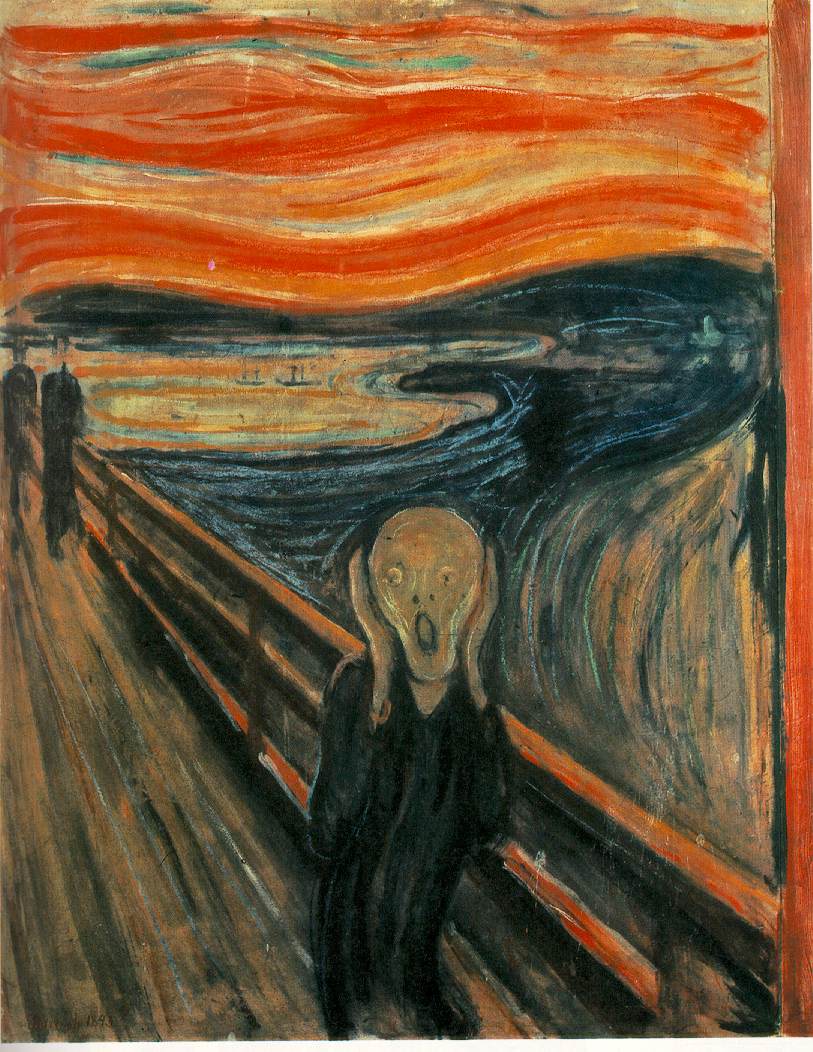
Or take the case of Edvard Munch's most famous, and now stolen, The Scream. It has been said by some to "...symbolize modern man taken by an attack of existential angst..." What if Munch had named it, "Thin Dark Wavy Guy (Weird) I Painted When I Was Stoned", or "Aargh! Sartre Owes Me 1,000,000 Francs And Now Says Hell Is Other People". The effect wouldn't be quite as dramatic, neh?

Wednesday, June 08, 2005

Of Male Bondage...Bonding...Bondage

Two posts in one day. Some kind of record.

Verily, The Poet has said:

On Male Bonding
--July 2003, Amtrak, somewhere between Penn Station and South Station

Behind a successful man, they say
Lurks a woman or three
Au contraire, I beg to differ,
What about his best buddy?

Enkidu was a hairy freak
But without him, no Gilgamesh;
And could Leander ever have beaten Pete,
If he never partnered with Mahesh?

"He doth not bite", they say,
"The canine that loudly barks."
But Friedrich E. did sustain a Dawg,
That did both in the person of Marx.

Adolf H. had Rudolf H.,
As every dictator must his scribe.
Both were ravening psychopaths,
But together they did jive.

"To be, or not to be?",
That is all good and sound.
Ere Laertes reaches for his envenom'd blade,
I would surely have Horatio around.

Heroes Gallic, I descry two,
I speak, of course, of Aster- and Obel-ix.
And that incomparabale duo,
That revealed the secret of the double helix.

Those ineffably elegant prime numbers,
Demurely inscrutable to mortal man...
They may never reveal all their treasures,
For whither art Hardy-Ramanujan?

He might've been a rotten cad,
Was Raskolnikov, steeped in the ways of sin.
I personally think, his only saving grace,
Was his long-suffering chum, Razumihin.

You'll never get fame, if you're called 'Butch',
But we all know one bloke who did.
I really wouldn't have fancied his chances,
If he didn't team up with the Sundance Kid.

Alimentary, my dear large intestine,
If Sherlock had written all those tomes,
He would've just been a terrible egotist;
Without faithful Watson, whither Holmes?

You find them friendly pairs,
In real-life, myth, legend, and drama
Damon and Pythias, Lewis and Clark,
And, may I add, Krishna and Sudama.

But I shed a tear for that worthy pair,
Those icons of friendship, profound
For Veeru who gave his life for Jai.
(Or was it the other way around?)


And Scheherezade saw the approach of the dawn and discreetly fell silent.

Operation Overlord Remembered

On June 6, in 1944, the largest amphibious landing in the history of warfare was succesfully attempted. Codenamed 'Operation Overlord', several British, US and Canadian infantry, armoured and parachute units landed across a broad front (5 beaches) in France. Facing them in the immediate vicinity was the German Seventh Army, a motely crew of infantry and parachute units, and one Panzer division (21st Panzer, reconstituted after the original one surrendered in North Africa).

There are several 'standard' resources for information on the Normandy Landings (including the BBC, Encyclopaedia Britannica, Wikipedia), so we will focus on some little known trivia.
  • Exhibit A: The Crossword Panic Of 1944 - when a 54 year old teacher who compiled crosswords unwittingly set clues over several weeks, the answers to which were all code names of various things involved in the invasion
  • Exhibit B: The area in the English Channel where the Allied armada would fall into formation, having arrived from various ports in England, was (appropriately enough) named Piccadilly Circus!
That's all. Got to go...

Tuesday, June 07, 2005

The Line Less Travelled

Nothing works wonders for your frame of mind as the sight and sound of a train passing by. From a very yeng yaze, we have been fascinated by trains and locomotives. We never misses a chance to gets on a train, my precious. So 'ere be a list of some of our more memorable train journeys.
  • Visakhapatnam-Trichur: Those good 'ol summer holidays. Mangos, guavas, the posh 'cushion' seats of Coromandel Express (which is so famous, it lends its name to a small Parisian publishing house) until Vijayawada, and the wooden slats of the Jayanthi Janatha after that. The names of Tamil Nadu stations rolling off the tongue (Arakkonam-Katpadi-Jolarpettai-Salem...), and the stations themselves rolling past the windows. The headlong rush into the Palghat Gap, and then God's Own Country. Actually, it is Marx's Own Country, but Marx is God, so that's OK.
  • Visakhapatnam-Araku: On the Kirandul-Kottavalasa line. Wonderful views, tunnels, people from the hills loading produce on the way to the market, clouds, waterfalls. The works.
  • Mettupalayam-Ooty: On the Nilgiri Mountain Railway. One of the last outposts of steam traction in India. Very touristy, but nevertheless thrilling.
  • Kalka-Shimla: Another mountain railway, the northern cousin of the Nilgiri line. No steam on this line (not regularly, anyway), but the climb from the plains to the Himalayas over a long afternoon makes up for that. Again touristy, unforgettable.
Farther afield, we have:
  • Philadelpha-San Francisco: Amtrak. 4 days and 3 nights in a chair car, but what a trip. If it only had been more leisurely...
  • Zurich-Rheinfall-Grenchen-Geneva-Bern-Zurich: Switzerland. Pretty as a postcard, inhumanly punctual and efficient.
  • London-Abergavenny: Welsh excursion, on British Rail. "Watson, my Bradshaw's tells me that if we hurry, we can find seats on the 10:18 from Waterloo" etc.
  • Edinburgh-Fort William: Single malt, bagpipes, and moors outside, beautiful, beautiful country. The occasional antediluvian saurian raises rears out of a passing loch and gives us a gander...
  • Glasgow-London: On the GNER. Passes through the Lake District. Skimbleshanks country?
  • Tokyo-Kamakura-Tokyo: Japan Rail. Our motto: "We give those Swiss a run for their monies". Inhuman efficiency, on the other side of the world.
  • Kyoto-Tokyo: On the unbelievably fast, comfortable, quiet Tokaido Shinkansen
  • Aguas Calientes-Ollyantaytambo: After 4 grimy dirty days on the Inca Trail to Machhu Pichhu, this little train ride in the Andes was blissful. The feet got to rest, the throats and stomachs got to eat, the eyes got to ogle, and so on.

Friday, June 03, 2005

In Which Arundhati Gives It Those Ones

Long before she won the Booker Prize for "The God Of Small Things", Arundhati Roy was a seller of empty beer bottles, a student of architecture, and a dabbler in films. She studied architecture at the Delhi School Of Architecture, dropped out, went to Goa, came back broke, found a job at the National Institute Of Urban Affairs, and was spotted by director Pradip Kishen, who offered her a role in his film "Massey Sahib" in 1986.

In 1988, Roy wrote the screenplay of, and Krishen directed In Which Annie Gives It Those Ones", about life at a not-so-fictitious school of architecture in Delhi. Thanks to a colleague, I managed to lay my slimy paws on a somewhat grainy (camera print?) of this movie. It was shown exactly once on Doordarshan, and the original print seems to have disappeared.

The movie is eminently watchable, even if it isn't a Kurosawa. There isn't much by way of a story, just a fly-on-the-wall look at the life of college students in the last days before graduation. Anyone who went through the hostel experience in India will empathize with the characters. Its worth the time spent, if only to see what Roy was like before her catapult to fame (and now infamy?).

Roy, who was the darling of the middle class ("Oh look, an Indian girl has won the Booker Prize, how nice, we must be a great people!") after winning the prize, has subsequently become the object of much revulsion and hate ("She's an anti-national!"). Several people have accused her of discovering her bleeding heart after discovering stardom. One only has to watch the movie, and listen to the words she (the scriptwriter) puts in her (the Radha character's) mouth, to discover that her political views aren't anything new, she has had them from the beginning, and her winning the prize only resulted in those views getting publicity.

She can't act to save her life, but boy she's cute :)

P.S. King Khan makes a very brief appearance, as a senior student.

Tuesday, May 31, 2005

Whither Are The Zeros Of Zeta Of S?

First, the following needs to be got off one's chest.

Two hydrogen atoms meet in a bar. "I think I lost my electron." "Are you sure?" "Yes, I'm positive." Whew...

Desultory flipping through of Karl Sabbagh's book, The Riemann Hypothesis - The Greatest Unsolved Problem In Mathematics. Like other mathematics books for laypeople (such as Zero - The Biography Of A Dangerous Idea and Fermat's Last Enigma), this one is a judicious mix of history, anecdotes and some relatively accesible mathematics.

The Riemann Hypothesis states (more or less) that
that the nontrivial Riemann zeta function zeros, i.e., the values of s other than -2, -4, -6, ... such that ζ(s)=0 (where ζ is the Riemann zeta function) all lie on the "critical line" σ=R[s]=½ (where R denotes the real part of s).
Yes, its really that simple. A child could tackle this.

Why is this important, you ask? Maybe you don't ask. But I tell. In the words of Sabbagh
The Riemann Hypothesis matters because, if it is true, it proves that there is a rule for generating the prime numbers...
If Tom, Li Mu Bai, and Thirunavukkarasu start generating prime numbers, one will have to wonder what the implications for cryptography are. This is only the tip of the iceberg. There are other obscure mathematical reasons (which I fully comprehend, mind you, but which will be so much Greek to you folks) why this is such an important result.

Many great mathematicians have been trying to prove or disprove the Riemann Hypothesis. It features as one of the 23 unsolved (at the time) problems of David Hilbert. Hardy and Ramanujan tried it and couldn't. Hardy was quite a character, but this post is too long already.

Interesting mathematics websites include the MacTutor History of Mathematics archive. Wolfram Research's Mathworld is a positive treasure, they also have similar sections on physics, chemistry and other sciences. If you fancy yourself as a mathematician, you might want to check out IBM Research's Ponder This problem of the month.

Tailpiece
Grafitti on New York City subway wall:

xn + yn = zn

There is no value of n>2 for which the above is true. I have found a truly remarkable proof of this, but my train is coming and I have to go...

Friday, May 27, 2005

Zorba, The Indian?

Long time no post. Actually - long to post, no time. Ha ha.

Read this article on the Indian influence on Greek cinema many moons back, and then lost track of it. It is back online now, with audio clippings and such. A bit long-ish, but most definitely interesting, if you're at all interested in Indian cinema. Or Greece. Or both. Other interesting Indian cinema websites include Upperstall, philip's fil-ums I've said before has some of the best movie reviews of masala and not-so-masala Indian movies, Sarai has some unusual and hard-to-find material including a section called FilmCity, a gargantuan section on Indian cinematography, including an absolutely unputdownable interview with Guru Dutt's cinematographer V.K.Murthy.

Wednesday, May 18, 2005

Of Many Things English

Dictionary.com provides the following, as one of the meanings of the word sandbagging:
To downplay or misrepresent one's ability in a game or activity in order to deceive (someone), especially in gambling: sandbagged the pool player by playing poorly in the first game when stakes were low.

First came across this at a team race, where some accused others of sandbagging and fooling everyone by running a lot faster than they said in their initial estimates.
The Bangalore marathon was fun, in spite of the fact that it started at a hottish 9:30 a.m., and the unbelievable crowd of banner holding, slogan chanting, corporate runners rooting for their own companies. Finished a lot faster (41 min. for 7 k.m.) than expected, thanks to Flo "Sandbagger" Jo [now the connections emerge] who was in a tearing hurry to reach someplace just around the next corner. "Knackered" at the end, but that made the steak at "The Only Place" (Museum Road, Bangalore) that much more sllurrp.
While on the general topic of English usages, and since we're into putative lists nowadays, here is the list of top 5 annoying English bloopers (IMO) that have insidiously crept their way into common use:
  • momentarily: Some centuries ago, "momentarily" used to mean, "for a moment". Then the United States came into existence. Fast forward to the 1990s/2000s and now the darn word means, "in a moment" to most people. We will pause momentarily to reflect on what this means. . . . . .Having reflected, we move on. The disease seems to have crossed the Atlantic. One distinctly remembers hearing a, "Wait here children, Professor Dumbledore will be with you momentarily." in a motion picture. Or is this just Hollywood scriptwriters putting words in mouths of the doyens of British cinema?
  • presently: Mostly Indian. "Presently I am doing my MBA in Neo-Fascism from IIM-X." And presently, I am going to going to bonk you on the head with a tomato (large, putrid). Whatever happened to "currently"?
  • disinterested/uninterested: The distinctions have blurred. The centre cannot hold. The falcon spirals. A great beast slouches through the dunes towards Bethlehem. [disinterested = impartial, uninterested = not interested]
  • TBD UPDATE: You're all set. You are therefore a pudding. One pays heed to cannibals.
  • TBD UPDATE: According to me. You might suffer from a serious case of split personality, but you can't accord to yourself, IMO. Which brings us [rather cleverly, smirk, smirk] to what the correct phrase would be: "In my opinion..." Stop according to yourselves peoples!
  • UPDATE:This door is alarmed. Oh really? How do you know? Did it scream in a high pitched voice? Or do you communicate with it via ESP? By way of the friendly neighbourhood [someone came with an eraser and scrub-a-dub-ed this bit] cannibal.

Age doth wither and custom doth stale the memory, the list will have to be completed anon.

Tuesday, May 10, 2005

Obligatory Weekend Roundup

How can I blow money over a weekend? Let me count the ways...
  1. Hang out in a Barista with the excuse of trying to find out if the wireless card on the laptop works.
  2. Go with buddy to Taj Residency, drink Glenfiddich, eat kababs, ice cream, and solve the outstanding problems with the world.
  3. Buy some more DVDs from Music World.
  4. Buy another book. But this one is really good. The author is a co-alumnus who dared to be different.
  5. Play snooker in a Gillian's like Hyderabadi adda.

That apart... Watched "Saath Saath", and A Bridge Too Far. Another fantastic WW2 movie, a keeper. This one is about Monty's ill conceived plan, code-named Operation Market Garden to drop 3 airborne divisions behind German lines in the Netherlands, and cut off German supply lines to the Western Front, with the aim of shortening the war. A star cast, and very nice camera work. Annoyingly, there were no subtitles for the German and Dutch dialogues. So everything that Rundstedt, Model, and Bittrich said went into thin air!
Gaana paattus of the weekend were a hotch potch of various things. Some more candidates for running songs
  • Tubthumpin' (Chumbawumba) - "I get knocked down, and I get up..."
  • Zombie (Cranberries) :-)
  • Another One Bites The Dust (Queen)
  • We Didn't Start The Fire (Billy Joel) - Not a particularly "rocky" song, but if you know the words you can't help but sing along, and it takes your mind off the the running for a full 5 minutes!
  • All Star (Smash Mouth) - "Hey now, you're an all star, get your game on..."
  • Moving In Stereo (The Cars) - Fairly obscure. But this is the rockin' tune that plays in that umm... immortal scene from what is regarded by many as the best teen movie ever, where Phoebe Cates emerges from a swimming pool and enters "Brad's" fantasy world.
  • There were more... I forget

And once you're a sweating wreck, you can shower, eat, and lie down and listen to Sanjeev Abhyankar do a Malkauns in vilambit ektaal. I wouldn't know a vilambit ektaal if it came and bit me on the behind, but I can recognize Malkauns once someone bonks me on the head with it, and it is quite the nice raagam. Maybe I like it so much because I like Hindolam and Saamajavaragamana. Who knows? We will leave this mystery alone.

Saturday, May 07, 2005

What Parthiv Hath Wrought

As the 7K Celeberation/Celebrity run at the Bangalore Marathon looms, it occupies many of my thoughts nowadays, including thought no. 21297.

This insane running endeavour started in March 2003, when an MIT graduate student named Parthiv Shah showed up at the weekly Asha For Education Boston chapter meeting and said he would be interested in helping us organize a marathon fundraiser.

Having always suffered from delusions of athletic grandeur, I signed up, and went on to finish the Marine Corps Marathon in Washington, DC in 5:00:33. My only regret was not carrying an accurate stopwatch so that I could've shaved off those annoying 33 seconds and had a 4:xx:xx time.

The Asha marathon program grew last year, with AID-Boston joining in - the number of runners went up, the money raised, blisters, injuries, pain, happiness.

And it continues to grow. This year, Asha and AID have officially joined together to organize the fundraiser, and it already feels like it will be a smashing success.

And I can't help but sit here in Hyderabad with a silly grin on my face and wonder what has come to pass after those lonely, wet Sunday mornings when the few of us who could make it, slogged our way up and down the Minuteman Trail. Thanks Parthiv!!

Thursday, May 05, 2005

Pome du jour

baaziichaa-e-atfaal hai duniyaa mere aage

Jagjit Singh sings this, rather well IMO, for Gulzar's TV serialization of Mirza Ghalib's life. Google will give you all the links you want about Jagjit Singh, Gulzar, TVs, serialization, Ghalib and life. So we will not belabour you with links. Instead


baaziichaa-e-atfaal hai duniyaa mere aage
hotaa hai shab-o-roz tamaashaa mere aage
[baaziichaa-e-atfaal = child's play]

hotaa hai nihaa.N gard me.n seharaa mere hote
ghisataa hai jabii.n Khaak pe dariyaa mere aage
[nihaa.N = hidden; gard = dust]
[seharaa = desert, jabii.n = forehead]

mat puuchh ke kyaa haal hai meraa tere piichhe
tuu dekh ke kyaa rang hai teraa mere aage

imaa.N mujhe roke hai jo khii.nche hai mujhe kufr
kaabaa mere piichhe hai kaliisaa mere aage
[kufr = impiety, kaliisaa = church/cathedral]

go haath ko jumbish nahii.n aa.Nkho.n me.n to dam hai
rahane do abhii saaGar-o-miinaa mere aage
[jumbish = movement; saaGar-o-miinaa = glass of wine]

Monday, May 02, 2005

Listing - This Way And That

There be lists 'ere. The number of things you can make lists about are countless as the grains of sand. So we will make lists. This idea is partly inspired by the blogger's complete lack of creativity, and partly by the Nick Hornby book and film, "High Fidelity" - in which the protagonist is an obsessive list-maker. This week's theme [trumpets, cymbals, kettledrums, other Ramses II type noises]

Running Songs

Songs/music that inspire running. [Note: I don't listen to music when I'm running, am afraid of getting distracted and run over. So this list is a bit of a scam.] The candidates

  1. The Chariots Of Fire theme by Vangelis. How can this not be Numero Uno? Many true runners will disagree. Too cliched, too predictable. But what the hell, it is the running song.
  2. Paradise City, by Guns N' Roses. Very odd, I know. But there is something to said for this song blaring out of a 12 seater van with your stinking sweaty teammates rooting for you, at a very groggy 6 a.m. when you're limping through your allotted 8 odd miles of Leg 27, on a cool September New Hampshire morning
  3. Eye Of The Tiger by Survivor
  4. The theme from Rocky
  5. O Fortuna from Fortuna Imperatrix Mundi, from Carmina Burana by Carl Orff.
As you can see, the list is sketchy at the moment. However, if someone set this to music, it would be on my list. Gives you something nice, long and continuous to hang on to. And while we're at it, one should take a gander at this great poem about sex and running.

Wednesday, April 27, 2005

Run, Forrest, run!!

In another day and age, I used to be a runner. Even used to have a running log. Dimly remember crawling across the finish of the Marine Corps Marathon in 2003, with my all but dismembered left leg in tow.

Desultory running has happened since, but now, finally, a target to shoot for: The Bangalore Marathon on May 15. Well, not all of it, but at least the 7 k.m. wuss race! Got to train like crazy. Have downloaded the ultimate running song and all that remains is to drag the soporific carcass out of bed every morning and hit the roads...

Whither blog?

And before you can say Sivasubramaniam Chandrasegarampillai, another week has elapsed. To paraphrase Inspector Sydney Wang from Murder By Death, "Confucius say, 'Maintaining this blog, like train without wheels. Soon get nowhere.'" Be that as it may, one forges on. The list for this week:
  • Visited Navadarshanam. Not quite Timbaktu, but worth a gander. Many experiments in alterative lifestyles have been tried at Navadarshanam, the website says it all. Interestingly, Navadarshanam is located near Gummalapuram, and apparently the two hills are mentioned in The Spotted Devil Of Gummalapur, from "Nine Maneaters And One Rogue" by Kenneth Anderson.
  • More money spent on books. In this instance, two volumes by Murakami, Prey - which apparently has something to do with a previous post, and James Clavell's Shogun - for old times' sake
  • Finished the empire book. Turns out that most of the book is devoted to describing how the empire grew and expanded, in a very non-judgemental way (if anything Ferguson is critical of various imperial policies). In the final couple of chapters, there is a sudden jump from, "OK, so the British Empire was bad, as we've seen. But your alternatives were the French, German or Japanese empires, and we all know that the Brits were saints compared to those foreign johnnies, ergo the British Empire was a good thing in that it prevented said johnnies from taking over the world." Somehow leaves one with an unfinished taste...
  • Am now proud owner of my first Apple gadget. The heavens be thanked for mildly insane kid sisters.
  • Got some more music. Getz, Cale, and Hey Baby Hey Baby Yeah.

Wednesday, April 20, 2005

Ants To The Rescue

Strictly for people with mathematical and operations research inclinations. Someone introduced me to the notion of "Ant Colony Optimization" (ACO) today. First proposed by Marco Dorigo in his Ph.D. thesis, this "metaheuristic for combinatorial optimization problems" is inspired by the behaviour of real ant colonies.

ACO is just one of many techniques that are part of the fields of "Nature Inspired *", includingBees, the flocking of birds, the schooling of fish, are all grist to these mills apparently. Very intriguing.

Tuesday, April 19, 2005

The Empire Strikes Back

Borrowed Empire: How Britain Made the Modern World by Niall Ferguson from a friend this weekend. Have not yet started it, but desultory flipping through has happened. There is a long review available, possibly more.

The thrust of the book is that on balance, the existence of the British Empire did more good than harm. According to him, it is responsible for the spread of liberal values and parliamentary democracy around the world, the English language, the industrial age, globalization and free trade (in its modern forms). He does not deny that horrible things happened, but constantly reminds us that things would've been a lot worse if say, the Japanese or the Germans, had been the great colonial power of the 19th and 20th centuries.

So far, the problem is that he constantly presents the Japanese (and German, French, or Dutch) empire as the only alternative to the British empire. As in, "If India had not been part of the British empire, it would've been under the Japanese. That the Japanese were butchers, we've seen during the Second World War. Therefore, India was better off under the British." Not much consideration is given to the idea of, "Hey, what if India wasn't part of any empire? What if parliamentary democracy and liberal values and other such things had taken root on their own here? What if there had been agricultural and industrial development independently here?"

Should be an interesting read. The book seems to have divided the world into three camps. Those who support the thesis, those who oppose it, and of course those who have not read it.