Before we do the Light Brigade act into the pomes, a delightful discovery needs to be shared. Terry Mordue (may his tribe increase) is trying to annotate as many allusions as he can from the works of P.G.Wodehouse. And from the notes on The Clicking Of Cuthbert, we learn about this absolutely delightful lady, Jael the wife of Heber. Read on. Its absolutely deliciously cute. Might have to slip a little something in Heber's drink and live happily ever after with Jael.
Poems from fillums. First of all, before you Google experts scuttle away to your little searches, in the manner of roaches when the light is turned on, a very decent list is available. So no nenu cheppanu kadaas from you. Secondly, we have already spoken of some of these here and here. And finally, perhaps we should try to avoid being lazy by resorting to such stratagems as including Shakespeare poems from "Shakespeare movies", Neruda poems from Neruda movies or even including Paul Verlaine's tragic sounding Song Of Autumn, just because the verses were used by the Allies to advise the French Resistance about the impending Normandy landings (and this was later depicted in The Longest Day.
Caveats having been dispensed with,
I
A very favourite movie has a couple of very favourite poems. First, Robert washes Meryl's hair to the pace of the fantastic Rime Of The Ancient Mariner. Very apt poem for such an activity. Also a great poem to mug up during long runs. Then, near the end, Meryl reads A.E.Housman's To An Athlete Dying Young over Robert's grave.
II
Surely, we must include The Hollow Men, read so chillingly by Marlon in Apocalypse Now.
III
The very very entertaining Dreamcatcher apparently has this one thrown in there somewhere.
More can be added.
Friday, September 16, 2005
Thursday, September 15, 2005
Smorgasboard
0. Happy Onam.
1. Finished yet another John Keay book, The Spice Route: A History. This man is rapidly turning into one's favourite historian about these matters. His India: A History was also very good, a judicious mix of history sprinkled with Keay's own pointed remarks about everything ("...the Near East in the Middle Ages was almost as troubled and strife-torn as the Middle East in nearer ages..."). Of course, it all started off over a year and a half back when we wrote about Tall Ships and en passant touched upon The Honourable Company, which was a history of the British East India Company. "The Spice Route" and "The Honourable Company" have much in common, intertwined as the history of colonialism and spices is.
The chronology of "The Spice Route" however starts in the dimly seen past, when Phoenicians, Egyptians and other sundry Levantine types started sailing. A history of spices follows - Greece-Rome-Dark Ages-Middle Ages and so on, before arriving at the point where the Iberians, the Italians, the Low Countries, and of course the English took to serious blue water sailing in search of "The Origin Of Spices". The pioneering work of Hippalos; the mysteries of Periplus Maris Erythraei (which is available in its entirety here); the peregrinations of Marco Polo, Ibn Batuta and Xuan Zhuang; of Admiral Cheng-ho's argosy (thanks to Zoo Station) and so on.
This history is full of the most surprising characters: shady Italian industrial espionage types who converted to Islam so as to be able to hang out with Arabs and learn their secrets; a Greek cabin boy who joins a British ship, finds his way to Siam, becomes a favourite at the King's court and is virtually Prime Minister of Thailand for a few years; Siam and Golconda going to war over the harassment of Indian porters (at British instigation) who carried cargos from the eastern end of the Malay peninsula to the western end over the isthmus of Kra, and so on.
UPDATE: This should've been posted yesterday (thanks to Anonymous for the reminder), but John Keay is indeed touring the country. More information is available. If you get a chance to hear the man speak, please intimidate us at Choultry also.
2. There are many blogs devoted to economics. Zoo Station, Indian Economy, Deesha, Secular Right, India Uncut are some blogs that frequently feature very readable posts on economics, government, the role of government in economics, and so on.
While they present different and interesting facets of and takes on various economic systems, it wouldn't be unfair to say that by and large the bloggers agree on (for want of a better phrase) "laissez faire free market capitalism" as their preferred economic system, for various reasons. Further, in general, these blogs are critical about socialism, communism and all other related -isms (complete the list yourself).
As someone who's knowledge of conventional economics and economic history is abysmal, and further more someone whose ability to gather the facts and analyze them is also pathetic, it becomes hard to frame any decent questions, or come up with any decent arguments about these issues. But but but...as someone who writes a blog read by 6 people, who's to stop us from asking some stupid questions anyway? Huh?!
And so on and so forth... Very vexing these questions are, no answers in sight, and no one making a halfway decent attempt to explain this to the hoi polloi like us.
And a bloody long post.
Finis.
1. Finished yet another John Keay book, The Spice Route: A History. This man is rapidly turning into one's favourite historian about these matters. His India: A History was also very good, a judicious mix of history sprinkled with Keay's own pointed remarks about everything ("...the Near East in the Middle Ages was almost as troubled and strife-torn as the Middle East in nearer ages..."). Of course, it all started off over a year and a half back when we wrote about Tall Ships and en passant touched upon The Honourable Company, which was a history of the British East India Company. "The Spice Route" and "The Honourable Company" have much in common, intertwined as the history of colonialism and spices is.
The chronology of "The Spice Route" however starts in the dimly seen past, when Phoenicians, Egyptians and other sundry Levantine types started sailing. A history of spices follows - Greece-Rome-Dark Ages-Middle Ages and so on, before arriving at the point where the Iberians, the Italians, the Low Countries, and of course the English took to serious blue water sailing in search of "The Origin Of Spices". The pioneering work of Hippalos; the mysteries of Periplus Maris Erythraei (which is available in its entirety here); the peregrinations of Marco Polo, Ibn Batuta and Xuan Zhuang; of Admiral Cheng-ho's argosy (thanks to Zoo Station) and so on.
This history is full of the most surprising characters: shady Italian industrial espionage types who converted to Islam so as to be able to hang out with Arabs and learn their secrets; a Greek cabin boy who joins a British ship, finds his way to Siam, becomes a favourite at the King's court and is virtually Prime Minister of Thailand for a few years; Siam and Golconda going to war over the harassment of Indian porters (at British instigation) who carried cargos from the eastern end of the Malay peninsula to the western end over the isthmus of Kra, and so on.
UPDATE: This should've been posted yesterday (thanks to Anonymous for the reminder), but John Keay is indeed touring the country. More information is available. If you get a chance to hear the man speak, please intimidate us at Choultry also.
2. There are many blogs devoted to economics. Zoo Station, Indian Economy, Deesha, Secular Right, India Uncut are some blogs that frequently feature very readable posts on economics, government, the role of government in economics, and so on.
While they present different and interesting facets of and takes on various economic systems, it wouldn't be unfair to say that by and large the bloggers agree on (for want of a better phrase) "laissez faire free market capitalism" as their preferred economic system, for various reasons. Further, in general, these blogs are critical about socialism, communism and all other related -isms (complete the list yourself).
As someone who's knowledge of conventional economics and economic history is abysmal, and further more someone whose ability to gather the facts and analyze them is also pathetic, it becomes hard to frame any decent questions, or come up with any decent arguments about these issues. But but but...as someone who writes a blog read by 6 people, who's to stop us from asking some stupid questions anyway? Huh?!
- What are the ethical/moral underpinnings of any economic systems? What is "good", "bad"? What does "equitable" mean? Is "equal access to resources and opportunities" "good"? Is it necessary? Is it sufficient? Have people who advocate any one system over the other answered these questions to their satisfaction? Is that necessary?
- Generally, the laissez faire folk seem to be "meritocrats". This means, you have minimal regulatory interference, let individuals/firms compete in the open against each other, may the best man win, and to the winner go the spoils. This is "fair", and this is "good" for everyone. This seems to work nicely when all concerned start on the same level playing field, in terms of access to resources and opportunities, and the only variables are the capabilities of the entities concerned.
Unfortunately, these entities include people. What happens after the first generation?
Mr. A did well in life, so his children go to the best schools and so on. Ms. B didn't do so well, so her children weren't able to get an education and so on. Now what? Is anyone studying the effect of inequalities and how they are propagated across generations? What is the "good" solution to this problem? What is the "fair" solution? Wouldn't it be "fair" and "meritorious" to separate all children away from their parents as soon as possible, put them in some kind of residential school system where everyone is equal and turn them loose in the real world, without their parents' accomplishments backing them up? How do we draw these lines? - Doesn't it seem as though for about 5000 years, we lived in a free-for-all smash-and-grab world, where the bhains resided with the owner of the lathi, and the more you managed to hoodwink others, the better off you were? Then, suddenly, in the last 100 years or so, we've discovered "ethics" and "fairness" and now we changed the rules. "Oh no, you can't use violence to become rich any more." Seems like a bit of a children's game.
- Macro economically speaking, what is the "end" of economics? If economic performance is measured in terms of "growth", and rewarded based on that performance, does this mean that this "prosperity" thing is inextricably linked with "growth"? Does "economic growth" always mean that, ultimately, we are using up more and more of some non-renewable resource? Per conventional wisdom: "economic growth" is a "good" thing, population growth is a bad thing, does this mean that the same number of (or fewer) people have to consume more and more things forever? Aren't war/calamities and the subsequent rebuilding, or even economic activity for the sake of economic activity, then a viable solution to our economic problems? Does this ever end? Where does this end? Where do economists want this to end, and where do they see this whole shebang going?
And so on and so forth... Very vexing these questions are, no answers in sight, and no one making a halfway decent attempt to explain this to the hoi polloi like us.
And a bloody long post.
Finis.
Monday, August 29, 2005
Nauti Stuff - The Sinking
The title says it all. Gazing at the dying day, as the trackless plains of Andhra Pradesh rolled past the windows of the Hyderabad-Chennai Express (or, the Hyderabad-Chennai Express rolled past the trackless plains of India, as the case may be, if you're a stickler for these things), it is hard to keep thoughts of sinking ships out of one's mind. Your is not to ask why, yours is but to do or die. Die, die, die...[extricates ice pick]
Since we have not done a list in aeons, we will do a list. Famous ships that stank. Sank. Or were otherwise tragically interrupted as they went about their maritime activities. And the nominees are
Since we have not done a list in aeons, we will do a list. Famous ships that stank. Sank. Or were otherwise tragically interrupted as they went about their maritime activities. And the nominees are
- The Titanic - this ship unfortunately has to top the list. Hated the movie, will not say anything more about this disaster, everyone and their aunty Akhilandeswari knows everything about this. You only have to say "Tit..." and people's arms just go up and glazed look colonizes visage, as though they were Leo and Kate coochicooing on the prow.
- The Lusitania - The world's first quadruple screw steamer, and also the first ship to exceed 30,000 tons.
On 7 May 1915, while heading east off the Old Head of Kinsale, Ireland...Lusitania was torpedoed without warning by U-20 and sank within 18 minutes. ..
The Lusitania incident was later used by Woodrow Wilson (who was officially keeping the US out of the First World War), as a propaganda tool.
...Of those on board, 761 were rescued, while 1,198 perished. Lusitania's sinking, and the sinking of White Star's Arabic a few months later, vividly demonstrated that prior concepts of the rules of war no longer prevailed, and that unarmed merchant ships were no longer safe from attack. - The Kursk disaster - The Russian Typhoon (?) class SSBN sank with all hands off the coasts of Norway and Russia in 2000. He (the Russians use the male pronoun for ships, apparently) was part of military exercises, when it is believed that leaking fuel from a torpedo ignited and caused an explosion in the forward sections. Some 23 sailors survived the explosion and flooding in the aftmost compartment, and slowly asphyxiated, as rescue attempts to reach them, first by the Russians and later by an international team, failed. RIP.
- The Exxon Valdez incident - No loss of life this time, but a lot of fishies and birdies and other cuties paid the price for this balls up.
Exxon Valdez was the original name of an oil tanker owned by the Exxon oil company. The ship was renamed to "Sea River Mediterranean" after the March 24, 1989 oil spill in which the tanker hit Prince William Sound's Bligh Reef and spilled between 11 million and 35 million U.S. gallons (42,000 and 132,000 m³) of crude oil that killed billions of animals: the Exxon Valdez oil spill, or the EVOS. As a result of the spill, 10% of the wildlife died and 50% of the season catch of fish were killed. The captain of the Exxon Valdez was then found guilty of negligence, and in 1991 a federal judge rejected a $1.1 billion settlement reached by Exxon, the federal government, and Alaska.
Interestingly, the ship makes a cameo appearance in a movie. - The Cheat List - Here we will bunch a list of World War II sinkings and be done...
- HMS Royal Oak - Battleship. Torpedoed in Scapa Flow by Obertleutnant Gunther Prien
- HMS Hood - Battlecruiser. Sunk by gunfire from the German battleship Bismark, in the course of The Battle Of The Denmark Strait" on May 24, 1941. There were 1400+ crew. 3 survived.
- The Bismarck - Followed up her brief and spectacular success (above), by proceeding to be battered by the British Home Fleet, and was finally torpedoed by the HMS Dorsetshire. About 2200 died.
- HMS Prince Of Wales and HMS Repulse" - Sunk by Japanese aircraft within an hour of each other off the east coast of Malaya on 10 December, 1941. The question of the battleship versus the bomber was answered.
- TODO: USS Arizona and Pearl Harbor, the whole Pacific theater shebang, IJNS Yamato and IJNS Musashi, and so on...
Thursday, August 11, 2005
I Thoth I Thaw A Thweethybird
All right, very well! It has been ages since our desperate, thirsting readers were treated to a snack at the choultry. Last week was like a curate's egg. About the size of a regular chicken egg, round, offwhite, solid-yet-fragile and so on. Actually, that isn't true. Like all self-respecting layers of eggs and progenitors of hatchlings, the curate spent some time sitting on his egg. So it eventually ended up rather flat, yellowish, drippy, and mottled with little pieces of shell. So that's what last week was like.
And the disgusting egg and egglayer prelude lets us segue into the meat of this post. Not only does it let us segue into the meat of this post, it even lets us use the word segue in a sentence. Who uses segue in a sentence? We do. It is like wanting to use gargantuan, in a legitimate context. Some of use will go to any lengths, even feed an ex-colleague to a black mamba (or whatever), so that we can say "gargantuan" as the poor sod gasps his life out on the floor next to us. We're li' 'at.
We digress too much. For an urban jungle, Hyderabad seems to be exactly that. A jungle. A bunch of us go running ever so often on the banks of the Hussain Sagar, and the sheer variety of birdlife is amazing. You have your egrets, your cormorants (untrained, no politicians and/or lighthouse keepers in evidence), your ducks (not Ganguly's, yours! ha ha...), and so on. Vijay Cavale runs Indiabirds where you can see his rather fantastic pictures of various feathered fiends. Earlier this year, there was a bunch of differently plumed and hued egrets in the Sagar, a reliable source (not a little bird!) says that that's "breeding plumage" for 'em egret blokes.
And just last week, outside the flat windows, as one dissolutely plied the toothbrush in the oral cavity and gazed out over the unfolding morning scene in customary why-me-why-now-Suzanna fashion, out of the blue, a brace of Indian grey hornbills (ocyceros birostris) showed up in the neem (azadirachta indica) tree. It felt like a dream, as they flitted around in the dappled sunlight, as birds are wont to in literary works. None of the neighbours (homo sapiens) seem to have noticed them, and the passing cockroaches (periplaneta americana) motored on and took no heed. Even the Irrawady dolphins (oracella brevirostris) and the blue whales (balaenoptera musculus) scarcely raised a waterspout. Which is well and proper. Would've been one helluva of weirdass dolphin or blue whale to catch a glimpse of an Indian grey hornbill. Having used many scientific names in a paragraph (in case you didn't notice)...
A very good place to see birds, if you're in Bangalore, is to get out of Bangalore. Drive sou' sou' west, towards the Biligiri Ranganna Hills. You will pass through several wetlands, where impeccably feathered and improbably named jacanas wade through the marshes, and fill you with joy (the sight of Nature's variety and beauty), and perplexity ("How do I pronounce jacana?"). When you get to BR Hills, if you're very lucky, you will get to see an Asiatic paradise flycatcher and be amazed. "How did an Asiatic birdie make it into India without passport, visa, and bottle of Scotch for Customs?", you will wonder. Perhaps not. Certainly, you'll get goosebumps from seeing this creature.
The point of this diatribe is, there are many beautiful things in the world, outside of well designed Java applications.
And the disgusting egg and egglayer prelude lets us segue into the meat of this post. Not only does it let us segue into the meat of this post, it even lets us use the word segue in a sentence. Who uses segue in a sentence? We do. It is like wanting to use gargantuan, in a legitimate context. Some of use will go to any lengths, even feed an ex-colleague to a black mamba (or whatever), so that we can say "gargantuan" as the poor sod gasps his life out on the floor next to us. We're li' 'at.
We digress too much. For an urban jungle, Hyderabad seems to be exactly that. A jungle. A bunch of us go running ever so often on the banks of the Hussain Sagar, and the sheer variety of birdlife is amazing. You have your egrets, your cormorants (untrained, no politicians and/or lighthouse keepers in evidence), your ducks (not Ganguly's, yours! ha ha...), and so on. Vijay Cavale runs Indiabirds where you can see his rather fantastic pictures of various feathered fiends. Earlier this year, there was a bunch of differently plumed and hued egrets in the Sagar, a reliable source (not a little bird!) says that that's "breeding plumage" for 'em egret blokes.
And just last week, outside the flat windows, as one dissolutely plied the toothbrush in the oral cavity and gazed out over the unfolding morning scene in customary why-me-why-now-Suzanna fashion, out of the blue, a brace of Indian grey hornbills (ocyceros birostris) showed up in the neem (azadirachta indica) tree. It felt like a dream, as they flitted around in the dappled sunlight, as birds are wont to in literary works. None of the neighbours (homo sapiens) seem to have noticed them, and the passing cockroaches (periplaneta americana) motored on and took no heed. Even the Irrawady dolphins (oracella brevirostris) and the blue whales (balaenoptera musculus) scarcely raised a waterspout. Which is well and proper. Would've been one helluva of weirdass dolphin or blue whale to catch a glimpse of an Indian grey hornbill. Having used many scientific names in a paragraph (in case you didn't notice)...
A very good place to see birds, if you're in Bangalore, is to get out of Bangalore. Drive sou' sou' west, towards the Biligiri Ranganna Hills. You will pass through several wetlands, where impeccably feathered and improbably named jacanas wade through the marshes, and fill you with joy (the sight of Nature's variety and beauty), and perplexity ("How do I pronounce jacana?"). When you get to BR Hills, if you're very lucky, you will get to see an Asiatic paradise flycatcher and be amazed. "How did an Asiatic birdie make it into India without passport, visa, and bottle of Scotch for Customs?", you will wonder. Perhaps not. Certainly, you'll get goosebumps from seeing this creature.
The point of this diatribe is, there are many beautiful things in the world, outside of well designed Java applications.
Tuesday, August 02, 2005
We Were There
Extended break from blogging, thanks to an interminable week in Bombay. New Bombay, to be precise. Vashi-Mahape-Nerul to be more precise. In the manner of Alistair MacLean narrating H.M.S. Ulysses, we will describe the week:
Monday, a.m.: "Hey, those hills look so pretty in the rain, don't they? The mist, and the little cataracts tumbling off the Sahyadris. Its so pretty. I'm glad for the clouds, otherwise it would've been beastly hot and humid."
Monday, p.m.: "Ah, the smell of wet earth, and green growing things, and that wonderful feeling of moist things squelching as we walk over the verdure. I hope it stays this way for the rest of the week, love the rains in India, can't get enough of it."
Tuesday, a.m.: "Though it stopped last night, it seems to have started up again just now. Looks a bit heavy too. And the sky has that dull, metallic, grey look to it. Wish I'd thought of some way to waterproof the laptop backpack. Hope it doesn't rain too much. It'll probably stop by the time we have to leave the office."
Tuesday, early afternoon: "Hey, look at these Bombay locals machaan, they're ready to run home scared of a little rain. Ha ha ha."
"Its still raining, machaan."
Tuesday, a little later: "Did that guy just say that he was up to his chest in water outside the office gate?"
Tuesday, evening: "Oh well, if these wusses are all heading home, we might as well too. Its still raining, so lets not walk in the rain with the laptops. We'll call the hotel guy and ask him to send a car."
"Hey, the hotel guy says his car is in Chembur, and he'll send it over as soon as it gets to the hotel. That's not too bad, maybe 45 minutes or 1 hour of waiting?"
"Hmm...why again are we walking in the rain, sharing a borrowed umbrella, trying to catch a company bus that is clearly going to burst at the seams before it leaves?"
[Outside the office gates]: "Holy Fuck! Was that Maruti 800 really up to its roof in water??...Mommeeee!"
[In downtown Vashi]: "The hotel is only 1 k.m. away, we can easily wade through the knee-deep sludge and get there. If you go into a manhole, I'll scream, and vice versa."
Tuesday, night: "Shit. This stupid room doesn't have a fan. Only airconditioning. No TV. No phones. No cellphones. No radio. No power. What are we gonna do?"
Tuesday, 11 p.m.: "Its still raining, machaan. Do you think we'll be able to finish tomorrow and go home on Thursday?"
Wednesday, 2 a.m.: "Its still raining, machaan."
Wednesday, 8 a.m.: "Its still raining, machaan."
Wednesday, noon: "Its still raining, machaan. WTF. I think I saw something slimy crawl out of yesterdays clothes lying in the bathroom. Apparently everyone else on yesterday's bus reached home at 5 a.m. Things must be bad. Remind me never to rave about the rain again."
Wednesday, evening: "Ah, finally. Its stopped. Good thing we bought those umbrellas. They'll be really useful, now that the rains have stopped."
Thursday, a.m.: "Atleast we made it to the office. Where is everyone else? Slackers!"
Thursday, evening: "Phew! Done here. Do you think we'll be able to make it to the airport in time for the flight tomorrow? Do you think the airport exists? Do planes exist? What are planes? Hasn't civilization dissolved into a blob and flowed into Mahim Creek over the last two days?"
Friday, 4 a.m.: "Hey, its raining again. Hopefully we'll be able to take off."
Friday, 6 a.m. [Sakinaka] : "Was that really a bicycle in that tree?"
Friday, 8 a.m.: "Huzzah! Out of Bombay. Is it raining in Hyderabad?"
The rains have been horrendous in Bombay.
Monday, a.m.: "Hey, those hills look so pretty in the rain, don't they? The mist, and the little cataracts tumbling off the Sahyadris. Its so pretty. I'm glad for the clouds, otherwise it would've been beastly hot and humid."
Monday, p.m.: "Ah, the smell of wet earth, and green growing things, and that wonderful feeling of moist things squelching as we walk over the verdure. I hope it stays this way for the rest of the week, love the rains in India, can't get enough of it."
Tuesday, a.m.: "Though it stopped last night, it seems to have started up again just now. Looks a bit heavy too. And the sky has that dull, metallic, grey look to it. Wish I'd thought of some way to waterproof the laptop backpack. Hope it doesn't rain too much. It'll probably stop by the time we have to leave the office."
Tuesday, early afternoon: "Hey, look at these Bombay locals machaan, they're ready to run home scared of a little rain. Ha ha ha."
"Its still raining, machaan."
Tuesday, a little later: "Did that guy just say that he was up to his chest in water outside the office gate?"
Tuesday, evening: "Oh well, if these wusses are all heading home, we might as well too. Its still raining, so lets not walk in the rain with the laptops. We'll call the hotel guy and ask him to send a car."
"Hey, the hotel guy says his car is in Chembur, and he'll send it over as soon as it gets to the hotel. That's not too bad, maybe 45 minutes or 1 hour of waiting?"
"Hmm...why again are we walking in the rain, sharing a borrowed umbrella, trying to catch a company bus that is clearly going to burst at the seams before it leaves?"
[Outside the office gates]: "Holy Fuck! Was that Maruti 800 really up to its roof in water??...Mommeeee!"
[In downtown Vashi]: "The hotel is only 1 k.m. away, we can easily wade through the knee-deep sludge and get there. If you go into a manhole, I'll scream, and vice versa."
Tuesday, night: "Shit. This stupid room doesn't have a fan. Only airconditioning. No TV. No phones. No cellphones. No radio. No power. What are we gonna do?"
Tuesday, 11 p.m.: "Its still raining, machaan. Do you think we'll be able to finish tomorrow and go home on Thursday?"
Wednesday, 2 a.m.: "Its still raining, machaan."
Wednesday, 8 a.m.: "Its still raining, machaan."
Wednesday, noon: "Its still raining, machaan. WTF. I think I saw something slimy crawl out of yesterdays clothes lying in the bathroom. Apparently everyone else on yesterday's bus reached home at 5 a.m. Things must be bad. Remind me never to rave about the rain again."
Wednesday, evening: "Ah, finally. Its stopped. Good thing we bought those umbrellas. They'll be really useful, now that the rains have stopped."
Thursday, a.m.: "Atleast we made it to the office. Where is everyone else? Slackers!"
Thursday, evening: "Phew! Done here. Do you think we'll be able to make it to the airport in time for the flight tomorrow? Do you think the airport exists? Do planes exist? What are planes? Hasn't civilization dissolved into a blob and flowed into Mahim Creek over the last two days?"
Friday, 4 a.m.: "Hey, its raining again. Hopefully we'll be able to take off."
Friday, 6 a.m. [Sakinaka] : "Was that really a bicycle in that tree?"
Friday, 8 a.m.: "Huzzah! Out of Bombay. Is it raining in Hyderabad?"
The rains have been horrendous in Bombay.
Friday, July 22, 2005
Phavourite Phoren Phlix
There is nothing quite like that feeling as you sit in the darkened theatre, surrounded by the hubub of pre-movie conversation, and the lights dim, the curtains rise (in India anyway), something flickers on the screen. For We Who Love The Movies, this is a moment of anticipation unlike any other, the laws of diminishing returns never apply, the nebulous thrill never quite loses its edge.
It never really matters what movie you're watching - it could be some ho-hum mega movie or a true masterpiece, that moment is always there to relish. It is like...umm...the almost-burnt crispy portion of tandoori chicken. The finished article may be of varying quality, but you have to admit that the crispy bit is delicious, every time. Anyway, it is a magical moment, and if you don't know it...well, not everyone is perfect.
Many a time have we sat in one cinema or the other, and eaten the crispy bits of tandoori chicken. Let us all join hands before it is too late and salvage this post from the clutches of Chicken, Tandoori. This post is not about TC. It is about movies. Phoren ones. Seeing a good movie is pleasure enough, if it happens to be in a language you don't understand, and it has subtitles (slurrrp...weird, neh?), it is that much more satisfying. And the list of favourite foreign flicks is (classified by language):
It never really matters what movie you're watching - it could be some ho-hum mega movie or a true masterpiece, that moment is always there to relish. It is like...umm...the almost-burnt crispy portion of tandoori chicken. The finished article may be of varying quality, but you have to admit that the crispy bit is delicious, every time. Anyway, it is a magical moment, and if you don't know it...well, not everyone is perfect.
Many a time have we sat in one cinema or the other, and eaten the crispy bits of tandoori chicken. Let us all join hands before it is too late and salvage this post from the clutches of Chicken, Tandoori. This post is not about TC. It is about movies. Phoren ones. Seeing a good movie is pleasure enough, if it happens to be in a language you don't understand, and it has subtitles (slurrrp...weird, neh?), it is that much more satisfying. And the list of favourite foreign flicks is (classified by language):
- Spanish: Amores Perros (Love's A Bitch). A tale of three interrelated tales, set in Mexico City, with a certain gritty feel to it. Y tu mamá también (And Your Mother Also) was also enjoyable - about love, friendship, desire, growing up, death and so on.
- Iranian: There are many stalwarts here apparently, Majid Majidi, the unbelievable Makhmalbaf family, Jafar Panahi, Abbas Kiarostami and others. Badkonake Sefid (The White Balloon) was unbelievably enjoyable, and very very poignant.
- Chinese: Clear all-time favourite movie, watchable again and again and again is Chong qing sen lin (Chungking Express) by the very talented (lyrical, almost?) Wong Kar Wai. Set in Hong Kong, two love stories that keep running into each other, and into a fast food joint. See this one. Buy it. In The Mood For Love is also fantastic, lovely background music.
- Russian: Remember seeing only one of these, that too an old, incredibly long (200 minutes!), sometimes monumentally dragging Andrey Rublyov by Tarkovsky. This biopic charts the life of an (apparently) great icon painter, through a period of Russian-Tartar strife. It contains some of the most impressive shots and cinematic techniques one can recollect. This movie makes the list, simply because of one outstanding scene, involving a bell. Briefly (and probably inaccurately), the Tsar's troops spare the life of only one child in the village because he knows the secret formula for mixing the metals to make the alloy used in some stupendous church bells that his father used to make. The Tsar commissions the bell, and under the supervision of the kid, hundreds of thousands of peasants toil (think of the Saruman-Isengard-factory scenes from "The Lord Of The Rings" trilogy) to melt and shape the metal. All of this is pretty mundane stuff initially, but as the date for conducting the User Acceptance Testing of the bell comes closer, the audience is really set on the edge, the suspense is incredible, and the denouement comes with a palpable sense of joy and relief. Very rarely happens.
- Japanese: This guy and his movies are very good (especially Madadayo), but the award goes to Tampopo. Really funny, and enjoyably weird, in the manner of the Japanese. Mix of Western (as in cowboy), the Food Network channel, erotica.
Friday, July 15, 2005
Friday Verse Thingy (Redux) - 2
Non-English pomes. A bit maudlin' (some would go so far as to say Mawkish). Popular ones, but (as Mr. W.T.Srinivasan was wont to advise Master W.S.Swaminathan), it doesn't hurt to revise the syllabus ever so often.
I
Had never heard of the poet, till that fateful day when we watched a film in which Rani Mukherjee recites a few verses of another poem by him...umm...on (as it were) Kamal Haasan. The pome presented here is perhaps the poet's most famous, although he has written several others.
Banalata Sen
- Jibanananda Das
For thousands of years I roamed the paths of this earth,
From waters round Ceylon in dead of night to Malayan seas.
Much have I wandered. I was there in the grey world of Asoka
And Bimbisara, pressed on through darkness to the city of Vidarbha.
I am a weary heart surrounded by life's frothy ocean.
To me she gave a moment's peace -- Banalata Sen from Natore.
Her hair was like an ancient darkling night in Vidisa,
Her face, the craftsmanship of Sravasti. As the helmsman,
His rudder broken, far out upon the sea adrift,
Sees the grass-green land of a cinnamon isle, just so
Through darkness I saw her. Said she, "Where have you been so long?"
And raised her bird's nest-like eyes -- Banalata Sen from Natore.
At day's end, like hush of dew
Comes evening. A hawk wipes the scent of sunlight fom its wings.
When earth's colors fade and some pale design is sketched,
Then glimmering fireflies paint in the story.
All birds come home, all rivers, all of this life's tasks finished.
Only darkness remains, as I sit there face to face with Banalata Sen.
The poem in Bengali is available, and a transliteration also exists. There is even a sequel to Banalata Sen, but not by Das.
II
Another old chestnut. See the movie, if you haven't already. Transliteration of this one, particularly hard to find, been, has.
Saddest Poem
- Pablo Neruda
I can write the saddest poem of all tonight.
Write, for instance: "The night is full of stars,
and the stars, blue, shiver in the distance."
The night wind whirls in the sky and sings.
I can write the saddest poem of all tonight.
I loved her, and sometimes she loved me too.
On nights like this, I held her in my arms.
I kissed her so many times under the infinite sky.
She loved me, sometimes I loved her.
How could I not have loved her large, still eyes?
I can write the saddest poem of all tonight.
To think I don't have her. To feel that I've lost her.
To hear the immense night, more immense without her.
And the poem falls to the soul as dew to grass.
What does it matter that my love couldn't keep her.
The night is full of stars and she is not with me.
That's all. Far away, someone sings. Far away.
My soul is lost without her.
As if to bring her near, my eyes search for her.
My heart searches for her and she is not with me.
The same night that whitens the same trees.
We, we who were, we are the same no longer.
I no longer love her, true, but how much I loved her.
My voice searched the wind to touch her ear.
Someone else's. She will be someone else's. As she once
belonged to my kisses.
Her voice, her light body. Her infinite eyes.
I no longer love her, true, but perhaps I love her.
Love is so short and oblivion so long.
Because on nights like this I held her in my arms,
my soul is lost without her.
Although this may be the last pain she causes me,
and this may be the last poem I write for her.
III
Three rather interesting blokes ran their operations out of Persia and Anatolia. One poet/philosopher/mystic became the founder of his own sect/order. Another is apparently "...well known for inventing the method of solving cubic equations by intersecting a parabola with a circle..." and for his astronomical observations. Eventually, he made Eddie famous for translating his magnum opus into the English. Here, we deal with #3.
What Should We Do about that Moon?
- Khwajeh Shams al-Din Muhammad Hafez-e Shirazi
A wine bottle fell from a wagon
And broke open in a field.
That night hundred beetles and all their cousins
Gathered
And did some serious binge drinking.
They even found some seed husks nearby
And began to play them like drums and whirl.
This made God very happy.
Then the 'night candle' rose into the sky
And one drunk creature, laying down his instrument
Said to his friend - for no apparent
Reason,
"What should we do about that moon?"
Seems to Hafiz
Most everyone has laid aside the music
Tackling such profoundly useless
Questions.
I
Had never heard of the poet, till that fateful day when we watched a film in which Rani Mukherjee recites a few verses of another poem by him...umm...on (as it were) Kamal Haasan. The pome presented here is perhaps the poet's most famous, although he has written several others.
Banalata Sen
- Jibanananda Das
For thousands of years I roamed the paths of this earth,
From waters round Ceylon in dead of night to Malayan seas.
Much have I wandered. I was there in the grey world of Asoka
And Bimbisara, pressed on through darkness to the city of Vidarbha.
I am a weary heart surrounded by life's frothy ocean.
To me she gave a moment's peace -- Banalata Sen from Natore.
Her hair was like an ancient darkling night in Vidisa,
Her face, the craftsmanship of Sravasti. As the helmsman,
His rudder broken, far out upon the sea adrift,
Sees the grass-green land of a cinnamon isle, just so
Through darkness I saw her. Said she, "Where have you been so long?"
And raised her bird's nest-like eyes -- Banalata Sen from Natore.
At day's end, like hush of dew
Comes evening. A hawk wipes the scent of sunlight fom its wings.
When earth's colors fade and some pale design is sketched,
Then glimmering fireflies paint in the story.
All birds come home, all rivers, all of this life's tasks finished.
Only darkness remains, as I sit there face to face with Banalata Sen.
The poem in Bengali is available, and a transliteration also exists. There is even a sequel to Banalata Sen, but not by Das.
II
Another old chestnut. See the movie, if you haven't already. Transliteration of this one, particularly hard to find, been, has.
Saddest Poem
- Pablo Neruda
I can write the saddest poem of all tonight.
Write, for instance: "The night is full of stars,
and the stars, blue, shiver in the distance."
The night wind whirls in the sky and sings.
I can write the saddest poem of all tonight.
I loved her, and sometimes she loved me too.
On nights like this, I held her in my arms.
I kissed her so many times under the infinite sky.
She loved me, sometimes I loved her.
How could I not have loved her large, still eyes?
I can write the saddest poem of all tonight.
To think I don't have her. To feel that I've lost her.
To hear the immense night, more immense without her.
And the poem falls to the soul as dew to grass.
What does it matter that my love couldn't keep her.
The night is full of stars and she is not with me.
That's all. Far away, someone sings. Far away.
My soul is lost without her.
As if to bring her near, my eyes search for her.
My heart searches for her and she is not with me.
The same night that whitens the same trees.
We, we who were, we are the same no longer.
I no longer love her, true, but how much I loved her.
My voice searched the wind to touch her ear.
Someone else's. She will be someone else's. As she once
belonged to my kisses.
Her voice, her light body. Her infinite eyes.
I no longer love her, true, but perhaps I love her.
Love is so short and oblivion so long.
Because on nights like this I held her in my arms,
my soul is lost without her.
Although this may be the last pain she causes me,
and this may be the last poem I write for her.
III
Three rather interesting blokes ran their operations out of Persia and Anatolia. One poet/philosopher/mystic became the founder of his own sect/order. Another is apparently "...well known for inventing the method of solving cubic equations by intersecting a parabola with a circle..." and for his astronomical observations. Eventually, he made Eddie famous for translating his magnum opus into the English. Here, we deal with #3.
What Should We Do about that Moon?
- Khwajeh Shams al-Din Muhammad Hafez-e Shirazi
A wine bottle fell from a wagon
And broke open in a field.
That night hundred beetles and all their cousins
Gathered
And did some serious binge drinking.
They even found some seed husks nearby
And began to play them like drums and whirl.
This made God very happy.
Then the 'night candle' rose into the sky
And one drunk creature, laying down his instrument
Said to his friend - for no apparent
Reason,
"What should we do about that moon?"
Seems to Hafiz
Most everyone has laid aside the music
Tackling such profoundly useless
Questions.
Tuesday, July 12, 2005
One Hit Wonders
Radio stations get endless kicks out of playing OHWs, so why not a OHW book list? To qualify as an OHW, the most important condition is that the average bookworm should not know of any other book by the same author. And the nominees are:
Points to be noted, milard.
- Moby Dick by Herman Melville - Also called The Whale, apparently. No kidding, we always thought it was also called The Four Masted Schooner From Nantucket. Not sure if this really qualifies, Hermie seems to be the kind of boy who must've written more than this one book.
- Dracula, by Bram Stoker - A genuine OHW. Nary a peep out of old Brammy after his magnum opus. Probably flitting outside our windows every night, looking for a way in.
- Frankenstein by Mary Shelley - A remarkable woman by all accounts, and a remarkable book. An indication of what hanging out with the likes of George and Percy does to one's constitution and temerpament.
- The Scarlet Pimpernel by Baroness Orczy - This is the quintessential OHW. No idea who the woman was. All that is known of her is that one J.R.R.T took one long hard look at the Orczy baroness and decided to name some nice furry creatures after her. Must've been something, eh?
- To Kill A Mockingbird by Harper Lee - Making a triumphant and successful entry into another list, is this classic.
Points to be noted, milard.
- 3 out of 5 are women
- 2.5 out of 5 are horror stories (a whale with a mind of its own, and a captain without one count as a 0.5 horror story)
- Couldn't think of anything else to note, but that didn't stop you from reading this note, did it?
Thursday, July 07, 2005
A is for Alexandria
By all accounts, a great city. Right up there in the "...age doth not wither, nor custom stale her infinite variety..." bracket [Aside: What other cities qualify? Damascus? Varanasi? Baghdad?]. Alexandria captures the imagination of peoples all around the world, in many different times and contexts. She (can a city be anything but a she?) has been used in history, wars, literature, poetry and so on.
Exhibit A - History & Conquest: a Macedonian yuppie created her, the Ptolemies and Cleopatra (Mykingdomforanos!) trod her streets (well, they were probably carried in a litter or something, but you get the picture), the Romans treasured her(but also massacred her children), Persians and Byzantines and Arabs conquered her, the Ottomans neglected her, Napoleon and the British bloodied the sands for her, Rommel tried to take her and failed... Clearly, a lot of to-ing and fro-ing for one bit of real estate.
Exhibit B - Literature: Perhaps we will speak only of the most famous work(s) about Alexandria: Lawrence Durrell's magnum opus, The Alexandria Quartet. While TAQ is populated by a set of fascinating characters, the city itself plays no small part in the tale, it is always there, lurking in the background, a canvas on which Durrell etches his sketches. Or whatever. The problem, of course, is that TAQ deals mostly with the lives of the Europeans and Westernized Egyptians of Alexandria, the hoi polloi don't make too many appearances. Nevertheless, all 4 books are eminently readable, employ some very clever narrative devices (in theory, you can read the first 3 books in any order you choose!), and must surely rank as one of the great literary achievements of the 20th century.
En passant, we may note that E.M.Forster lived and worked in Alexandria, and wrote Alexandria: A History And Guide.
Has Mahfouz written about Alexandria?
Exhibit C - Poetry: One name towers over the rest: Constantine P. Cavafy. Was born, and died, in Alex. More about him here. Although much of his work was not published when he was alive, it got people's attention when it was. Auden wrote an introduction to the English translations, and there is a Cavafy Museum in his city. Incidentally, Cavafy also lurks in the background in The Alexandria Quartet. The volumes are replete with references to "The Old Poet Of The City" and other such Voldemort type names, all referring to good 'ol Constantine.
About Alexandria and Egypt, there is much more to say,
But then the blog won't see, the light of the day,
To borrow a stanza, many poems rhyme
This one don't.
Exhibit A - History & Conquest: a Macedonian yuppie created her, the Ptolemies and Cleopatra (Mykingdomforanos!) trod her streets (well, they were probably carried in a litter or something, but you get the picture), the Romans treasured her(but also massacred her children), Persians and Byzantines and Arabs conquered her, the Ottomans neglected her, Napoleon and the British bloodied the sands for her, Rommel tried to take her and failed... Clearly, a lot of to-ing and fro-ing for one bit of real estate.
Exhibit B - Literature: Perhaps we will speak only of the most famous work(s) about Alexandria: Lawrence Durrell's magnum opus, The Alexandria Quartet. While TAQ is populated by a set of fascinating characters, the city itself plays no small part in the tale, it is always there, lurking in the background, a canvas on which Durrell etches his sketches. Or whatever. The problem, of course, is that TAQ deals mostly with the lives of the Europeans and Westernized Egyptians of Alexandria, the hoi polloi don't make too many appearances. Nevertheless, all 4 books are eminently readable, employ some very clever narrative devices (in theory, you can read the first 3 books in any order you choose!), and must surely rank as one of the great literary achievements of the 20th century.
En passant, we may note that E.M.Forster lived and worked in Alexandria, and wrote Alexandria: A History And Guide.
Has Mahfouz written about Alexandria?
Exhibit C - Poetry: One name towers over the rest: Constantine P. Cavafy. Was born, and died, in Alex. More about him here. Although much of his work was not published when he was alive, it got people's attention when it was. Auden wrote an introduction to the English translations, and there is a Cavafy Museum in his city. Incidentally, Cavafy also lurks in the background in The Alexandria Quartet. The volumes are replete with references to "The Old Poet Of The City" and other such Voldemort type names, all referring to good 'ol Constantine.
About Alexandria and Egypt, there is much more to say,
But then the blog won't see, the light of the day,
To borrow a stanza, many poems rhyme
This one don't.
Friday, July 01, 2005
Friday Verse Thingy (Redux) - 1
Some poems we love, re-posted from other lists and sites. This post may open a can of worms and come back to haunt us, so desu ne, precious?
I
This is a poem about an addiction that is healthy, non-fattening (thinnening, actually) and fulfilling.
Sex Without Love
- Sharon Olds
How do they do it, the ones who make love
without love? Beautiful as dancers,
Gliding over each other like ice-skaters
over the ice, fingers hooked
inside each other's bodies, faces
red as steak, wine, wet as the
children at birth, whose mothers are going to
give them away. How do they come to the
come to the come to the God come to the
still waters, and not love
the one who came there with them, light
rising slowly as steam off their joined
skin? These are the true religious,
the purists, the pros, the ones who will not
accept a false Messiah, love the
priest instead of the God. They do not
mistake the lover for their own pleasure,
they are like great runners: they know they are alone
with the road surface, the cold, the wind,
the fit of their shoes, their over-all cardio
vascular health--just factors, like the partner
in the bed, and not the truth, which is the
single body alone in the universe
against its own best time.
A rather wonderfully crafted piece of work, no? Quite superb.
A couple of old, old, favourites.
II
Sea Fever
- John Masefield
I must go down to the sea again, to the lonely sea and the sky,
And all I ask is a tall ship and a star to steer her by;
And the wheel's kick and the wind's song and the white sail's shaking,
And a grey mist on the sea's face, and a grey dawn breaking.
I must go down to the seas again, for the call of the running tide
Is a wild call and a clear call that may not be denied;
And all I ask is a windy day with the white clouds flying,
And the flung spray and the blown spume, and the sea-gulls crying.
I must go down to the seas again, to the vagrant gypsy life,
To the gull's way and the whale's way where the wind's like a whetted knife;
And all I ask is a merry yarn from a laughing fellow-rover,
And quiet sleep and a sweet dream when the long trick's over.
If you've grown up close to a beach, and/or are remotely interested in affairs nautical, this rhyme cries out to you.
III
The Lake Isle Of Innisfree
- William Butler Yeats
I WILL arise and go now, and go to Innisfree,
And a small cabin build there, of clay and wattles made;
Nine bean rows will I have there, a hive for the honey bee,
And live alone in the bee-loud glade.
And I shall have some peace there, for peace comes dropping slow,
Dropping from the veils of the morning to where the cricket sings;
There midnight's all a glimmer, and noon a purple glow,
And evening full of the linnet's wings.
I will arise and go now, for always night and day
I hear lake water lapping with low sounds by the shore;
While I stand on the roadway, or on the pavements gray,
I hear it in the deep heart's core.
Makes you homesick, dunnit?
I
This is a poem about an addiction that is healthy, non-fattening (thinnening, actually) and fulfilling.
Sex Without Love
- Sharon Olds
How do they do it, the ones who make love
without love? Beautiful as dancers,
Gliding over each other like ice-skaters
over the ice, fingers hooked
inside each other's bodies, faces
red as steak, wine, wet as the
children at birth, whose mothers are going to
give them away. How do they come to the
come to the come to the God come to the
still waters, and not love
the one who came there with them, light
rising slowly as steam off their joined
skin? These are the true religious,
the purists, the pros, the ones who will not
accept a false Messiah, love the
priest instead of the God. They do not
mistake the lover for their own pleasure,
they are like great runners: they know they are alone
with the road surface, the cold, the wind,
the fit of their shoes, their over-all cardio
vascular health--just factors, like the partner
in the bed, and not the truth, which is the
single body alone in the universe
against its own best time.
A rather wonderfully crafted piece of work, no? Quite superb.
A couple of old, old, favourites.
II
Sea Fever
- John Masefield
I must go down to the sea again, to the lonely sea and the sky,
And all I ask is a tall ship and a star to steer her by;
And the wheel's kick and the wind's song and the white sail's shaking,
And a grey mist on the sea's face, and a grey dawn breaking.
I must go down to the seas again, for the call of the running tide
Is a wild call and a clear call that may not be denied;
And all I ask is a windy day with the white clouds flying,
And the flung spray and the blown spume, and the sea-gulls crying.
I must go down to the seas again, to the vagrant gypsy life,
To the gull's way and the whale's way where the wind's like a whetted knife;
And all I ask is a merry yarn from a laughing fellow-rover,
And quiet sleep and a sweet dream when the long trick's over.
If you've grown up close to a beach, and/or are remotely interested in affairs nautical, this rhyme cries out to you.
III
The Lake Isle Of Innisfree
- William Butler Yeats
I WILL arise and go now, and go to Innisfree,
And a small cabin build there, of clay and wattles made;
Nine bean rows will I have there, a hive for the honey bee,
And live alone in the bee-loud glade.
And I shall have some peace there, for peace comes dropping slow,
Dropping from the veils of the morning to where the cricket sings;
There midnight's all a glimmer, and noon a purple glow,
And evening full of the linnet's wings.
I will arise and go now, for always night and day
I hear lake water lapping with low sounds by the shore;
While I stand on the roadway, or on the pavements gray,
I hear it in the deep heart's core.
Makes you homesick, dunnit?
Sunday, June 26, 2005
Bachpan Ke Woh Din
Since we haven't done a list here in some time, we now bloweth where it listeth. The awards for the Best Books About Childhood And Growing Up1 category will be presented by...well, if you're not going to do it, Ludwig will. "Hey Ludwig, git here boy."
End of weird conversation with oneself. Anyway, the nominees are
We cease and desist now. Nominations from faithful readers are invited. Because yeh public hai, sab jaanti hai.
1. Note that we will not strictly concentrate on childhood. From infant to young teen to young adult. Alles ist grist to die Mill.
End of weird conversation with oneself. Anyway, the nominees are
- To Kill A Mockingbird, Harper Lee - Note to self: Have fingernails pulled out in a slow and painful manner for not reading this book earlier. This book is so good, we might as well bung the rest of the list into a nearby large water body. How does a book remind you of your own childhood (especially with a sibling) so vividly, and yet 'carry a message'? How? Howhow?
- Swami And Friends, R.K.Narayan - We spoke too soon when we said we could throw the list away. This one is at least as good as the Harper Lee book, if not better. Especially if you grew up in a small South Indian town. Stealing out of home on summer afternoons, eating pickles under a tree, vitally important cricket matches, weird maths problems, the works. Unmissable. The TV version was exceptional too.
- Huckleberry Finn, The Adventures Of Tom Sawyer, Mark Twain - Is it cheating to include two books under one item in the list? Yes, it is? Feel free to litigate. These two cannot really be separated from each other.
- Kim, The Jungle Books, Rudyard Kipling - Cheated again. So there.
- Peyton Place, Grace Metalious - A bit of an obscure choice, but doesn't it bring out the horrors and joys of growing up in small-town New England in the 50s (or is it the 60s?). One suspects that Stephen King owes this book a big (unacknowledged) debt.
- My Family And Other Animals, Birds Beasts And Relatives, Gerald Durrell - If you're even remotely interested in nature, Greece, food, or laziness, you should read these books.
We cease and desist now. Nominations from faithful readers are invited. Because yeh public hai, sab jaanti hai.
1. Note that we will not strictly concentrate on childhood. From infant to young teen to young adult. Alles ist grist to die Mill.
Wednesday, June 22, 2005
The Day The World Held Its Breath
Another important military anniversary comes along. 64 years ago this day, Operation Barbarossa was launched. Hitler (there are too many links about this creep), who had a genius for embellishment and overstatement was not exaggerating for once when he said, "The world will hold its breath." At 4:45 a.m., 4 million German and vassal troops launched themselves across the German-Russian border in Poland. They were organized into 3 Army Groups that contained 4 Panzer (armoured) groups under very able commanders. The aim was to dash across the Soviet Union, seize the important cities, and set up a front line separating Europe from Asia, providing lebensraum for the volk.
In the end, the Germans got almost as far as Moscow, laid seige to Leningrad and Stalingrad, but the offensive petered to a halt across a broad front, in the winter of 1941. Traditionally, a delay in starting the offensive, caused by Schicklgruber's insistence that Yugoslavia and Greece be subdued, is suspected to be the main reason why the attempt failed. General Winter set in for the Soviets and they were able to hold the line.
A momentous, momentous day that decided the fates of many, many people across the world, one way or the other.
[2 minutes silence]
In the end, the Germans got almost as far as Moscow, laid seige to Leningrad and Stalingrad, but the offensive petered to a halt across a broad front, in the winter of 1941. Traditionally, a delay in starting the offensive, caused by Schicklgruber's insistence that Yugoslavia and Greece be subdued, is suspected to be the main reason why the attempt failed. General Winter set in for the Soviets and they were able to hold the line.
A momentous, momentous day that decided the fates of many, many people across the world, one way or the other.
[2 minutes silence]
Monday, June 20, 2005
Bloggerwocky
Since our faithful audience has been waiting, for over 10 days, with breathless anticipation, for the next Choultry installment; and since one is exhausted from various inter-city travels, and governmental travails, the faithful audience will have to chew on this one for a few days. The present work is, of course, a parody of a slightly better and more famous one. Others have tried similar variations on a theme by C.L.Dodgson. This opus is a slight modification of an hitherto published (online) work about something else, so if you've read it before, you know where.
Bloggerwocky
'Twas onetyone, and the idle crowds
Did blather and babble at blogger.com;
All worked up and clamouring aloud,
Venting their spleen in every form.
"Beware the Bloggerwock, my friends!
Mind full o' stuff, with time on hand!
Beware these cranky ladies and gents,
And shun those psychos numerous as sand!"
He took his grimy keyboard in lap;
Long time the Ctrl-Alt-Del he sought--
So rested he with his Windows NT,
And sat awhile in thought.
And, as in cyber-thought he sat,
The Muse of Blog, that has no name,
Came screeching to this jobless brat,
And expounded forth as it came!
Clip-clop! Clip-clop! And without a stop,
His fingers o'er the keyboard danced!
He clicked on "Send", and in the end
Stood up and like a madman pranced.
"And hast thou read the Bloggerwock?
Come to my arms, my demented chum!
Oh joyous day! Hip-hip! Hooray!
We have a new member in the asylum!"
'Twas onetyone, and the idle crowds
Did blather and babble at blogger.com;
All worked up and clamouring aloud,
Venting their spleen in every form.
Bloggerwocky
'Twas onetyone, and the idle crowds
Did blather and babble at blogger.com;
All worked up and clamouring aloud,
Venting their spleen in every form.
"Beware the Bloggerwock, my friends!
Mind full o' stuff, with time on hand!
Beware these cranky ladies and gents,
And shun those psychos numerous as sand!"
He took his grimy keyboard in lap;
Long time the Ctrl-Alt-Del he sought--
So rested he with his Windows NT,
And sat awhile in thought.
And, as in cyber-thought he sat,
The Muse of Blog, that has no name,
Came screeching to this jobless brat,
And expounded forth as it came!
Clip-clop! Clip-clop! And without a stop,
His fingers o'er the keyboard danced!
He clicked on "Send", and in the end
Stood up and like a madman pranced.
"And hast thou read the Bloggerwock?
Come to my arms, my demented chum!
Oh joyous day! Hip-hip! Hooray!
We have a new member in the asylum!"
'Twas onetyone, and the idle crowds
Did blather and babble at blogger.com;
All worked up and clamouring aloud,
Venting their spleen in every form.
Wednesday, June 15, 2005
Bhaarat's Varsha
The title of the post is borrowed from a very well written piece by Khushwant Singh, from his book, "India Without Humbug" (which now appears to be out of print). The article revolves around the weather, more specifically the monsoon and its vital role in Indian life. Singh touches upon agriculture, ornithology, poverty alleviation, music, and other ways in which life in India is impacted by this annual whim of the sun and the oceans.
For seven years, one ("perpendicular pronouns Bhaarat chodo", see previous post) looked at the weather at a tactical level. In Amherst and in Boston, this meant paying attention to daily weather reports for about 6 months of the year, and then deciding what to wear, what to do, and where and how to go. Careful attention to details such as predicted daily (non substance induced) highs and lows, wind chill and such. The more prolonged and always-looming-in-the-background wait for the spring thaw, and to some extent even the first snows around Thanksgiving were certainly there, but the waiting didn't seem to matter in a larger sense.
On the other hand, here in the heart of the dustbowl that is the Deccan plateau, the weather has a completely different meaning. Who cares whether the temperature is going to hit 43 degrees centigrade, or 45? Us well heeled types have airconditioning at work, anyway. What really matters, is the rains. When they'll come, whether they'll come, will it rain smaller vertebrata (cats, dogs, ferrets, cows (small)) or are we going to see something quite at the other end of the spectrum (saurians (extinct), cetaceans, Moby Dick)?
Around the middle of May, the real protracted waiting begins. Read Singh's book, he does a really good job of describing the atmosphere. The parched earth, the dusty streets, listless living things, the pathetic whirring of ceiling fans and their futile attempts to stir the soupy air into a breeze of some kind. And the waiting... We scan newspapers in the hope that our untrained eyes will be able to glean something from the satellite images that the much maligned meteorology folk haven't been able to see.
The monsoon, Bhaarat's Varsha is [begin-aside:
The point is, this whole monsoon thingy is pretty critical, and not just from the perspective of selling movies. The bigger point is that this year, so far, the monsoon has been a big no-show. This is worrisome. One has one's weather spies scattered across the peninsula and nearby archipelagos. Our correspondent from Kerala reports that the rains there haven't been like in the old days. The embedded reporter from the Nicobar islands says that its raining there, and is bewildered as to what all the griping from the mainland is all about. Here, in the dustbowl, the wait continues. Almost every day, the satellite picture shows serried ranks of white approaching the south-west coast of India, but it isn't raining yet. Are the worthy Meteorlogical Ones using Adobe Photoshop more than helium balloons nowadays? It should've been pouring a week ago.
We squint at the skies, crinkle our brows and sing, "And we wait, and we wait, for you...with or without you...we can't live..."
For seven years, one ("perpendicular pronouns Bhaarat chodo", see previous post) looked at the weather at a tactical level. In Amherst and in Boston, this meant paying attention to daily weather reports for about 6 months of the year, and then deciding what to wear, what to do, and where and how to go. Careful attention to details such as predicted daily (non substance induced) highs and lows, wind chill and such. The more prolonged and always-looming-in-the-background wait for the spring thaw, and to some extent even the first snows around Thanksgiving were certainly there, but the waiting didn't seem to matter in a larger sense.
On the other hand, here in the heart of the dustbowl that is the Deccan plateau, the weather has a completely different meaning. Who cares whether the temperature is going to hit 43 degrees centigrade, or 45? Us well heeled types have airconditioning at work, anyway. What really matters, is the rains. When they'll come, whether they'll come, will it rain smaller vertebrata (cats, dogs, ferrets, cows (small)) or are we going to see something quite at the other end of the spectrum (saurians (extinct), cetaceans, Moby Dick)?
Around the middle of May, the real protracted waiting begins. Read Singh's book, he does a really good job of describing the atmosphere. The parched earth, the dusty streets, listless living things, the pathetic whirring of ceiling fans and their futile attempts to stir the soupy air into a breeze of some kind. And the waiting... We scan newspapers in the hope that our untrained eyes will be able to glean something from the satellite images that the much maligned meteorology folk haven't been able to see.
The monsoon, Bhaarat's Varsha is [begin-aside:
- dark clouds,
- preliminary dust storms,
- wet earth, the smell of wet earth rising like steam from an idli,
- the hawk cuckoo (in Hindi sings pee kahaan ("Where is my Beloved?"), in Marathi sings paos aalaa ("The rains are coming!"), in English, somewhat morbidly, "Brain fever! Brain fever!"), peacocks strut,
- Raagamala paintings of the rain raagas,
- sari clad Bollywood starlets prancing in the gardens,
- a large and interesting selection of creepy crawlies materializes out of thin air, possessed by the most desperate Samwise Gamgeeish desire to give your dinner company, as it wends its way on a perilous journey down your oesophagus,
- and much much more
The point is, this whole monsoon thingy is pretty critical, and not just from the perspective of selling movies. The bigger point is that this year, so far, the monsoon has been a big no-show. This is worrisome. One has one's weather spies scattered across the peninsula and nearby archipelagos. Our correspondent from Kerala reports that the rains there haven't been like in the old days. The embedded reporter from the Nicobar islands says that its raining there, and is bewildered as to what all the griping from the mainland is all about. Here, in the dustbowl, the wait continues. Almost every day, the satellite picture shows serried ranks of white approaching the south-west coast of India, but it isn't raining yet. Are the worthy Meteorlogical Ones using Adobe Photoshop more than helium balloons nowadays? It should've been pouring a week ago.
We squint at the skies, crinkle our brows and sing, "And we wait, and we wait, for you...with or without you...we can't live..."
Friday, June 10, 2005
Pictionary Musings
Always wanted to use 'musings' in the title. All one has to do is become ancient, have bad knees, and be elected Prime Minister, and 1 billion people will lap up this output.
Most paintings leave one cold. Mainly because one has to endure the igloo like conditions that prevail in most museums where the darn things hang. Even otherwise, one finds that one likes (relatively) very few painters and paintings. One's more malicious mates will attribute this to one's colour-blindness, but one scoffs at such suggestions. [Aside: One feels vaguely uncomfortable today about using the perpendicular pronoun, ergo one uses one.]
One finds that the really interesting paintings are by painters about whose life and circumstances one has greater knowledge. Exampli gratia, one reads The Moon And Sixpence by Somerset Maugham (or as the itinerant bard from Andhraa Desamu once put it, Saamarasetti Maaghamu Panditulu) and discovers that this Gauguin bloke was an interesting sort of bird - investment banker turned Tahiitian tourist type. And one blustery day, one stumbles across a painting in the (iglooish) neighbourhood museum, and suddenly the picture begins to appear...well, pretty as a picture.
Similarly, one discovers a crumbling copy of Pierre La Mure's novel, "Moulin Rouge" at home, and discovers that Henri de Toulouse-Lautrec is more than a longish, unpronounceable, French nome. T-L had a privileged, if sad childhood and youth, and seems to have spent a lot of time hanging out at various cafes and other esatblishments in the Montmartre section of Paris, as Frenchmen with longish, pronounceable names are wont to do. He also seems to have consumed industrial quantities of absinthe, which is some kind of libation which is nowadays commonly used to scrape clean the insides of blast furnaces. His paintings are very Paris-cafe-brothel-brooding-existentialists-smoking-endless-Gauloises-wondering-why-
existence-is-why-can't-we-get some type. Whatever that type is.
Having sampled Gauguin and T-L, the lives and works of Monet and Degas also became interesting. Perhaps reading The Agony And The Ecstasy (or watching it), and watching/reading "Lust For Life" will make one take a more lively interest in Michelangelo and Van Gogh.
TAILPIECE: How important is the name of a painting? Absolutely critical, neh? If the Mona Lisa was called La Gioconda, many millions would think it has something to do with a large South Indian fortress (or beer!). Many other millions would conjecture that Da Vinci had a pleasing encounter with a member of eunectes murinus which inspired him?
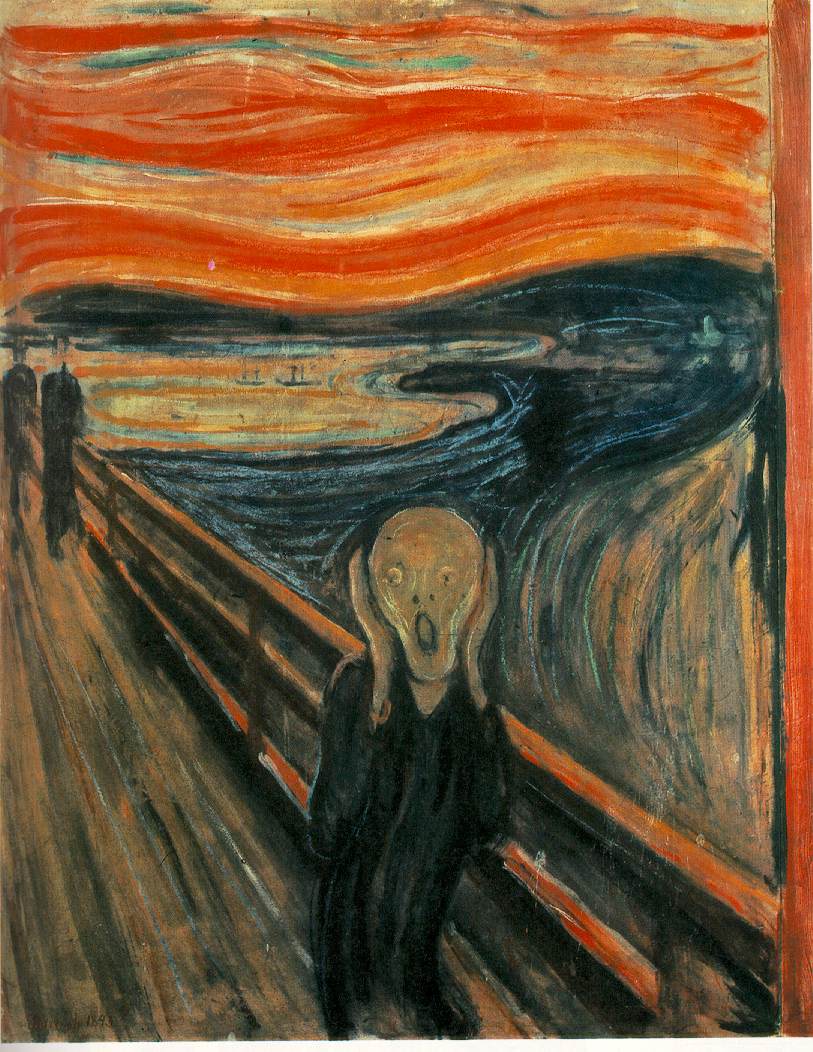
Or take the case of Edvard Munch's most famous, and now stolen, The Scream. It has been said by some to "...symbolize modern man taken by an attack of existential angst..." What if Munch had named it, "Thin Dark Wavy Guy (Weird) I Painted When I Was Stoned", or "Aargh! Sartre Owes Me 1,000,000 Francs And Now Says Hell Is Other People". The effect wouldn't be quite as dramatic, neh?
Most paintings leave one cold. Mainly because one has to endure the igloo like conditions that prevail in most museums where the darn things hang. Even otherwise, one finds that one likes (relatively) very few painters and paintings. One's more malicious mates will attribute this to one's colour-blindness, but one scoffs at such suggestions. [Aside: One feels vaguely uncomfortable today about using the perpendicular pronoun, ergo one uses one.]
One finds that the really interesting paintings are by painters about whose life and circumstances one has greater knowledge. Exampli gratia, one reads The Moon And Sixpence by Somerset Maugham (or as the itinerant bard from Andhraa Desamu once put it, Saamarasetti Maaghamu Panditulu) and discovers that this Gauguin bloke was an interesting sort of bird - investment banker turned Tahiitian tourist type. And one blustery day, one stumbles across a painting in the (iglooish) neighbourhood museum, and suddenly the picture begins to appear...well, pretty as a picture.

Similarly, one discovers a crumbling copy of Pierre La Mure's novel, "Moulin Rouge" at home, and discovers that Henri de Toulouse-Lautrec is more than a longish, unpronounceable, French nome. T-L had a privileged, if sad childhood and youth, and seems to have spent a lot of time hanging out at various cafes and other esatblishments in the Montmartre section of Paris, as Frenchmen with longish, pronounceable names are wont to do. He also seems to have consumed industrial quantities of absinthe, which is some kind of libation which is nowadays commonly used to scrape clean the insides of blast furnaces. His paintings are very Paris-cafe-brothel-brooding-existentialists-smoking-endless-Gauloises-wondering-why-
existence-is-why-can't-we-get some type. Whatever that type is.
Having sampled Gauguin and T-L, the lives and works of Monet and Degas also became interesting. Perhaps reading The Agony And The Ecstasy (or watching it), and watching/reading "Lust For Life" will make one take a more lively interest in Michelangelo and Van Gogh.
TAILPIECE: How important is the name of a painting? Absolutely critical, neh? If the Mona Lisa was called La Gioconda, many millions would think it has something to do with a large South Indian fortress (or beer!). Many other millions would conjecture that Da Vinci had a pleasing encounter with a member of eunectes murinus which inspired him?
Or take the case of Edvard Munch's most famous, and now stolen, The Scream. It has been said by some to "...symbolize modern man taken by an attack of existential angst..." What if Munch had named it, "Thin Dark Wavy Guy (Weird) I Painted When I Was Stoned", or "Aargh! Sartre Owes Me 1,000,000 Francs And Now Says Hell Is Other People". The effect wouldn't be quite as dramatic, neh?
Wednesday, June 08, 2005
Of Male Bondage...Bonding...Bondage
Two posts in one day. Some kind of record.
Verily, The Poet has said:
On Male Bonding
--July 2003, Amtrak, somewhere between Penn Station and South Station
Behind a successful man, they say
Lurks a woman or three
Au contraire, I beg to differ,
What about his best buddy?
Enkidu was a hairy freak
But without him, no Gilgamesh;
And could Leander ever have beaten Pete,
If he never partnered with Mahesh?
"He doth not bite", they say,
"The canine that loudly barks."
But Friedrich E. did sustain a Dawg,
That did both in the person of Marx.
Adolf H. had Rudolf H.,
As every dictator must his scribe.
Both were ravening psychopaths,
But together they did jive.
"To be, or not to be?",
That is all good and sound.
Ere Laertes reaches for his envenom'd blade,
I would surely have Horatio around.
Heroes Gallic, I descry two,
I speak, of course, of Aster- and Obel-ix.
And that incomparabale duo,
That revealed the secret of the double helix.
Those ineffably elegant prime numbers,
Demurely inscrutable to mortal man...
They may never reveal all their treasures,
For whither art Hardy-Ramanujan?
He might've been a rotten cad,
Was Raskolnikov, steeped in the ways of sin.
I personally think, his only saving grace,
Was his long-suffering chum, Razumihin.
You'll never get fame, if you're called 'Butch',
But we all know one bloke who did.
I really wouldn't have fancied his chances,
If he didn't team up with the Sundance Kid.
Alimentary, my dear large intestine,
If Sherlock had written all those tomes,
He would've just been a terrible egotist;
Without faithful Watson, whither Holmes?
You find them friendly pairs,
In real-life, myth, legend, and drama
Damon and Pythias, Lewis and Clark,
And, may I add, Krishna and Sudama.
But I shed a tear for that worthy pair,
Those icons of friendship, profound
For Veeru who gave his life for Jai.
(Or was it the other way around?)
And Scheherezade saw the approach of the dawn and discreetly fell silent.
Verily, The Poet has said:
On Male Bonding
--July 2003, Amtrak, somewhere between Penn Station and South Station
Behind a successful man, they say
Lurks a woman or three
Au contraire, I beg to differ,
What about his best buddy?
Enkidu was a hairy freak
But without him, no Gilgamesh;
And could Leander ever have beaten Pete,
If he never partnered with Mahesh?
"He doth not bite", they say,
"The canine that loudly barks."
But Friedrich E. did sustain a Dawg,
That did both in the person of Marx.
Adolf H. had Rudolf H.,
As every dictator must his scribe.
Both were ravening psychopaths,
But together they did jive.
"To be, or not to be?",
That is all good and sound.
Ere Laertes reaches for his envenom'd blade,
I would surely have Horatio around.
Heroes Gallic, I descry two,
I speak, of course, of Aster- and Obel-ix.
And that incomparabale duo,
That revealed the secret of the double helix.
Those ineffably elegant prime numbers,
Demurely inscrutable to mortal man...
They may never reveal all their treasures,
For whither art Hardy-Ramanujan?
He might've been a rotten cad,
Was Raskolnikov, steeped in the ways of sin.
I personally think, his only saving grace,
Was his long-suffering chum, Razumihin.
You'll never get fame, if you're called 'Butch',
But we all know one bloke who did.
I really wouldn't have fancied his chances,
If he didn't team up with the Sundance Kid.
Alimentary, my dear large intestine,
If Sherlock had written all those tomes,
He would've just been a terrible egotist;
Without faithful Watson, whither Holmes?
You find them friendly pairs,
In real-life, myth, legend, and drama
Damon and Pythias, Lewis and Clark,
And, may I add, Krishna and Sudama.
But I shed a tear for that worthy pair,
Those icons of friendship, profound
For Veeru who gave his life for Jai.
(Or was it the other way around?)
And Scheherezade saw the approach of the dawn and discreetly fell silent.
Operation Overlord Remembered
On June 6, in 1944, the largest amphibious landing in the history of warfare was succesfully attempted. Codenamed 'Operation Overlord', several British, US and Canadian infantry, armoured and parachute units landed across a broad front (5 beaches) in France. Facing them in the immediate vicinity was the German Seventh Army, a motely crew of infantry and parachute units, and one Panzer division (21st Panzer, reconstituted after the original one surrendered in North Africa).
There are several 'standard' resources for information on the Normandy Landings (including the BBC, Encyclopaedia Britannica, Wikipedia), so we will focus on some little known trivia.
There are several 'standard' resources for information on the Normandy Landings (including the BBC, Encyclopaedia Britannica, Wikipedia), so we will focus on some little known trivia.
- Exhibit A: The Crossword Panic Of 1944 - when a 54 year old teacher who compiled crosswords unwittingly set clues over several weeks, the answers to which were all code names of various things involved in the invasion
- Exhibit B: The area in the English Channel where the Allied armada would fall into formation, having arrived from various ports in England, was (appropriately enough) named Piccadilly Circus!
Tuesday, June 07, 2005
The Line Less Travelled
Nothing works wonders for your frame of mind as the sight and sound of a train passing by. From a very yeng yaze, we have been fascinated by trains and locomotives. We never misses a chance to gets on a train, my precious. So 'ere be a list of some of our more memorable train journeys.
- Visakhapatnam-Trichur: Those good 'ol summer holidays. Mangos, guavas, the posh 'cushion' seats of Coromandel Express (which is so famous, it lends its name to a small Parisian publishing house) until Vijayawada, and the wooden slats of the Jayanthi Janatha after that. The names of Tamil Nadu stations rolling off the tongue (Arakkonam-Katpadi-Jolarpettai-Salem...), and the stations themselves rolling past the windows. The headlong rush into the Palghat Gap, and then God's Own Country. Actually, it is Marx's Own Country, but Marx is God, so that's OK.
- Visakhapatnam-Araku: On the Kirandul-Kottavalasa line. Wonderful views, tunnels, people from the hills loading produce on the way to the market, clouds, waterfalls. The works.
- Mettupalayam-Ooty: On the Nilgiri Mountain Railway. One of the last outposts of steam traction in India. Very touristy, but nevertheless thrilling.
- Kalka-Shimla: Another mountain railway, the northern cousin of the Nilgiri line. No steam on this line (not regularly, anyway), but the climb from the plains to the Himalayas over a long afternoon makes up for that. Again touristy, unforgettable.
- Philadelpha-San Francisco: Amtrak. 4 days and 3 nights in a chair car, but what a trip. If it only had been more leisurely...
- Zurich-Rheinfall-Grenchen-Geneva-Bern-Zurich: Switzerland. Pretty as a postcard, inhumanly punctual and efficient.
- London-Abergavenny: Welsh excursion, on British Rail. "Watson, my Bradshaw's tells me that if we hurry, we can find seats on the 10:18 from Waterloo" etc.
- Edinburgh-Fort William: Single malt, bagpipes, and moors outside, beautiful, beautiful country. The occasional antediluvian saurian raises rears out of a passing loch and gives us a gander...
- Glasgow-London: On the GNER. Passes through the Lake District. Skimbleshanks country?
- Tokyo-Kamakura-Tokyo: Japan Rail. Our motto: "We give those Swiss a run for their monies". Inhuman efficiency, on the other side of the world.
- Kyoto-Tokyo: On the unbelievably fast, comfortable, quiet Tokaido Shinkansen
- Aguas Calientes-Ollyantaytambo: After 4 grimy dirty days on the Inca Trail to Machhu Pichhu, this little train ride in the Andes was blissful. The feet got to rest, the throats and stomachs got to eat, the eyes got to ogle, and so on.
Friday, June 03, 2005
In Which Arundhati Gives It Those Ones
Long before she won the Booker Prize for "The God Of Small Things", Arundhati Roy was a seller of empty beer bottles, a student of architecture, and a dabbler in films. She studied architecture at the Delhi School Of Architecture, dropped out, went to Goa, came back broke, found a job at the National Institute Of Urban Affairs, and was spotted by director Pradip Kishen, who offered her a role in his film "Massey Sahib" in 1986.
In 1988, Roy wrote the screenplay of, and Krishen directed In Which Annie Gives It Those Ones", about life at a not-so-fictitious school of architecture in Delhi. Thanks to a colleague, I managed to lay my slimy paws on a somewhat grainy (camera print?) of this movie. It was shown exactly once on Doordarshan, and the original print seems to have disappeared.
The movie is eminently watchable, even if it isn't a Kurosawa. There isn't much by way of a story, just a fly-on-the-wall look at the life of college students in the last days before graduation. Anyone who went through the hostel experience in India will empathize with the characters. Its worth the time spent, if only to see what Roy was like before her catapult to fame (and now infamy?).
Roy, who was the darling of the middle class ("Oh look, an Indian girl has won the Booker Prize, how nice, we must be a great people!") after winning the prize, has subsequently become the object of much revulsion and hate ("She's an anti-national!"). Several people have accused her of discovering her bleeding heart after discovering stardom. One only has to watch the movie, and listen to the words she (the scriptwriter) puts in her (the Radha character's) mouth, to discover that her political views aren't anything new, she has had them from the beginning, and her winning the prize only resulted in those views getting publicity.
She can't act to save her life, but boy she's cute :)
P.S. King Khan makes a very brief appearance, as a senior student.
In 1988, Roy wrote the screenplay of, and Krishen directed In Which Annie Gives It Those Ones", about life at a not-so-fictitious school of architecture in Delhi. Thanks to a colleague, I managed to lay my slimy paws on a somewhat grainy (camera print?) of this movie. It was shown exactly once on Doordarshan, and the original print seems to have disappeared.
The movie is eminently watchable, even if it isn't a Kurosawa. There isn't much by way of a story, just a fly-on-the-wall look at the life of college students in the last days before graduation. Anyone who went through the hostel experience in India will empathize with the characters. Its worth the time spent, if only to see what Roy was like before her catapult to fame (and now infamy?).
Roy, who was the darling of the middle class ("Oh look, an Indian girl has won the Booker Prize, how nice, we must be a great people!") after winning the prize, has subsequently become the object of much revulsion and hate ("She's an anti-national!"). Several people have accused her of discovering her bleeding heart after discovering stardom. One only has to watch the movie, and listen to the words she (the scriptwriter) puts in her (the Radha character's) mouth, to discover that her political views aren't anything new, she has had them from the beginning, and her winning the prize only resulted in those views getting publicity.
She can't act to save her life, but boy she's cute :)
P.S. King Khan makes a very brief appearance, as a senior student.
Tuesday, May 31, 2005
Whither Are The Zeros Of Zeta Of S?
First, the following needs to be got off one's chest.
Two hydrogen atoms meet in a bar. "I think I lost my electron." "Are you sure?" "Yes, I'm positive." Whew...
Desultory flipping through of Karl Sabbagh's book, The Riemann Hypothesis - The Greatest Unsolved Problem In Mathematics. Like other mathematics books for laypeople (such as Zero - The Biography Of A Dangerous Idea and Fermat's Last Enigma), this one is a judicious mix of history, anecdotes and some relatively accesible mathematics.
The Riemann Hypothesis states (more or less) that
Why is this important, you ask? Maybe you don't ask. But I tell. In the words of Sabbagh
Many great mathematicians have been trying to prove or disprove the Riemann Hypothesis. It features as one of the 23 unsolved (at the time) problems of David Hilbert. Hardy and Ramanujan tried it and couldn't. Hardy was quite a character, but this post is too long already.
Interesting mathematics websites include the MacTutor History of Mathematics archive. Wolfram Research's Mathworld is a positive treasure, they also have similar sections on physics, chemistry and other sciences. If you fancy yourself as a mathematician, you might want to check out IBM Research's Ponder This problem of the month.
Tailpiece
Grafitti on New York City subway wall:
xn + yn = zn
There is no value of n>2 for which the above is true. I have found a truly remarkable proof of this, but my train is coming and I have to go...
Two hydrogen atoms meet in a bar. "I think I lost my electron." "Are you sure?" "Yes, I'm positive." Whew...
Desultory flipping through of Karl Sabbagh's book, The Riemann Hypothesis - The Greatest Unsolved Problem In Mathematics. Like other mathematics books for laypeople (such as Zero - The Biography Of A Dangerous Idea and Fermat's Last Enigma), this one is a judicious mix of history, anecdotes and some relatively accesible mathematics.
The Riemann Hypothesis states (more or less) that
that the nontrivial Riemann zeta function zeros, i.e., the values of s other than -2, -4, -6, ... such that ζ(s)=0 (where ζ is the Riemann zeta function) all lie on the "critical line" σ=R[s]=½ (where R denotes the real part of s).Yes, its really that simple. A child could tackle this.
Why is this important, you ask? Maybe you don't ask. But I tell. In the words of Sabbagh
The Riemann Hypothesis matters because, if it is true, it proves that there is a rule for generating the prime numbers...If Tom, Li Mu Bai, and Thirunavukkarasu start generating prime numbers, one will have to wonder what the implications for cryptography are. This is only the tip of the iceberg. There are other obscure mathematical reasons (which I fully comprehend, mind you, but which will be so much Greek to you folks) why this is such an important result.
Many great mathematicians have been trying to prove or disprove the Riemann Hypothesis. It features as one of the 23 unsolved (at the time) problems of David Hilbert. Hardy and Ramanujan tried it and couldn't. Hardy was quite a character, but this post is too long already.
Interesting mathematics websites include the MacTutor History of Mathematics archive. Wolfram Research's Mathworld is a positive treasure, they also have similar sections on physics, chemistry and other sciences. If you fancy yourself as a mathematician, you might want to check out IBM Research's Ponder This problem of the month.
Tailpiece
Grafitti on New York City subway wall:
xn + yn = zn
There is no value of n>2 for which the above is true. I have found a truly remarkable proof of this, but my train is coming and I have to go...
Friday, May 27, 2005
Zorba, The Indian?
Long time no post. Actually - long to post, no time. Ha ha.
Read this article on the Indian influence on Greek cinema many moons back, and then lost track of it. It is back online now, with audio clippings and such. A bit long-ish, but most definitely interesting, if you're at all interested in Indian cinema. Or Greece. Or both. Other interesting Indian cinema websites include Upperstall, philip's fil-ums I've said before has some of the best movie reviews of masala and not-so-masala Indian movies, Sarai has some unusual and hard-to-find material including a section called FilmCity, a gargantuan section on Indian cinematography, including an absolutely unputdownable interview with Guru Dutt's cinematographer V.K.Murthy.
Read this article on the Indian influence on Greek cinema many moons back, and then lost track of it. It is back online now, with audio clippings and such. A bit long-ish, but most definitely interesting, if you're at all interested in Indian cinema. Or Greece. Or both. Other interesting Indian cinema websites include Upperstall, philip's fil-ums I've said before has some of the best movie reviews of masala and not-so-masala Indian movies, Sarai has some unusual and hard-to-find material including a section called FilmCity, a gargantuan section on Indian cinematography, including an absolutely unputdownable interview with Guru Dutt's cinematographer V.K.Murthy.
Wednesday, May 18, 2005
Of Many Things English
Dictionary.com provides the following, as one of the meanings of the word sandbagging:
First came across this at a team race, where some accused others of sandbagging and fooling everyone by running a lot faster than they said in their initial estimates.
The Bangalore marathon was fun, in spite of the fact that it started at a hottish 9:30 a.m., and the unbelievable crowd of banner holding, slogan chanting, corporate runners rooting for their own companies. Finished a lot faster (41 min. for 7 k.m.) than expected, thanks to Flo "Sandbagger" Jo [now the connections emerge] who was in a tearing hurry to reach someplace just around the next corner. "Knackered" at the end, but that made the steak at "The Only Place" (Museum Road, Bangalore) that much more sllurrp.
While on the general topic of English usages, and since we're into putative lists nowadays, here is the list of top 5 annoying English bloopers (IMO) that have insidiously crept their way into common use:
Age doth wither and custom doth stale the memory, the list will have to be completed anon.
To downplay or misrepresent one's ability in a game or activity in order to deceive (someone), especially in gambling: sandbagged the pool player by playing poorly in the first game when stakes were low.
First came across this at a team race, where some accused others of sandbagging and fooling everyone by running a lot faster than they said in their initial estimates.
The Bangalore marathon was fun, in spite of the fact that it started at a hottish 9:30 a.m., and the unbelievable crowd of banner holding, slogan chanting, corporate runners rooting for their own companies. Finished a lot faster (41 min. for 7 k.m.) than expected, thanks to Flo "Sandbagger" Jo [now the connections emerge] who was in a tearing hurry to reach someplace just around the next corner. "Knackered" at the end, but that made the steak at "The Only Place" (Museum Road, Bangalore) that much more sllurrp.
While on the general topic of English usages, and since we're into putative lists nowadays, here is the list of top 5 annoying English bloopers (IMO) that have insidiously crept their way into common use:
- momentarily: Some centuries ago, "momentarily" used to mean, "for a moment". Then the United States came into existence. Fast forward to the 1990s/2000s and now the darn word means, "in a moment" to most people. We will pause momentarily to reflect on what this means. . . . . .Having reflected, we move on. The disease seems to have crossed the Atlantic. One distinctly remembers hearing a, "Wait here children, Professor Dumbledore will be with you momentarily." in a motion picture. Or is this just Hollywood scriptwriters putting words in mouths of the doyens of British cinema?
- presently: Mostly Indian. "Presently I am doing my MBA in Neo-Fascism from IIM-X." And presently, I am going to going to bonk you on the head with a tomato (large, putrid). Whatever happened to "currently"?
- disinterested/uninterested: The distinctions have blurred. The centre cannot hold. The falcon spirals. A great beast slouches through the dunes towards Bethlehem. [disinterested = impartial, uninterested = not interested]
TBDUPDATE: You're all set. You are therefore a pudding. One pays heed to cannibals.TBDUPDATE: According to me. You might suffer from a serious case of split personality, but you can't accord to yourself, IMO. Which brings us [rather cleverly, smirk, smirk] to what the correct phrase would be: "In my opinion..." Stop according to yourselves peoples!- UPDATE:This door is alarmed. Oh really? How do you know? Did it scream in a high pitched voice? Or do you communicate with it via ESP? By way of the friendly neighbourhood [someone came with an eraser and scrub-a-dub-ed this bit] cannibal.
Age doth wither and custom doth stale the memory, the list will have to be completed anon.
Tuesday, May 10, 2005
Obligatory Weekend Roundup
How can I blow money over a weekend? Let me count the ways...
That apart... Watched "Saath Saath", and A Bridge Too Far. Another fantastic WW2 movie, a keeper. This one is about Monty's ill conceived plan, code-named Operation Market Garden to drop 3 airborne divisions behind German lines in the Netherlands, and cut off German supply lines to the Western Front, with the aim of shortening the war. A star cast, and very nice camera work. Annoyingly, there were no subtitles for the German and Dutch dialogues. So everything that Rundstedt, Model, and Bittrich said went into thin air!
Gaana paattus of the weekend were a hotch potch of various things. Some more candidates for running songs
And once you're a sweating wreck, you can shower, eat, and lie down and listen to Sanjeev Abhyankar do a Malkauns in vilambit ektaal. I wouldn't know a vilambit ektaal if it came and bit me on the behind, but I can recognize Malkauns once someone bonks me on the head with it, and it is quite the nice raagam. Maybe I like it so much because I like Hindolam and Saamajavaragamana. Who knows? We will leave this mystery alone.
- Hang out in a Barista with the excuse of trying to find out if the wireless card on the laptop works.
- Go with buddy to Taj Residency, drink Glenfiddich, eat kababs, ice cream, and solve the outstanding problems with the world.
- Buy some more DVDs from Music World.
- Buy another book. But this one is really good. The author is a co-alumnus who dared to be different.
- Play snooker in a Gillian's like Hyderabadi adda.
That apart... Watched "Saath Saath", and A Bridge Too Far. Another fantastic WW2 movie, a keeper. This one is about Monty's ill conceived plan, code-named Operation Market Garden to drop 3 airborne divisions behind German lines in the Netherlands, and cut off German supply lines to the Western Front, with the aim of shortening the war. A star cast, and very nice camera work. Annoyingly, there were no subtitles for the German and Dutch dialogues. So everything that Rundstedt, Model, and Bittrich said went into thin air!
Gaana paattus of the weekend were a hotch potch of various things. Some more candidates for running songs
- Tubthumpin' (Chumbawumba) - "I get knocked down, and I get up..."
- Zombie (Cranberries) :-)
- Another One Bites The Dust (Queen)
- We Didn't Start The Fire (Billy Joel) - Not a particularly "rocky" song, but if you know the words you can't help but sing along, and it takes your mind off the the running for a full 5 minutes!
- All Star (Smash Mouth) - "Hey now, you're an all star, get your game on..."
- Moving In Stereo (The Cars) - Fairly obscure. But this is the rockin' tune that plays in that umm... immortal scene from what is regarded by many as the best teen movie ever, where Phoebe Cates emerges from a swimming pool and enters "Brad's" fantasy world.
- There were more... I forget
And once you're a sweating wreck, you can shower, eat, and lie down and listen to Sanjeev Abhyankar do a Malkauns in vilambit ektaal. I wouldn't know a vilambit ektaal if it came and bit me on the behind, but I can recognize Malkauns once someone bonks me on the head with it, and it is quite the nice raagam. Maybe I like it so much because I like Hindolam and Saamajavaragamana. Who knows? We will leave this mystery alone.
Saturday, May 07, 2005
What Parthiv Hath Wrought
As the 7K Celeberation/Celebrity run at the Bangalore Marathon looms, it occupies many of my thoughts nowadays, including thought no. 21297.
This insane running endeavour started in March 2003, when an MIT graduate student named Parthiv Shah showed up at the weekly Asha For Education Boston chapter meeting and said he would be interested in helping us organize a marathon fundraiser.
Having always suffered from delusions of athletic grandeur, I signed up, and went on to finish the Marine Corps Marathon in Washington, DC in 5:00:33. My only regret was not carrying an accurate stopwatch so that I could've shaved off those annoying 33 seconds and had a 4:xx:xx time.
The Asha marathon program grew last year, with AID-Boston joining in - the number of runners went up, the money raised, blisters, injuries, pain, happiness.
And it continues to grow. This year, Asha and AID have officially joined together to organize the fundraiser, and it already feels like it will be a smashing success.
And I can't help but sit here in Hyderabad with a silly grin on my face and wonder what has come to pass after those lonely, wet Sunday mornings when the few of us who could make it, slogged our way up and down the Minuteman Trail. Thanks Parthiv!!
This insane running endeavour started in March 2003, when an MIT graduate student named Parthiv Shah showed up at the weekly Asha For Education Boston chapter meeting and said he would be interested in helping us organize a marathon fundraiser.
Having always suffered from delusions of athletic grandeur, I signed up, and went on to finish the Marine Corps Marathon in Washington, DC in 5:00:33. My only regret was not carrying an accurate stopwatch so that I could've shaved off those annoying 33 seconds and had a 4:xx:xx time.
The Asha marathon program grew last year, with AID-Boston joining in - the number of runners went up, the money raised, blisters, injuries, pain, happiness.
And it continues to grow. This year, Asha and AID have officially joined together to organize the fundraiser, and it already feels like it will be a smashing success.
And I can't help but sit here in Hyderabad with a silly grin on my face and wonder what has come to pass after those lonely, wet Sunday mornings when the few of us who could make it, slogged our way up and down the Minuteman Trail. Thanks Parthiv!!
Thursday, May 05, 2005
Pome du jour
baaziichaa-e-atfaal hai duniyaa mere aage
Jagjit Singh sings this, rather well IMO, for Gulzar's TV serialization of Mirza Ghalib's life. Google will give you all the links you want about Jagjit Singh, Gulzar, TVs, serialization, Ghalib and life. So we will not belabour you with links. Instead
baaziichaa-e-atfaal hai duniyaa mere aage
hotaa hai shab-o-roz tamaashaa mere aage
[baaziichaa-e-atfaal = child's play]
hotaa hai nihaa.N gard me.n seharaa mere hote
ghisataa hai jabii.n Khaak pe dariyaa mere aage
[nihaa.N = hidden; gard = dust]
[seharaa = desert, jabii.n = forehead]
mat puuchh ke kyaa haal hai meraa tere piichhe
tuu dekh ke kyaa rang hai teraa mere aage
imaa.N mujhe roke hai jo khii.nche hai mujhe kufr
kaabaa mere piichhe hai kaliisaa mere aage
[kufr = impiety, kaliisaa = church/cathedral]
go haath ko jumbish nahii.n aa.Nkho.n me.n to dam hai
rahane do abhii saaGar-o-miinaa mere aage
[jumbish = movement; saaGar-o-miinaa = glass of wine]
Jagjit Singh sings this, rather well IMO, for Gulzar's TV serialization of Mirza Ghalib's life. Google will give you all the links you want about Jagjit Singh, Gulzar, TVs, serialization, Ghalib and life. So we will not belabour you with links. Instead
baaziichaa-e-atfaal hai duniyaa mere aage
hotaa hai shab-o-roz tamaashaa mere aage
[baaziichaa-e-atfaal = child's play]
hotaa hai nihaa.N gard me.n seharaa mere hote
ghisataa hai jabii.n Khaak pe dariyaa mere aage
[nihaa.N = hidden; gard = dust]
[seharaa = desert, jabii.n = forehead]
mat puuchh ke kyaa haal hai meraa tere piichhe
tuu dekh ke kyaa rang hai teraa mere aage
imaa.N mujhe roke hai jo khii.nche hai mujhe kufr
kaabaa mere piichhe hai kaliisaa mere aage
[kufr = impiety, kaliisaa = church/cathedral]
go haath ko jumbish nahii.n aa.Nkho.n me.n to dam hai
rahane do abhii saaGar-o-miinaa mere aage
[jumbish = movement; saaGar-o-miinaa = glass of wine]
Monday, May 02, 2005
Listing - This Way And That
There be lists 'ere. The number of things you can make lists about are countless as the grains of sand. So we will make lists. This idea is partly inspired by the blogger's complete lack of creativity, and partly by the Nick Hornby book and film, "High Fidelity" - in which the protagonist is an obsessive list-maker. This week's theme [trumpets, cymbals, kettledrums, other Ramses II type noises]
Running Songs
Songs/music that inspire running. [Note: I don't listen to music when I'm running, am afraid of getting distracted and run over. So this list is a bit of a scam.] The candidates
Running Songs
Songs/music that inspire running. [Note: I don't listen to music when I'm running, am afraid of getting distracted and run over. So this list is a bit of a scam.] The candidates
- The Chariots Of Fire theme by Vangelis. How can this not be Numero Uno? Many true runners will disagree. Too cliched, too predictable. But what the hell, it is the running song.
- Paradise City, by Guns N' Roses. Very odd, I know. But there is something to said for this song blaring out of a 12 seater van with your stinking sweaty teammates rooting for you, at a very groggy 6 a.m. when you're limping through your allotted 8 odd miles of Leg 27, on a cool September New Hampshire morning
- Eye Of The Tiger by Survivor
- The theme from Rocky
- O Fortuna from Fortuna Imperatrix Mundi, from Carmina Burana by Carl Orff.
Wednesday, April 27, 2005
Run, Forrest, run!!
In another day and age, I used to be a runner. Even used to have a running log. Dimly remember crawling across the finish of the Marine Corps Marathon in 2003, with my all but dismembered left leg in tow.
Desultory running has happened since, but now, finally, a target to shoot for: The Bangalore Marathon on May 15. Well, not all of it, but at least the 7 k.m. wuss race! Got to train like crazy. Have downloaded the ultimate running song and all that remains is to drag the soporific carcass out of bed every morning and hit the roads...
Desultory running has happened since, but now, finally, a target to shoot for: The Bangalore Marathon on May 15. Well, not all of it, but at least the 7 k.m. wuss race! Got to train like crazy. Have downloaded the ultimate running song and all that remains is to drag the soporific carcass out of bed every morning and hit the roads...
Whither blog?
And before you can say Sivasubramaniam Chandrasegarampillai, another week has elapsed. To paraphrase Inspector Sydney Wang from Murder By Death, "Confucius say, 'Maintaining this blog, like train without wheels. Soon get nowhere.'" Be that as it may, one forges on. The list for this week:
- Visited Navadarshanam. Not quite Timbaktu, but worth a gander. Many experiments in alterative lifestyles have been tried at Navadarshanam, the website says it all. Interestingly, Navadarshanam is located near Gummalapuram, and apparently the two hills are mentioned in The Spotted Devil Of Gummalapur, from "Nine Maneaters And One Rogue" by Kenneth Anderson.
- More money spent on books. In this instance, two volumes by Murakami, Prey - which apparently has something to do with a previous post, and James Clavell's Shogun - for old times' sake
- Finished the empire book. Turns out that most of the book is devoted to describing how the empire grew and expanded, in a very non-judgemental way (if anything Ferguson is critical of various imperial policies). In the final couple of chapters, there is a sudden jump from, "OK, so the British Empire was bad, as we've seen. But your alternatives were the French, German or Japanese empires, and we all know that the Brits were saints compared to those foreign johnnies, ergo the British Empire was a good thing in that it prevented said johnnies from taking over the world." Somehow leaves one with an unfinished taste...
- Am now proud owner of my first Apple gadget. The heavens be thanked for mildly insane kid sisters.
- Got some more music. Getz, Cale, and Hey Baby Hey Baby Yeah.
Wednesday, April 20, 2005
Ants To The Rescue
Strictly for people with mathematical and operations research inclinations. Someone introduced me to the notion of "Ant Colony Optimization" (ACO) today. First proposed by Marco Dorigo in his Ph.D. thesis, this "metaheuristic for combinatorial optimization problems" is inspired by the behaviour of real ant colonies.
ACO is just one of many techniques that are part of the fields of "Nature Inspired *", includingBees, the flocking of birds, the schooling of fish, are all grist to these mills apparently. Very intriguing.
ACO is just one of many techniques that are part of the fields of "Nature Inspired *", includingBees, the flocking of birds, the schooling of fish, are all grist to these mills apparently. Very intriguing.
Tuesday, April 19, 2005
The Empire Strikes Back
Borrowed Empire: How Britain Made the Modern World by Niall Ferguson from a friend this weekend. Have not yet started it, but desultory flipping through has happened. There is a long review available, possibly more.
The thrust of the book is that on balance, the existence of the British Empire did more good than harm. According to him, it is responsible for the spread of liberal values and parliamentary democracy around the world, the English language, the industrial age, globalization and free trade (in its modern forms). He does not deny that horrible things happened, but constantly reminds us that things would've been a lot worse if say, the Japanese or the Germans, had been the great colonial power of the 19th and 20th centuries.
So far, the problem is that he constantly presents the Japanese (and German, French, or Dutch) empire as the only alternative to the British empire. As in, "If India had not been part of the British empire, it would've been under the Japanese. That the Japanese were butchers, we've seen during the Second World War. Therefore, India was better off under the British." Not much consideration is given to the idea of, "Hey, what if India wasn't part of any empire? What if parliamentary democracy and liberal values and other such things had taken root on their own here? What if there had been agricultural and industrial development independently here?"
Should be an interesting read. The book seems to have divided the world into three camps. Those who support the thesis, those who oppose it, and of course those who have not read it.
The thrust of the book is that on balance, the existence of the British Empire did more good than harm. According to him, it is responsible for the spread of liberal values and parliamentary democracy around the world, the English language, the industrial age, globalization and free trade (in its modern forms). He does not deny that horrible things happened, but constantly reminds us that things would've been a lot worse if say, the Japanese or the Germans, had been the great colonial power of the 19th and 20th centuries.
So far, the problem is that he constantly presents the Japanese (and German, French, or Dutch) empire as the only alternative to the British empire. As in, "If India had not been part of the British empire, it would've been under the Japanese. That the Japanese were butchers, we've seen during the Second World War. Therefore, India was better off under the British." Not much consideration is given to the idea of, "Hey, what if India wasn't part of any empire? What if parliamentary democracy and liberal values and other such things had taken root on their own here? What if there had been agricultural and industrial development independently here?"
Should be an interesting read. The book seems to have divided the world into three camps. Those who support the thesis, those who oppose it, and of course those who have not read it.
Monday, April 18, 2005
Mythical Weekend
It is narrated in the Kishkindhaakaanda of the Raamaayana that the monkey king Vali
Evening saw us "swing" to Kochi, on the "western oceans" where food was had, family members were met, a wedding was solemnized. Come Sunday evening, and I "swung" for points north, and spent the night in Bangalore eating paan and talking. And now its Monday morning, and I'm back in the northern parts, sleepy and exhausted.
This Vali dude was quite something.
...swings to eastern ocean for his daily bath, and from there to southern sea, to make aachamana, sipping water for self-purification, and then to western oceans to give arghya, water oblation, and from there to other ocean for japa and suuryopasthaana, meditation and welcome to daily sun...All this, on a daily basis. I feel like I've had a similar weekend. At 4:00 a.m. on Saturday, I had a bath in Hyderabad, and "swung" to Chennai on the "eastern ocean". Spent a good part of the morning transferring tsunami traumatized caimans from one sandy pit to another, took a dip in the Bay Of Bengal and ate fish curry with rice for lunch on the beach.
Evening saw us "swing" to Kochi, on the "western oceans" where food was had, family members were met, a wedding was solemnized. Come Sunday evening, and I "swung" for points north, and spent the night in Bangalore eating paan and talking. And now its Monday morning, and I'm back in the northern parts, sleepy and exhausted.
This Vali dude was quite something.
Sunday, April 10, 2005
Splurge
Money has been blown this weekend.
- The Great Hedge of India: Been eyeing this one for a while, finally caved in when it cast its lascivious looks at me from the Crosswords bookshelf. The subject is bloody interesting, but the book isn't all that great a read. The author skips between first person 'detective' style narrative, and third person colonial Indian history, and somehow it doesn't all gel together (though John Keay had good things to say on the back cover).
- Collected Poems, Vikram Seth
- Jeans
- Food and drink (Angeethi, Fusion, Eat Street)
- Kalyug, Mandi (both by Shyam Benegal) Saath Saath, Umrao Jaan, The Desert Rats.
Philip Lutgendorf, incidentally, writes some of the best reviews of Indian popular cinema. Upperstall is also quite a treasure trove.
"The Desert Rats" is highly romanticized, and the writer/director have taken artistic freedom to a new level. Ostensibly about the siege of Tobruk, the movie is full of the most unacceptable distortions. The most annoying (so far - have only seen one of the 2 VCDs) is the elevation of Rommel to Generalsfeldmarschall (to make the Allies look that much better?) about a year too early (he wasn't promoted until the battle of Gazala, and the subsequent capture of Tobruk). And Rommel speaks English in this movie. Oh well...
Friday, April 08, 2005
A bus too far?
The papers have been full of a certain bus ride. Fills one with hope and trepidation at the same time. This could boomerang so easily, or go on to become a watershed moment in Kashmiri history. There have been other watershed bus trips before...
Early days yet.
Early days yet.
Wednesday, April 06, 2005
The Story Thus Far (Part Deux)
10. Popped over to the watering holes of the Garden City.
11. Gawked at ruined cities.
12. Checked out Karl's Own Country
13. Took another interesting train
14. Watched elephas maximus gambol in her element. [Lost the fingernails on my right index and middle fingers, when the window of said train landed on said fingers, reducing them to an interesting looking pulp.]
11. Recuperated.
12. Headed northwards.
13. And northwards.
14. And northwards. At this point, one runs out of nation-state. So had to stop.
15. Gazed on the Bodhisat, at Leh, Shey, Thiksey, Alchi, Diskit...
TBC
11. Gawked at ruined cities.
12. Checked out Karl's Own Country
13. Took another interesting train
14. Watched elephas maximus gambol in her element. [Lost the fingernails on my right index and middle fingers, when the window of said train landed on said fingers, reducing them to an interesting looking pulp.]
11. Recuperated.
12. Headed northwards.
13. And northwards.
14. And northwards. At this point, one runs out of nation-state. So had to stop.
15. Gazed on the Bodhisat, at Leh, Shey, Thiksey, Alchi, Diskit...
TBC
Tuesday, April 05, 2005
What's in a name?
CHOULTRY (p. 211) , s. Peculiar to S. India, and of doubtful etymology; Malayalam chawati, Telugu chawadi, [tsavadi, chau, Skt. chatur, 'four,' vata, 'road, a place where four roads meet]. In W. India the form used is chowry or chowree (Dakh. chaori). A hall, a shed, or a simple loggia, used by travellers as a resting-place, and also intended for the transaction of public business. In the old Madras Archives there is frequent mention of the "Justices of the Choultry." A building of this kind seems to have formed the early Court-house.
Seems like a nice mix of my own roots. Ergo...
The Story Thus Far
Is this the fate of all blogs? They start with doubt. Then they die. About 345767 years later, the blogger finds herself in front of a computer once again for days on the end. And the blog is reborn.
Anyway, we owe our eager readers, who have been waiting with bated breath for the post Reichenbach version of this blog. Between the last posting here on March 02, 2004 and today, the following has happened:
1. Quit work
2. Locked up house, and left the People's Republic on cold, blustery May 9, 2004 for The City That Lost.
3. Ended up at a railway station, having passed through a university town, and the Urban Conglomeration of Fraternal, Deep, Tender, Ineffable Feeling of Affection and Solicitude toward a Person, Such as That Arising from Kinship, Recognition of Attractive Qualities, or a Sense of Underlying Oneness.
4. Took a train to the Hog Butcher for the World...
5. Took another train to the other People's Republic.
6. Flew off into the Blue Yonder. Actually, ended up in
a rather interesting place.
7. Spent time
8. Ended up for a few days on a hammock in the land of creepy crawlies via another techy marvel.
9. Went home.
This is getting way too painful. Almost 6 months of peregrinations to list, and we aren't even started properly yet. To be continued. See you next year.
Anyway, we owe our eager readers, who have been waiting with bated breath for the post Reichenbach version of this blog. Between the last posting here on March 02, 2004 and today, the following has happened:
1. Quit work
2. Locked up house, and left the People's Republic on cold, blustery May 9, 2004 for The City That Lost.
3. Ended up at a railway station, having passed through a university town, and the Urban Conglomeration of Fraternal, Deep, Tender, Ineffable Feeling of Affection and Solicitude toward a Person, Such as That Arising from Kinship, Recognition of Attractive Qualities, or a Sense of Underlying Oneness.
4. Took a train to the Hog Butcher for the World...
5. Took another train to the other People's Republic.
6. Flew off into the Blue Yonder. Actually, ended up in
a rather interesting place.
7. Spent time
- in a megalopolis
- contemplating the mysteries of existence in various shrines
- being gentle when the heathen prayed to him
- checking out some legendary type places,
- some historical type places, and
- some depressing (because one has to leave, eventually) type places
8. Ended up for a few days on a hammock in the land of creepy crawlies via another techy marvel.
9. Went home.
This is getting way too painful. Almost 6 months of peregrinations to list, and we aren't even started properly yet. To be continued. See you next year.
Subscribe to:
Posts (Atom)